


Child Custody for a Military Parent: What to Do First
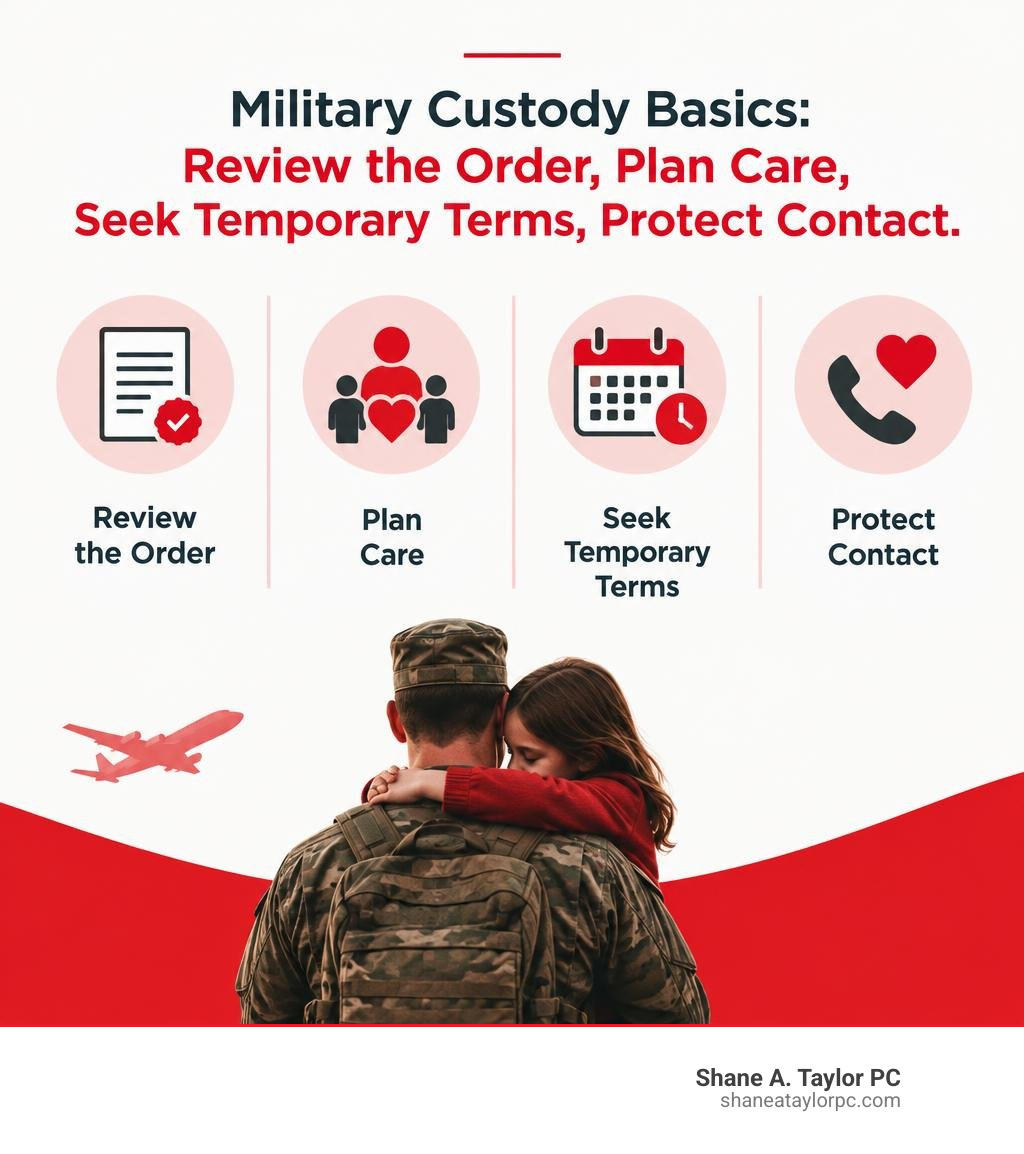
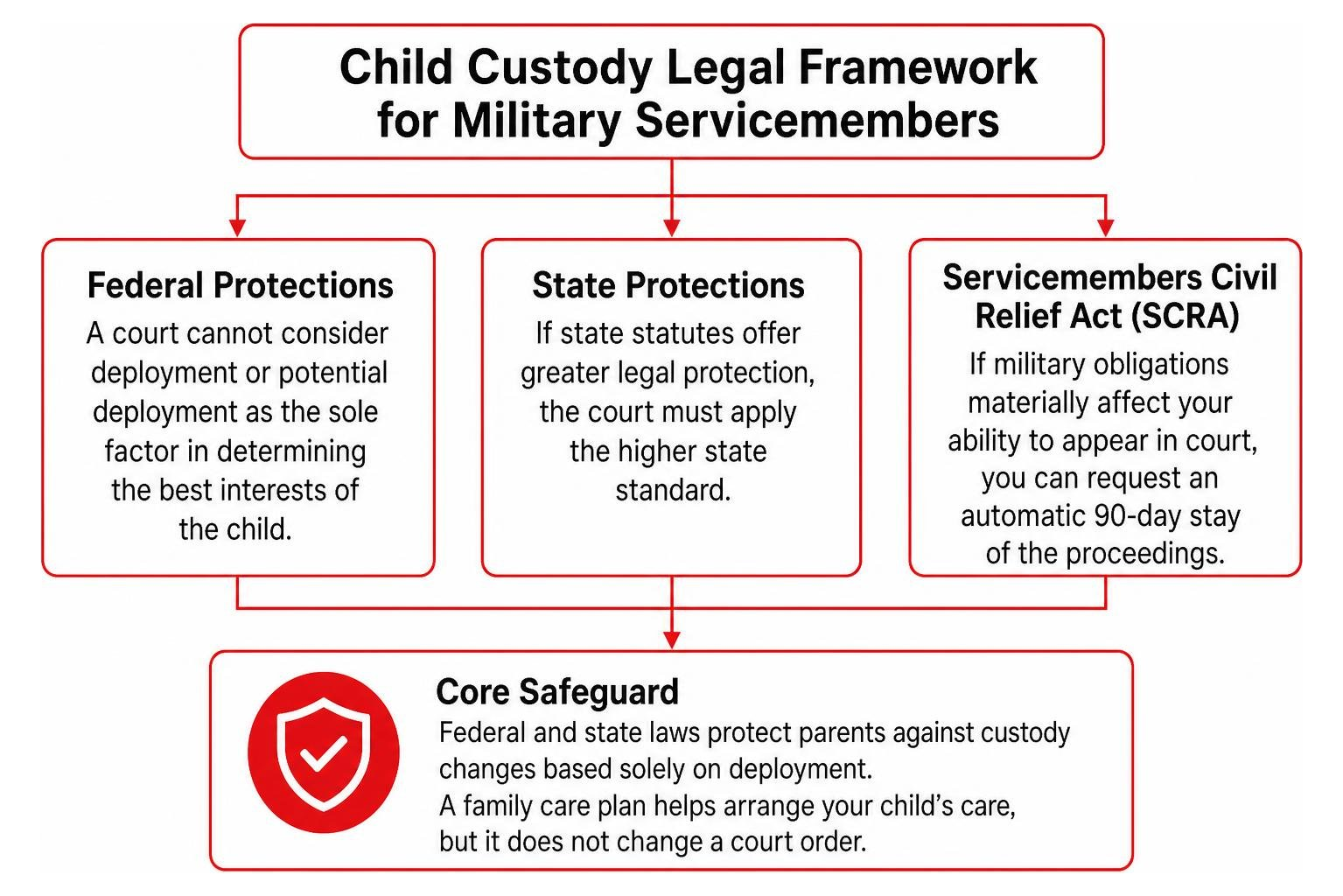
Military service does not automatically cost you custody. If deployment will affect your parenting time, review your custody order, make a family care plan, and seek a temporary court order before you leave. A family care plan helps arrange your child’s care, but it does not change a court order. Federal and state laws protect parents against custody changes based solely on deployment, and the Servicemembers Civil Relief Act may let you postpone a hearing if military duties prevent you from taking part.
I’m Shane A. Taylor, an Army veteran and Mobile attorney who practices in Alabama courts. My military and courtroom experience informs this guide for families searching for information on child custody for a military parent while planning for deployment.
Glossary for child custody military parent:
Legal Protections in Child Custody for a Military Parent
Active-duty life comes with intense operational demands. Across the armed forces, roughly 50 percent of active-duty members and 70 percent of National Guard members are parents. Furthermore, approximately 30,000 soldiers become unmarried fathers each year. When military orders arrive, service members often worry that leaving on assignment might jeopardize their parental rights.
Fortunately, robust legal frameworks exist to safeguard military families. At the federal level, federal custody protections under Title 50 establish core safeguards for deployed personnel. Under these federal statutes, a court cannot consider a service member’s deployment or potential deployment as the sole factor when determining the best interests of the child. When state statutes offer even greater legal protection, federal rules dictate that the court must apply the higher state standard. Successfully asserting these rights requires a strategic approach to navigating family court for custody representation.
The Servicemembers Civil Relief Act and Custody Stays
The Servicemembers Civil Relief Act (SCRA) is the primary federal safeguard shielding active-duty personnel from being disadvantaged in civil court proceedings. Under 50 U.S.C. § 3938 and related provisions, if military obligations materially affect your ability to appear in court, you can request an automatic 90-day stay of the proceedings.
To secure an SCRA stay in a child custody matter, your application must include specific evidentiary components:
- A written statement explaining how your current military duties materially affect your ability to appear, along with a date when you will be available.
- A letter from your commanding officer confirming that your current military duties prevent your personal appearance and stating that military leave is not authorized at the time of the hearing.
Beyond the initial 90-day pause, you or your attorney may petition the court for additional stays if military necessity continues to prevent your participation. Crucially, the SCRA also protects service members against default judgments, preventing the other party from obtaining custody orders behind your back while you are serving downrange.
State Legislation and the Uniform Deployed Parents Custody and Visitation Act
State laws reinforce these federal protections. Today, all 50 states have at least one meaningful statutory provision protecting the rights of service members in custody disputes, as tracked in NCSL military parent custody guidelines. Ten states have fully enacted the Uniform Deployed Parents Custody and Visitation Act (UDPCVA), a model act establishing clear, standardized procedures for temporary custody, expedited hearings, and out-of-court agreements during deployment.
In our jurisdiction, Alabama military custody statutes provide explicit safeguards under Alabama Code § 30-3-9. Alabama law establishes that a parent’s temporary absence, relocation, or failure to comply with custody orders due to military deployment cannot serve as the sole basis to modify an existing custody order permanently. Additionally, Alabama law allows deploying parents to request expedited hearings so temporary arrangements can be formalized before departure. Familiarity with Alabama child custody legal standards ensures your parental bond remains legally secure while you wear the uniform.
Managing Deployments, Relocations, and Family Care Plans
Deployments, mobilizations, and Permanent Change of Station (PCS) moves introduce significant logistical complexity for military parents. Meeting military operational standards while maintaining parental rights requires separating military administrative requirements from civil court orders. Helpful resources on these dual requirements can be found through Military OneSource child custody considerations.
A clear understanding of the differences between administrative military plans and enforceable court orders is essential:
| Feature | Military Family Care Plan (FCP) | Court-Ordered Temporary Custody |
|---|---|---|
| Issuing Authority | Military Command / Department of Defense | State Civil Family Court |
| Legal Purpose | Operational readiness & military logistics | Legally enforceable parental rights & physical placement |
| Enforceability | Enforceable only within military regulations | Enforceable by civilian law enforcement and family courts |
| Third-Party Rights | Designates a caregiver for military emergencies | Establishes formal temporary legal/physical custody |
| Impact on Other Parent | Cannot override noncustodial parent’s legal rights | Binds both parents to specific, enforceable legal terms |
Preparing for Deployment: Securing Child Custody as a Military Parent
Every dual-military couple and single-parent service member is required by Department of Defense regulations to maintain an up-to-date Family Care Plan. This administrative document outlines financial, medical, and logistical arrangements for your child during deployments, temporary duty assignments (TDY), or field exercises.
However, an administrative Family Care Plan does not carry the legal authority of a civil court order. It cannot legally override the constitutional rights of the child’s other legal parent, nor can it transfer legal custody to a third party if the other parent contests the arrangement. Deciding who gets custody during active deployment requires obtaining temporary court orders through your local family court before you deploy.
A thorough pre-deployment legal checklist should include:
- Drafting an out-of-court temporary custody and visitation agreement with the other parent.
- Submitting the agreement to the court for formal judicial approval.
- If an agreement cannot be reached, petitioning the court for an expedited temporary custody hearing.
- Securing certified copies of all active court orders and paternity documents.
- Executing military powers of attorney for specific medical and educational decisions.
Delegating Visitation and Parenting Time to Family Members
When a service member deploys, they often want their child to maintain strong relationships with extended family. Currently, 38 states protect a service member’s visitation rights by permitting them to delegate their court-ordered parenting time to another person during their deployment.
Delegation statutes allow a deployed parent to transfer their visitation time to an individual with a substantial, positive relationship with the child—such as a grandparent, step-parent, aunt, or uncle. For example, statutory frameworks like D.C. deployment custody and visitation law and Kansas military parenting time statutes explicitly authorize courts to delegate parenting time to close relatives, provided the delegation serves the child’s best interests. Delegated visitation gives the designated relative full legal standing to exercise and enforce that parenting time while you are away.
How Courts Evaluate Custody and Best Interest Factors

Whether you are navigating an initial custody determination or responding to a modification request, family courts evaluate every dispute through the lens of the “best interests of the child.” Retaining a qualified child custody lawyer helps present your military career to the court as a foundation of stability, discipline, and support rather than a barrier to effective parenting.
Best Interests of the Child and Child Custody for a Military Parent
Judges possess broad discretion when evaluating a child’s best interests. In military custody cases, courts weigh several primary factors:
- The historical role of each parent as a primary caregiver.
- The emotional bonds and connection between the child and each parent.
- The child’s adjustment to their home, school, and community environment.
- Each parent’s willingness to support and facilitate an ongoing relationship between the child and the other parent.
- The child’s developmental and emotional stability.
Courts are prohibited by state and federal statutes from treating military obligations as a negative factor or presuming that active-duty parents are unfit simply because they may deploy. You can present a compelling custody case by showing a stable household routine, reliable support networks, and proactive co-parenting practices. Understanding what every parent must know before hiring a divorce and custody lawyer is an important step when preparing your case.
Virtual Visitation and Maintaining Parent-Child Bonds
Physical distance does not mean pausing your relationship with your child. Modern military custody orders routinely incorporate provisions for virtual visitation and electronic communication.
Your temporary custody order or parenting plan should explicitly outline:
- Scheduled video calls (e.g., FaceTime, Zoom, Teams) taking into account time zone differences.
- Unrestricted email and messaging access.
- Structured phone calls and shared digital bedtime routines.
- Makeup visitation provisions permitting the deployed parent to exercise additional in-person parenting time within 90 days of returning from deployment.
Establishing paternity is also critical for unmarried parents before formalizing communication and custody schedules. To understand these protections, explore the legal rights of unmarried military parents.
Military Child Support, Health Coverage, and Financial Modifications
Deployments, promotions, and changes in duty stations frequently alter a service member’s compensation structure. Understanding how military pay intersects with civilian support guidelines is essential for every military family. Helpful general information can be found in the federal Handbook for Military Families child support guidance, state guidance such as Wisconsin DCF military child support procedures, and the Texas Attorney General military parent guidelines. For local legal guidance, consider locating local family law attorneys.
Calculating Support with Military Pay and Non-Taxable Allowances
Child support calculations in civil family courts differ substantially from standard tax filings. When assessing a service member’s gross income, family courts review your Leave and Earnings Statement (LES) and typically incorporate:
- Basic Pay (base salary based on rank and time in service).
- Basic Allowance for Housing (BAH) (non-taxable, included as gross income for support).
- Basic Allowance for Subsistence (BAS) (non-taxable, included in support calculations).
- Special and incentive pays (e.g., jump pay, sea pay, flight pay).
Combat pay and hazardous duty allowances may be subject to specific statutory exclusions depending on state rules. Once a support order is entered, payments can be managed through voluntary allotments or automated income withholding through the Defense Finance and Accounting Service (DFAS).
Modifying Child Support and Health Benefits for Dependents
When deployment leads to significant changes in income, either parent can request a formal child support modification based on a material and substantial change in circumstances. Support obligations do not adjust automatically; you must petition the court for an updated order.
Additionally, military parents provide comprehensive medical coverage for their children by enrolling dependents in the Defense Enrollment Eligibility Reporting System (DEERS), which unlocks TRICARE health benefits. Civil family courts treat comprehensive military healthcare coverage as satisfying the parent’s medical support obligations. For comprehensive insights into domestic proceedings, consult our 2026 family law attorney guide.
Frequently Asked Questions About Military Child Custody
Can my ex-spouse get permanent full custody just because I am deployed?
No. Federal law under the SCRA and state statutes across all 50 states prohibit courts from issuing permanent custody modifications based solely on a parent’s military deployment. Any custody modifications ordered during active duty are temporary and must expire once the deployment ends.
What is the difference between a Family Care Plan and a court custody order?
A Family Care Plan is an internal military administrative requirement used by commanding officers to verify unit readiness and ensure children are cared for during duty assignments. It is not a legally binding court order. In contrast, a court custody order is issued by a state civil judge, carries full legal authority, and can be enforced by law enforcement and state courts.
How soon after returning from deployment must custody return to normal?
Temporary orders tied to deployment typically expire within a statutory window—often between 10 and 90 days following the end of the deployment, depending on applicable state law. During this reintegration window, the returning parent can resume their regular custody schedule and petition the court for makeup visitation time.
Conclusion
Balancing military duty with the responsibilities of raising children is one of the most demanding tasks a service member can undertake. While military legal assistance offices (JAG) offer valuable general legal advice, they cannot represent you directly in civilian family court hearings.
At Shane A. Taylor PC, we provide focused, client-centered representation for service members and military families. As an Army veteran practicing in Mobile, Alabama, Shane A. Taylor understands military service and provides responsive legal counsel in child custody, divorce, and support matters. If you are preparing for deployment or facing a custody dispute, contact our team today for experienced family law legal representation.