


Why a Probate Family Lawyer Matters When Inheritance and Family Conflict Collide
A probate family lawyer helps families settle a loved one’s estate while protecting inheritance rights when conflict, divorce, custody issues, blended-family concerns, or questions about a will arise. They can guide the personal representative through court filings, asset collection, creditor claims, and distribution – and represent an heir, spouse, or beneficiary when the estate becomes disputed.
Probate is the court-supervised process for validating a will, appointing someone to manage the estate, paying valid debts, and transferring probate assets to the right people. A will does not always avoid probate. And when there is no will, Alabama intestacy laws determine who inherits.
For a parent or spouse already facing family-law stress, estate disputes can create another difficult layer. The key is to preserve records, avoid informal promises about property, and get clear legal advice early if someone questions the will, the executor’s actions, or an heir’s share.
I am Shane A. Taylor, an Alabama and Mississippi attorney with experience practicing in state and federal courts, including family-law matters that can overlap with probate disputes. As a probate family lawyer, I bring a trial-focused approach to helping clients understand their options when family relationships and legal rights are both on the line.
Understanding Estate Administration: What Probate Entails and When It Applies
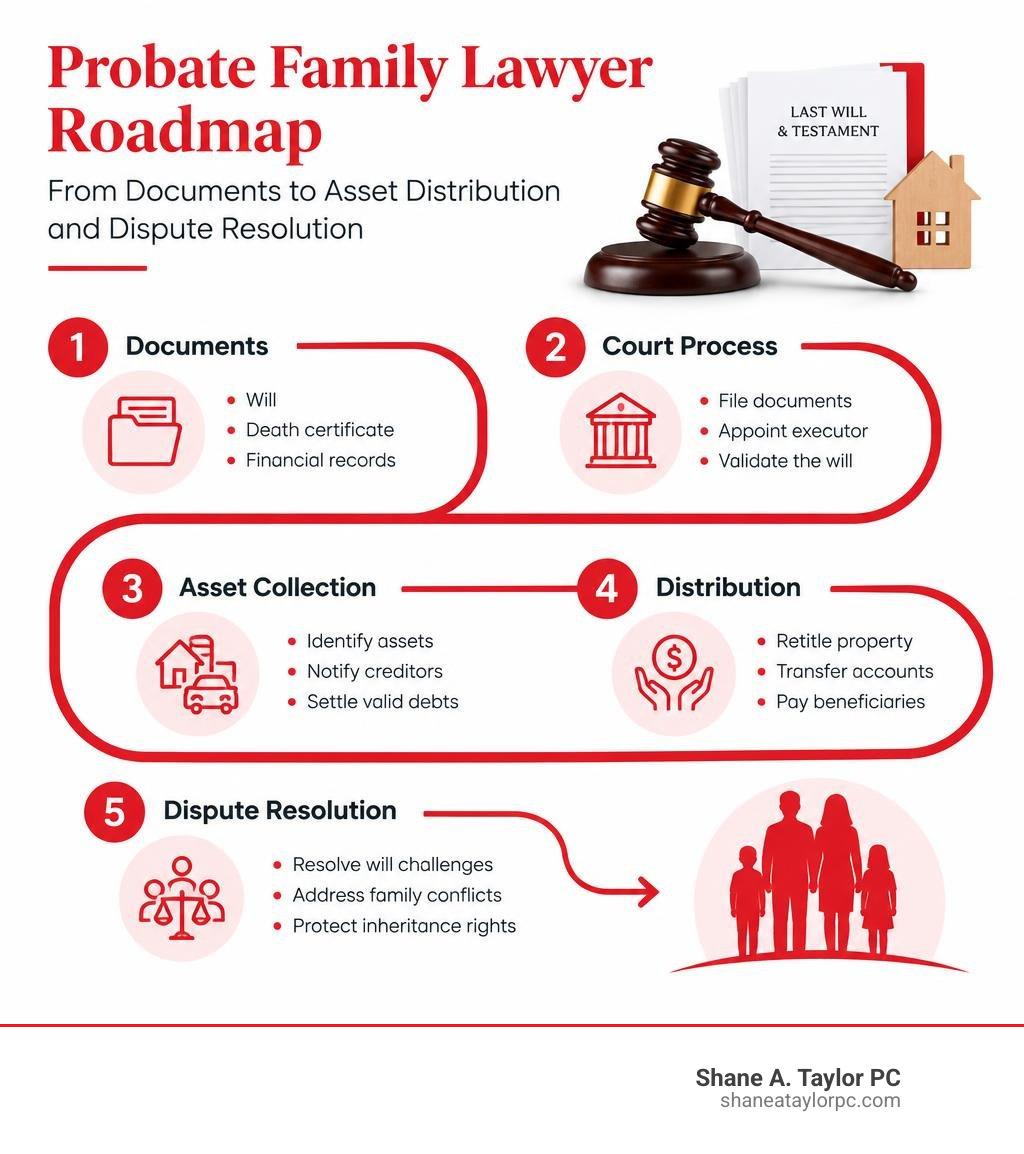
When someone passes away, their property does not automatically transfer to surviving family members. Estate administration is the formal, court-supervised mechanism designed to legally recognize a person’s death, validate their final wishes, settle outstanding debts, and transfer clear title of their property to legitimate heirs.
Probate court supervision ensures that all statutory filings, asset retitling, and debt settlements comply with state law. Without this judicial oversight, financial institutions will not release accounts held solely in the decedent’s name, and county recording offices cannot transfer real property deeds to beneficiaries. Navigating these court-mandated thresholds requires precision, which is why securing experienced legal counsel helps families avoid procedural delays and costly administrative missteps.
Types of Probate Proceedings and Key Steps in Court Administration
Depending on the size of the estate, whether a valid will exists, and the level of agreement among heirs, estate administration follows distinct legal paths:
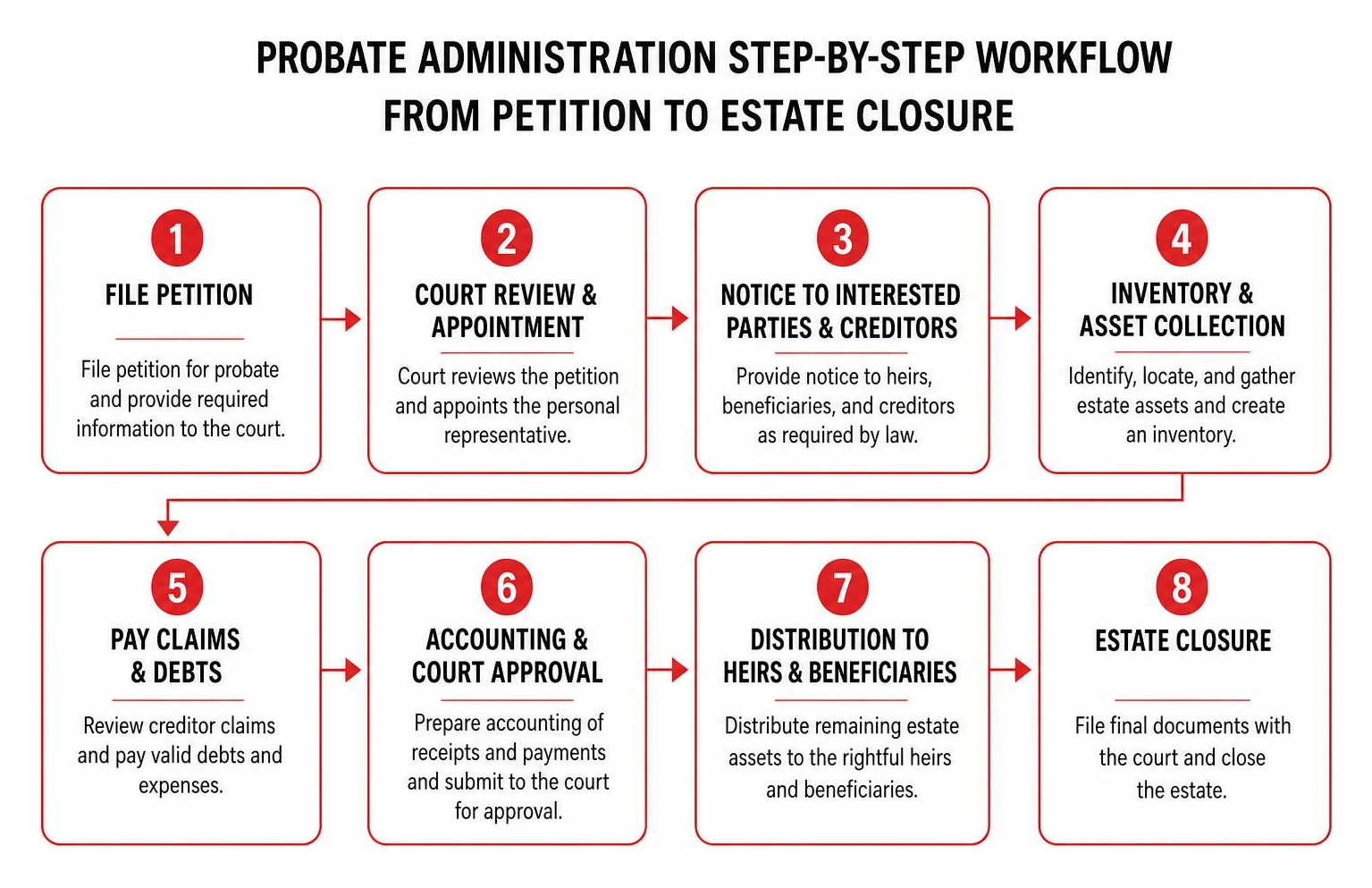
- Formal Administration: The traditional probate process used for larger estates or those involving real estate, complex debts, or disputes. It involves filing a formal petition, attending initial court hearings, obtaining letters testamentary (or letters of administration), publishing notices, appraising assets, and submitting formal accountings.
- Summary Administration (Small Estate): A streamlined alternative for smaller estates that fall below specific statutory asset thresholds. It allows personal representatives to distribute assets much faster without the extended timeline or burdensome procedural requirements of full formal administration.
Probate vs. Non-Probate Assets: What Must Pass Through Estate Courts?
A common misconception is that every asset owned by a deceased person must go through the probate court. In reality, assets are split into two primary legal categories: probate assets and non-probate assets.
Probate assets are those owned solely in the decedent’s name without a designated beneficiary or survivorship right. Non-probate assets transfer automatically by operation of law or contract upon death.
| Asset Category | Ownership Structure / Mechanism | Bypasses Probate Court? |
|---|---|---|
| Real Estate (Sole Name) | Titled solely in decedent’s name | No (Requires Probate) |
| Bank Accounts (Individual) | No beneficiary or POD designation | No (Requires Probate) |
| Personal Property | Vehicles, heirlooms, jewelry, artwork | No (Requires Probate) |
| Joint Tenancy Real Estate | Titled with Right of Survivorship (JTWROS) | Yes (Automatic Transfer) |
| Retirement Accounts (IRA/401k) | Designated beneficiary listed on file | Yes (Direct Payout) |
| Life Insurance Proceeds | Designated beneficiary named in policy | Yes (Direct Payout) |
| Living Trust Assets | Titled in the name of a Revocable/Living Trust | Yes (Trustee Administration) |
| Bank Accounts (POD/TOD) | Payable-on-Death / Transfer-on-Death forms | Yes (Direct Transfer) |
The Core Responsibilities and Legal Duties of an Estate Personal Representative

Serving as a personal representative (often called an executor if named in a will, or an administrator if appointed by the court when no will exists) carries immense legal responsibility. An executor owes a strict fiduciary duty to the estate and its beneficiaries. They cannot treat estate assets as personal funds, favor one heir over another, or make distributions before satisfying statutory claims.
Managing Creditor Claims, Inventory Filings, and Tax Obligations
A personal representative must systematically identify and safeguard the decedent’s property while resolving liabilities in strict statutory order:
- Filing the Estate Inventory: Within a specific statutory window following appointment (typically 60 days), the executor must locate, appraise, and file an itemized inventory of all probate property with the court.
- Providing Notice to Creditors: The representative must publish legal notice in a local publication and send direct written notice to all known or reasonably ascertainable creditors.
- Managing the Claims Period: Creditors have a fixed statutory window to submit claims against the estate. The representative must evaluate these claims, approving legitimate debts and contesting improper demands.
- Observing Debt Priority: If an estate does not have sufficient liquidity to cover all debts, state law dictates the strict hierarchy of payments (e.g., administrative expenses, funeral costs, taxes, medical expenses, and general unsecured creditors). Paying lower-priority debts first can result in personal financial liability for the representative.
- Handling Final Taxes and Accountings: The personal representative must prepare the decedent’s final personal income tax returns, file fiduciary income tax returns for the estate if necessary, and submit a detailed final accounting to the probate court before any assets are distributed.
Handling Out-of-State Property and Ancillary Administration Requirements
If a decedent owned real estate or tangible personal property in another state outside their primary residence, primary probate cannot transfer legal title to that foreign real estate. The court in the home jurisdiction lacks geographic authority over out-of-state real property.
In these situations, the personal representative must initiate an ancillary administration in the county and state where the real property is situated. This secondary court proceeding validates the original probate letters, complies with local land-recording statutes, and ensures clear title transfer or sale according to local law.
When and Why You Need a Probate Family Lawyer During Estate Battles
When a loved one passes away, unresolved family rivalries, financial tensions, and differing expectations often turn an otherwise straightforward administrative process into high-stakes litigation. Having knowledgeable legal counsel for estate matters becomes vital when an estate becomes contested, when personal representatives withhold information, or when vulnerable relatives are excluded.
Protecting Inheritance Rights in Intestate Estates and Blended Family Conflicts
When a person dies intestate (without a valid will), their estate is distributed according to rigid state intestacy statutes rather than verbal promises. This creates substantial challenges in blended families where surviving step-parents, biological children, and half-siblings compete for statutory shares.
Unmarried partners and non-marital children face unique evidentiary burdens to validate their heirship. Navigating statutory shares, elective shares for surviving spouses, and protecting unmarried parents’ inheritance rights requires assertive courtroom representation to ensure no rightful heir is unfairly disinherited or sidelined.
Challenging Validity: Grounds for Contesting Wills and Trusts
A will or trust cannot be challenged simply because an heir is unhappy with their share. To successfully contest an instrument, a party must establish specific legal grounds:
- Lack of Testamentary Capacity: Proving the decedent suffered from severe cognitive impairment, dementia, or mental illness that prevented them from understanding the nature of their property or the beneficiaries of their estate when the document was signed.
- Undue Influence: Demonstrating that a caregiver, relative, or advisor exerted improper psychological or physical pressure that overpowered the decedent’s free will, resulting in an unnatural distribution.
- Fraud and Forgery: Showing that signatures were forged, pages were swapped, or the decedent was misled into signing a document under false pretenses.
- Improper Execution: Establishing that the document failed to satisfy statutory execution requirements, such as lacking the necessary independent witnesses or formal notarization.
- Revocation: Providing evidence that a subsequent valid will or codicil was executed, revoking the document presented to the court.
How a Probate Family Lawyer Resolves Complex Family Court and Estate Disputes

Estate disputes rarely exist in a legal vacuum; they frequently intersect with domestic relations, ongoing divorces, support obligations, and protective proceedings. Experienced local legal advocates bridge the gap between probate procedure and family dynamics, employing strategic negotiation, court-ordered mediation, and aggressive trial advocacy to settle disputes without squandering the estate’s underlying value.
Guardianship, Child Custody, and Spousal Claims in Probate Litigation
When a surviving parent or guardian passes away leaving minor children, the probate court must appoint a legal guardian and conservator to manage the child’s care and financial inheritance. These proceedings often collide with ongoing child custody arrangements or family-court disputes over who is fit to raise the children. Applying comprehensive family law custody protections ensures that the minors’ personal welfare and financial assets remain shielded from opportunistic relatives.
Furthermore, surviving spouses enjoy statutory protections that cannot be eliminated entirely by a will. Spousal claims like elective shares, homestead allowances, and family support exemptions allow a surviving spouse to claim a designated percentage of the estate regardless of terms attempting to disinherit them.
Fee Structures, Retainers, and How a Probate Family Lawyer Bills for Court Cases
Legal fees in estate matters depend heavily on the nature and complexity of the case:
- Flat Fees: Commonly used for straightforward, uncontested summary or formal probate administrations where the scope of work is predictable.
- Hourly Rates & Retainers: Standard for contested probate matters, trust disputes, and active estate litigation. The client provides an initial retainer deposit from which hourly work is billed as the litigation progresses.
- Statutory Percentage or Court-Approved Fees: In certain administrations, attorney fees are submitted to the probate judge for review and approved as an administrative expense paid directly from estate funds prior to final distribution.
Proactive Planning: How Living Trusts and Estate Tools Prevent Future Court Battles
The most effective way to protect your family from courtroom battles is by implementing comprehensive estate planning during your lifetime. By transferring assets into a revocable living trust, you maintain full control over your property during your life while ensuring that upon your passing, a successor trustee distributes assets privately, immediately, and entirely outside the probate court system.
Pairing a living trust with durable financial powers of attorney, healthcare directives, and regularly updated transfer-on-death designations creates a seamless structure that eliminates ambiguities, prevents conservatorship battles during incapacity, and removes the administrative burden from your grieving loved ones.
Essential Documents Needed to Initiate Estate Filings and Administration
Before petitioning the court to open an estate, gathering the following documentation is essential:
- Certified copy of the legal Death Certificate.
- Original Last Will and Testament alongside any Codicils (or verification of search if intestate).
- Complete names, mailing addresses, and relationships of all named beneficiaries and statutory heirs.
- Real estate deeds, mortgages, and recent property tax assessments.
- Recent bank, brokerage, and investment account statements.
- Vehicle, boat, and mobile home titles.
- Life insurance policy documents and retirement plan summary statements.
- Itemized list of known debts, medical bills, funeral expenses, and creditor statements.
- Prior years’ personal federal and state tax returns.
Frequently Asked Questions About Estate Litigation and Probate Administration
How long does the probate process typically take from filing to closure?
An uncontested formal probate administration typically takes between 6 to 12 months. This timeframe is dictated by statutory creditor notice periods (which usually remain open for 6 months) and court processing schedules. Small estate summary proceedings may conclude in a few months, whereas contested estates involving will challenges, fiduciary litigation, or tax audits can span several years.
Do all states require hiring a probate attorney to settle an estate?
While some jurisdictions technically allow an individual to represent themselves if they are the sole personal representative and the only beneficiary with no creditors, the majority of courts strongly require or mandate legal representation for personal representatives. Because personal representatives act on behalf of third-party creditors and multiple heirs, courts view self-representation as the unauthorized practice of law on behalf of others.
What happens if an executor mismanages estate assets or breaches fiduciary duty?
Beneficiaries can petition the probate court to compel an immediate accounting, suspend the executor’s powers, or remove the personal representative entirely. If the court finds that the executor committed waste, engaged in self-dealing, or misappropriated funds, the judge can issue a financial surcharge, holding the executor personally liable to repay the estate for all losses incurred.
Conclusion
Losing a loved one is emotionally exhausting; being thrust into contentious probate court proceedings while navigating family rivalries only magnifies the difficulty. Whether you need to guide an uncontested estate smoothly through administration or stand your ground against unfair will modifications and fiduciary misconduct, having dedicated counsel protects your financial legacy.
At Shane A. Taylor PC, we deliver responsive, trial-tested advocacy to safeguard your rights across complex probate and estate disputes. Explore our comprehensive family law guidance to learn how our dedicated team can help you resolve inheritance conflicts and secure your family’s future.