


What a Custody Divorce Attorney Helps You Do
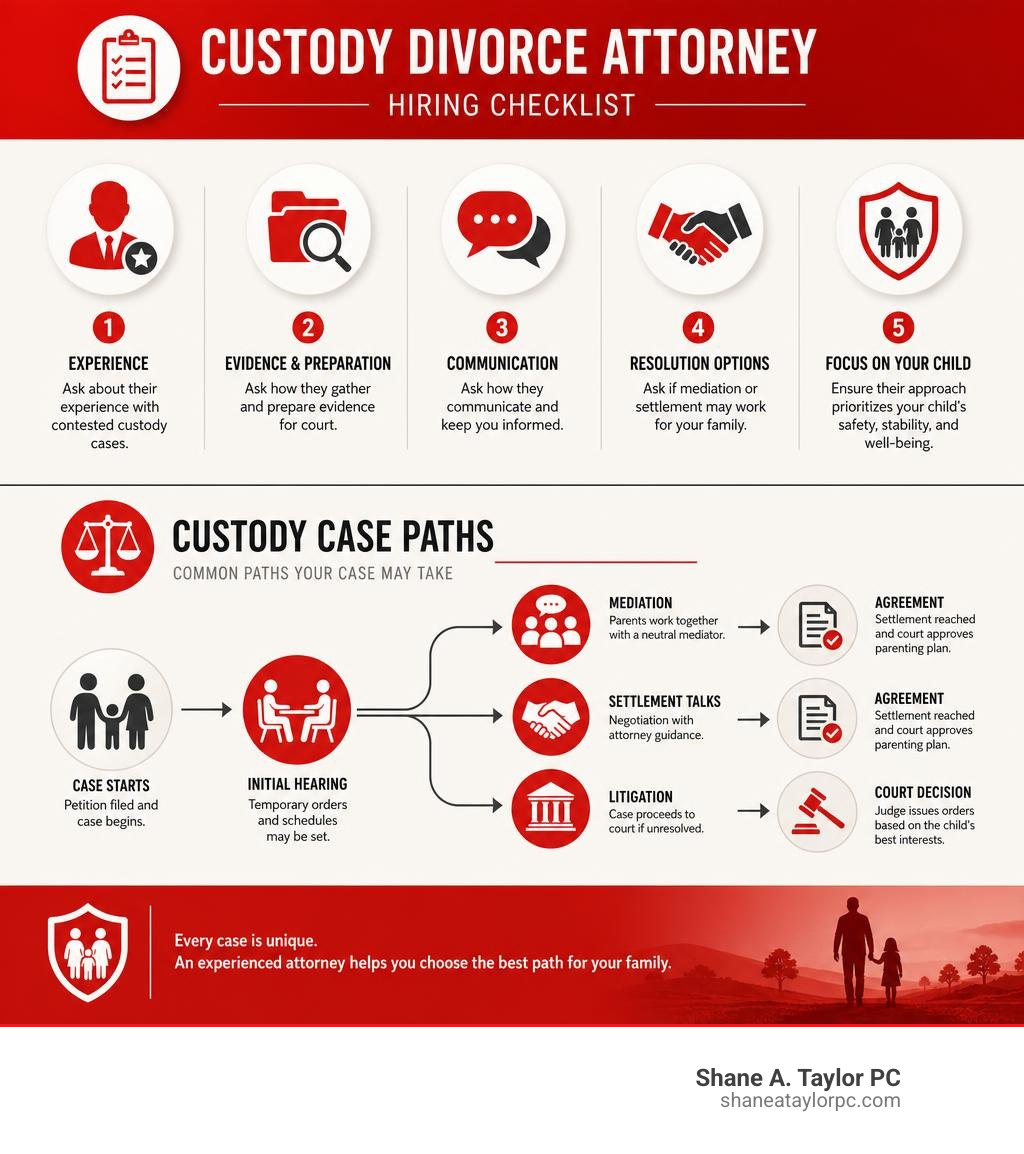
A custody divorce attorney helps you protect your relationship with your child while navigating divorce, custody, parenting-time, and support decisions. Before hiring one, ask about their experience with contested custody cases, how they prepare evidence for court, how they communicate, and whether mediation or settlement may work for your family.
The right lawyer should help you:
- Understand the custody options and legal standards that apply to your case.
- Build a clear plan for temporary orders, hearings, settlement talks, or trial.
- Gather useful records, such as parenting calendars, school communications, medical information, and financial documents.
- Keep the focus on your child’s safety, stability, and long-term well-being.
Custody cases are rarely just about who “wins.” Courts generally decide custody based on the child’s best interests, including each parent’s ability to provide care, promote a healthy relationship with the other parent, and meet the child’s needs. A strong attorney gives you practical advice, prepares you for the process, and helps you avoid mistakes that can affect a final parenting plan.
I am Shane A. Taylor, an Alabama and Mississippi attorney with experience in state and federal courts, as well as a background in military service and law enforcement. As a custody divorce attorney, I understand that parents need direct guidance, careful preparation, and an advocate who treats the future of their family with the seriousness it deserves.
The Strategic Value of Hiring an Experienced Custody Divorce Attorney
When family dynamics break down, the emotional stakes can make objective decision-making challenging. Navigating a custody battle while working through a separation requires tactical thinking, knowledge of local court expectations, and procedural precision. Partnering with a skilled contested divorce lawyer ensures your parental rights are protected throughout each stage of litigation.
An experienced lawyer helps you look past short-term frustration to focus on long-term legal strategy. While roughly 90% of child custody disputes resolve through mediation or negotiated settlements without going to trial, securing a favorable outcome depends entirely on entering negotiations from a position of strength and preparation.
How a Custody Divorce Attorney Prepares You for Court Hearings
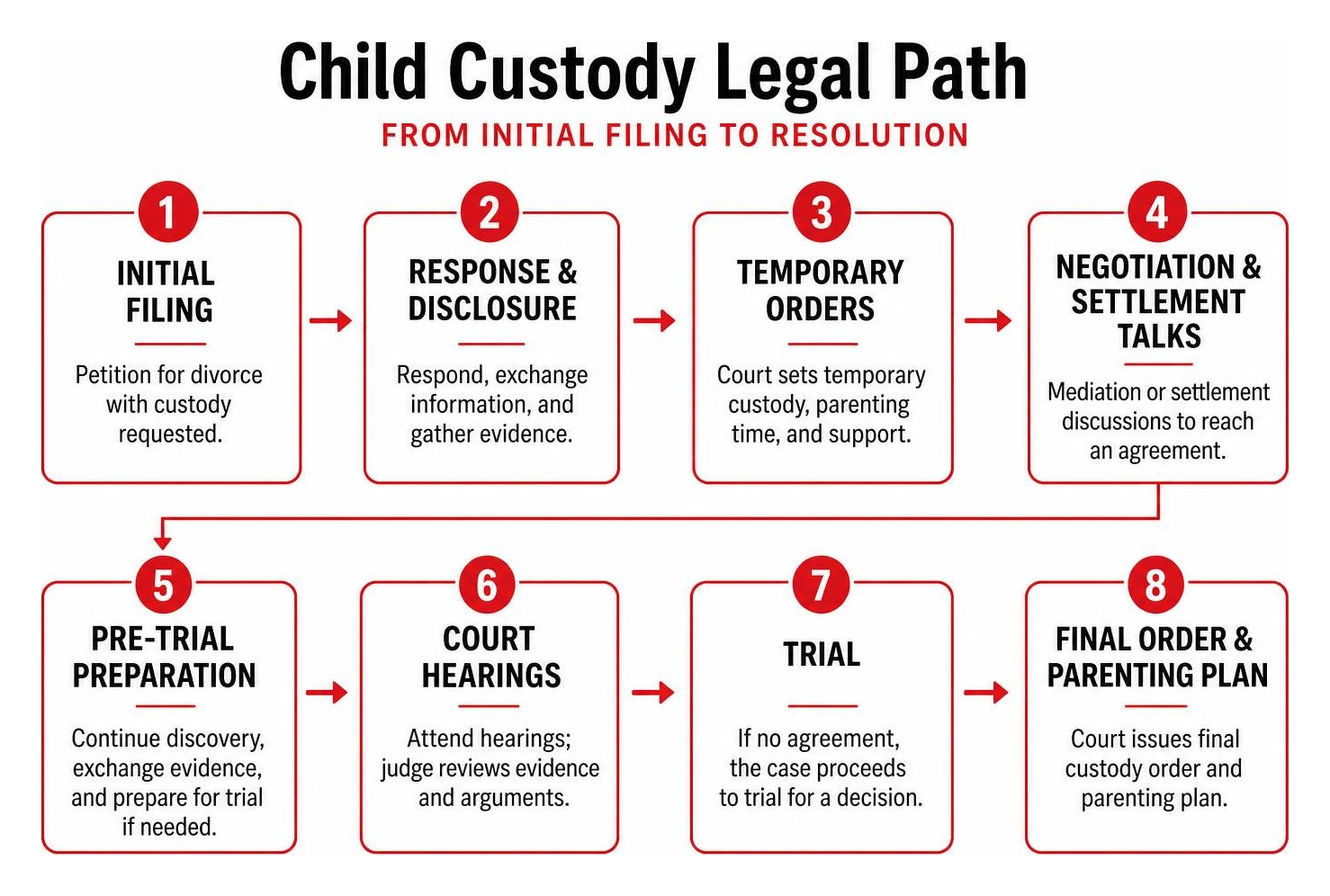
Preparation is what separates successful courtroom outcomes from preventable setbacks. In family court, judges make significant decisions based on temporary hearings held early in a case. Because courts often hesitate to disrupt routines once established, temporary orders can set the tone for the final decree.
Your attorney assists you with several critical preparation tasks:
- Gathering and Organizing Evidence: Collecting school performance records, medical histories, mental health logs, and financial affidavits.
- Creating Comprehensive Parenting Logs: Documenting daily caretaking responsibilities, visitation schedules, missed parenting time, and communication histories.
- Witness Preparation: Identifying and preparing teachers, counselors, neighbors, or neutral third parties who can provide testimony regarding your parenting capabilities.
- Mock Cross-Examinations: Preparing you to answer difficult questions calmly while identifying weaknesses in the opposing party’s claims.
Approaching court hearings with structured, admissible evidence rather than unsubstantiated claims allows your legal team to present a compelling narrative to the judge.
Key Qualities to Look for in a Custody Divorce Attorney

Finding the right representation means choosing an advocate whose communication style, courtroom experience, and approach align with your family’s needs. Reviewing 7 tips for finding a qualified divorce attorney can help narrow your search.
Key factors to evaluate include:
- Local Court Familiarity: Every jurisdiction and judicial bench has unique local rules and expectations. An attorney familiar with local family court judges understands how evidence is weighed in that specific venue.
- Clear Communication and Realistic Counsel: You need an advocate who provides practical assessments of your case rather than making promises that cannot be kept.
- Litigation and Settlement Experience: Your attorney should be skilled in alternative dispute resolution like mediation while maintaining the courtroom capabilities needed if trial becomes necessary.
- Fee Transparency: Clear billing agreements, whether structured as hourly retainers or predictable flat-fee arrangements, help prevent unexpected financial strain during litigation.
Legal Standards: Determining Custody and Best Interests of the Child
When deciding who gets custody, courts do not look at parental convenience. Instead, judicial rulings focus on the “best interests of the child” standard. This standard guides both legal custody (decision-making authority regarding education, medical care, and religious upbringing) and physical custody (where the child resides and the specific parenting-time schedule).
Parents seeking clarity on these legal standards can benefit from demystifying Alabama child custody laws to better understand how courts evaluate:
- The child’s age, physical health, emotional development, and unique educational needs.
- The emotional bond and interpersonal connection between the child and each parent.
- Each parent’s historical role as the primary caregiver handling daily routines, healthcare, and schooling.
- The stability and safety of each proposed home environment.
- Each parent’s demonstrated willingness to support and facilitate an ongoing, positive relationship between the child and the other parent.
Evaluating Parental Fitness and High-Conflict Dynamics
In high-conflict custody litigation, courts must frequently evaluate claims that affect parental fitness. These cases often involve allegations of domestic abuse, substance dependencies, severe untreated mental illness, or intentional parental alienation.
When verifiable domestic violence is proven, courts apply a statutory rebuttable presumption against awarding physical custody to the abusive parent. If personality disorders or high-conflict behaviors derail communication, judges may order psychological evaluations, appoint specialized mental health professionals, or issue specific protective orders to protect the child’s emotional and physical safety.
Unmarried Parents and Paternity Determinations
Custody disputes are not limited to formal divorce proceedings. For unmarried couples, establishing legal rights requires specific initial steps before a court will grant custody or visitation.
Understanding unmarried parents’ legal rights is critical for both mothers and biological fathers. A biological father generally must establish legal paternity and complete the legitimation process to obtain legal standing to petition for custody or visitation. Once paternity is established, the court applies the same best-interests analysis used in divorce cases to determine custody and calculate appropriate child support obligations.
Court-Appointed Child Representatives and Judicial Procedures
In complex or contentious custody cases, the court may determine that the parents’ conflicting testimony makes it difficult to get an objective view of the child’s needs. In these circumstances, the judge may appoint an independent representative to protect the child’s legal interests.
Depending on the case, courts can utilize distinct roles:
- Guardian ad Litem (GAL): An attorney appointed by the court to investigate the family circumstances, interview both parents, review records, and deliver an independent recommendation to the judge regarding the child’s best interests.
- Child’s Best Interest Attorney (BIA): An attorney appointed to independently evaluate the evidence and advocate for what serves the child’s best interests, even if that differs from the child’s stated desires.
- Child’s Advocate Attorney: A lawyer appointed to represent the child directly, bound by traditional attorney-client confidentiality rules, advocating strictly for the child’s expressed wishes.
- Child’s Privilege Attorney: Counsel appointed for the specific, limited purpose of deciding whether to waive or assert the minor child’s legal privilege regarding sensitive mental health, psychiatric, or therapy records.
Distinguishing Best Interest Attorneys from Child Advocates
Parents often confuse a Best Interest Attorney with a direct Child Advocate Attorney. These two roles carry fundamentally different legal responsibilities, confidentiality guidelines, and courtroom functions.
| Representation Feature | Child’s Best Interest Attorney (BIA) | Child’s Advocate Attorney |
|---|---|---|
| Primary Duty | Advocates for what is in the child’s overall best interests. | Advocates directly for the child’s stated wishes and choices. |
| Confidentiality | Can share statements and findings with the court if necessary. | Bound by strict attorney-client confidentiality rules. |
| Courtroom Role | Submits independent evidence and recommendations to the judge. | Represents the minor as a direct client, much like adult counsel. |
| Client Direction | Not bound by the minor’s instructions or immediate preferences. | Must follow lawful client instruction and express client goals. |
| Typical Appointment | High-conflict cases, younger children, parental dispute deadlocks. | Older children, mature minors, contested dependency proceedings. |
When Judges Order Independent Child Representation
Judges typically exercise their discretion to appoint independent legal counsel for a child in high-conflict cases. Triggers include contested allegations of physical abuse or neglect, severe parental alienation, relocation disputes that would separate siblings, or situations where one parent attempts to subpoena the child’s private psychotherapy records.
While either parent can file a formal motion asking the court to appoint an independent attorney for the child, the court is not required to grant every request. Judges retain broad discretion to evaluate whether an independent appointment is necessary or if less costly alternatives—such as an in-chambers judicial interview—can resolve the factual dispute. When an attorney is appointed, parents are generally required to deposit funds into a court-ordered escrow account to cover the appointed attorney’s fees, divided proportionally based on their respective incomes.
Post-Decree Modifications and Parental Relocation Disputes

A final custody decree reflects the circumstances of the family at the time the order was entered. As children grow and parents’ personal or professional lives change, existing custody orders and parenting schedules may no longer be practical.
Legal Grounds for Modifying an Established Custody Order
To modify an existing child custody order, the parent seeking the change must show a substantial, material change in circumstances affecting the child’s welfare. This legal standard prevents continuous, disruptive litigation over minor disagreements.
Legitimate grounds for requesting a custody modification often include:
- Significant changes in the child’s developmental, medical, or educational requirements.
- Unstable home environments, chronic substance abuse issues, or neglect developing in a parent’s household.
- Ongoing, documented refusal by one parent to follow court-ordered visitation schedules.
- A parent’s work schedule changing significantly, creating long-term child care issues.
Minor disagreements or minor schedule adjustments do not meet the threshold for a formal custody modification. The petitioner must prove that the material change directly impacts the child’s well-being and that modifying the order will result in a positive benefit that outweighs the disruption of changing the child’s routine.
Managing Parental Relocation and Cross-Jurisdiction Moves
Parental relocation is one of the most contested issues in family law. When a custodial parent plans to move outside the local area or out of state, the move can disrupt the other parent’s visitation schedule and parental relationship.
Specific relocation statutes govern proposed moves:
- Mandatory Advance Notice: The relocating parent must typically provide formal written notice (often 30 to 45 days in advance) detailing the proposed new address, the reasons for the move, and a proposed revised parenting-time schedule.
- Formal Objections: The non-relocating parent has a statutory window to file a formal objection and request an injunction to block the child’s relocation pending a hearing.
- Burden of Proof: The relocating parent must prove that the move is made in good faith and serves the child’s overall best interests, rather than being an attempt to limit the other parent’s access.
- Revised Visitation Logistics: If the court permits the move, orders must be updated to establish long-distance travel schedules, holiday allocation, and the division of travel costs.
Frequently Asked Questions About Custody and Divorce Lawyers
What is the difference between a child’s best interest attorney and a child advocate?
A child’s best interest attorney independently investigates the family situation and presents evidence on what will serve the child’s safety and development, even if that recommendation contradicts what the child wants. In contrast, a child advocate attorney functions as direct legal counsel for the child, maintaining attorney-client confidentiality and advocating solely for the child’s expressed desires.
Who is responsible for paying a court-appointed attorney for a child?
Parents are typically responsible for paying the fees of a court-appointed child attorney or Guardian ad Litem. The judge generally allocates these costs between the parents based on their relative incomes and financial resources, often requiring upfront deposits into a court escrow account. In cases involving severe financial hardship, the court may waive fees or appoint pro bono counsel.
Can an older child petition the court directly for a custody change?
In select jurisdictions, statutes allow a minor who has reached a specific statutory age (such as 16 years old) to petition the court directly for a custody modification. In most cases, however, a child cannot file a petition on their own. Instead, an older child’s clear, mature preferences are presented through an appointed Guardian ad Litem or during an official in-chambers interview with the presiding judge.
Conclusion
Child custody and divorce proceedings involve significant decisions that impact your family’s daily life and your relationship with your children. Navigating these proceedings requires direct advice, careful evidentiary preparation, and an understanding of how local courts apply the best interests of the child standard.
Whether you are preparing for initial divorce filings, establishing paternity, managing a high-conflict dispute, or seeking a post-decree custody modification, working with dedicated legal counsel helps protect your parental rights and maintain stability for your children.
If you are facing a divorce or contested custody dispute, explore how Shane A. Taylor PC family law representation can help you protect your rights and build a stable path forward for your family.