


When You Need a Child Custody Lawyer: What to Know First
A child custody lawyer helps parents protect their rights and their children’s well-being when families go through separation or divorce. If you’re in the middle of a custody dispute right now, here’s what matters most:
Quick answers for parents searching for help:
- A child custody lawyer guides you through court filings, parenting plans, and hearings
- Courts decide custody based on the best interests of the child — not which parent wants it more
- You need a lawyer especially for high-conflict cases, relocation disputes, or custody modifications
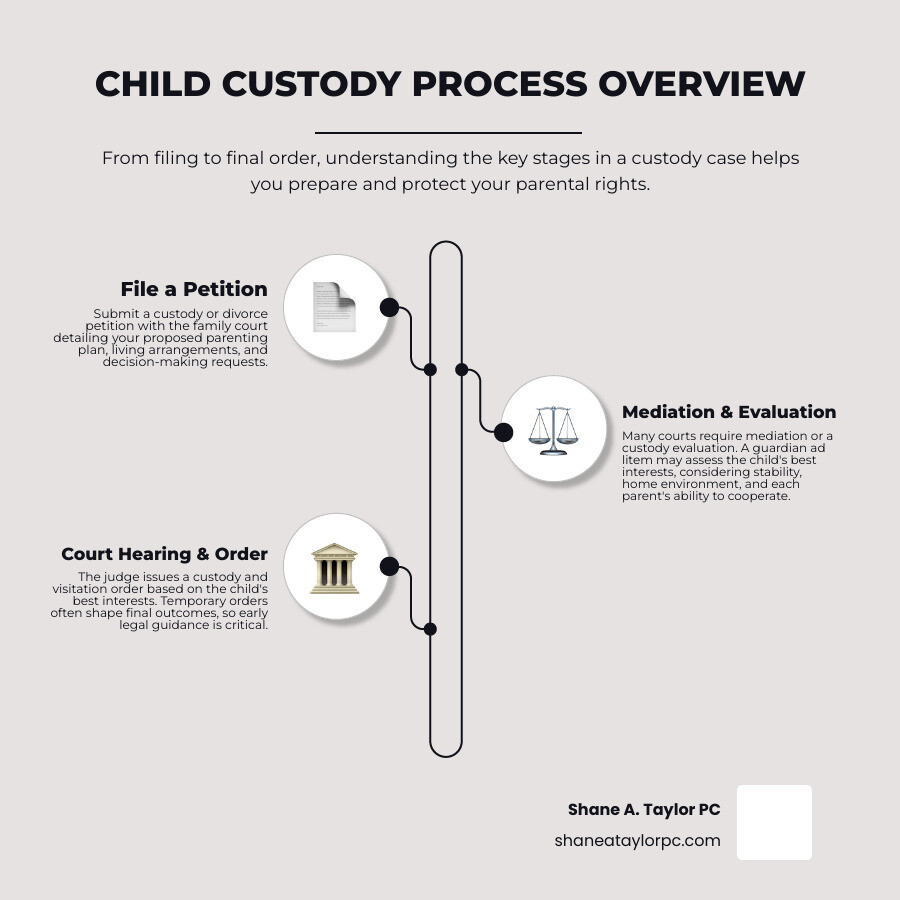
- Acting quickly matters — temporary orders made early in a case often shape the final outcome
Custody cases are some of the most emotionally difficult legal situations a parent can face. The stakes are high. The rules are complicated. And the decisions made in court can affect your relationship with your child for years.
Whether you’re just starting the process or trying to change an existing arrangement, understanding how custody law works — and having the right legal help — makes a real difference.
I’m Shane A. Taylor, and while my background is rooted in criminal defense, my experience as a former police officer and military veteran has given me a sharp understanding of high-stakes, high-conflict situations — exactly the kind that arise in contested child custody lawyer cases. I’m here to help you cut through the confusion and make informed decisions for your family.
Understanding Child Custody and Visitation Laws
When you step into family law, the terminology can quickly become overwhelming. You will hear terms like “legal custody,” “physical custody,” “sole custody,” and “joint custody” thrown around. Understanding these distinctions is the first step in building a clear strategy for your family.
In Alabama, the courts look at custody through two primary lenses: decision-making authority (legal custody) and where the child actually lives (physical custody). Neither parent starts with an automatic advantage. The law is designed to treat both parents equally, focusing entirely on what is best for the child.
Legal Custody vs. Physical Custody
The difference between legal and physical custody is one of the most common points of confusion for parents.
- Legal Custody refers to the right and responsibility to make major, long-term decisions about your child’s life. This includes decisions regarding education (such as choosing a school), healthcare (selecting doctors or undergoing major medical procedures), and religious upbringing.
- Physical Custody refers to where the child physically resides on a day-to-day basis. The parent with physical custody handles the daily routine, from making breakfast to helping with homework and putting the child to bed.
To help visualize how these two concepts interact, consider the following comparison:
In many cases, courts prefer to award joint legal custody, meaning both parents must consult each other and agree on major life decisions, even if the child primarily lives with one parent. If you are wondering how these dynamics might play out in your specific situation, you can read more about the initial determination process in our guide on Who Gets Custody.
Sole Custody vs. Joint Custody
The court can award these types of custody in different combinations:
- Joint Legal and Joint Physical Custody: Both parents share decision-making power and have significant, split physical time with the child. This does not always mean a perfect 50/50 split down to the minute, but it ensures both parents remain deeply involved in daily life.
- Joint Legal and Sole Physical Custody: Both parents make major decisions together, but the child lives primarily with one parent. The non-custodial parent is granted regular visitation rights.
- Sole Legal and Sole Physical Custody: One parent has both the primary physical placement of the child and the exclusive right to make major life decisions without needing the other parent’s consent. This is typically reserved for situations where one parent is deemed unfit due to issues like severe neglect, abuse, or substance abuse.
Establishing a joint custody arrangement requires a baseline level of parental cooperation. If the level of animosity between parents is so high that they cannot agree on basic medical care or schooling, a judge may find that joint legal custody is not practical. For a deeper dive into how Alabama courts approach these split arrangements, take a look at our article on Demystifying Alabama Child Custody Laws for Loving Parents.
Visitation Rights and Grandparent Visitation
When one parent is awarded sole physical custody, the other parent is almost always granted visitation rights (sometimes called “parenting time”). Courts recognize that, except in extreme circumstances, children thrive when they maintain a strong, ongoing relationship with both parents.
Visitation schedules can be highly customized. While some families use a standard alternating weekend and holiday schedule, others benefit from customized plans that accommodate non-traditional work hours, such as shift work for first responders or medical professionals. A skilled child custody lawyer can help build a “self-adjusting framework” that includes protocols for shift-swapping and the “right of first refusal” (where a parent must offer the other parent the chance to watch the child before hiring a babysitter).
But what about other family members? Grandparents often ask if they have a legal right to see their grandchildren. In Alabama, grandparent visitation laws exist, but they must clear high constitutional hurdles. Because parents have a fundamental right to make decisions about their children’s upbringing, a grandparent seeking court-ordered visitation must generally prove that the loss of the relationship would cause significant harm to the child.
Key Factors Courts Consider in Custody Disputes
If you and your co-parent cannot reach an agreement out of court, a judge will make the decision for you. To prepare a strong case, you must understand the exact criteria a judge uses to evaluate your family dynamic.
How Courts Determine the Best Interests of the Child
Every custody decision in Alabama is governed by the “best interests of the child” standard. This is not a vague guess; it is a structured evaluation of several key factors:
- The age and gender of the child.
- The safety, stability, and material environment of each parent’s home.
- The capacity of each parent to provide food, clothing, shelter, medical care, and education.
- The quality of the existing relationship between the child and each parent.
- The child’s preference (if the child is of sufficient age and maturity, typically evaluated by the judge on a case-by-case basis rather than a strict statutory age).
- Each parent’s willingness to facilitate and encourage a close, continuing relationship between the child and the other parent.
- Any history of domestic violence, substance abuse, or child neglect.
Courts do not favor mothers over fathers by default. Instead, they look for the parent who can provide the most stable, supportive, and cooperative environment. If one parent constantly badmouths the other or tries to block contact, a judge may view that behavior as a sign that they cannot support the child’s best interests.
The Role of a Guardian Ad Litem or Attorney for the Child
In high-conflict custody disputes, the court may appoint an independent representative for the minor child. In Alabama, this is typically a Guardian ad Litem (GAL).
A GAL is a licensed attorney whose sole job is to advocate for the best interests of the child. Unlike a parent’s lawyer, the GAL does not take direction from the child or the parents. Instead, they conduct an independent investigation, which may include:
- Interviewing the child in a comfortable setting.
- Visiting both parents’ homes.
- Speaking with teachers, pediatricians, and therapists.
- Reviewing school and medical records.
At the end of their investigation, the GAL submits a report and recommendation to the judge. Because the GAL is a neutral party focused entirely on the child, judges place significant weight on their recommendations.
In some jurisdictions, you may also encounter a “Child’s Privilege Attorney” (who handles the release of a child’s confidential records, like therapy notes) or a “Child’s Advocate Attorney” (who represents the child’s direct wishes if the child is mature enough). However, in Mobile and throughout Alabama, the Guardian ad Litem remains the standard appointment for protecting a child’s legal voice.
How Relocation Laws and Temporary Orders Impact Custody
Two major legal issues that frequently disrupt custody arrangements are temporary orders and relocation.
Temporary Custody Orders are put in place at the beginning of a custody case to establish a stable routine while the litigation proceeds. Do not underestimate these orders. Because courts prefer to maintain stability for children, temporary arrangements often heavily influence the final, permanent custody order. If a temporary order gives you limited parenting time, it can be uphill work to expand that time later without showing a major change in circumstances.
Relocation Laws come into play when a parent wants to move with the child. In Alabama, this is governed by the Alabama Parent Relocation Act. If a parent intends to move more than 60 miles away (or out of state), they must provide formal, written notice to the other parent at least 45 days in advance. The non-moving parent then has a specific window to object. If you move without following these strict statutory rules, the court can order you to return the child immediately and may even modify custody in favor of the non-relocating parent.
Navigating these rules is especially critical for unmarried parents who may not have established formal legal rights yet. You can read more about these specific protections in our article on being a Family Lawyer in Mobile AL – Your Legal Rights as Unmarried Parents.
Additionally, if a custody dispute crosses state lines, the Uniform Child Custody Jurisdiction and Enforcement Act (UCCJEA) determines which state has the legal authority to make or modify custody decisions, preventing parents from “forum shopping” by moving a child to another state to get a better ruling.
How a Child Custody Lawyer Navigates Complex Legal Challenges
A custody battle is rarely just about filling out paperwork. It is about presenting a compelling, evidence-backed narrative of your life as a parent. When the stakes are high, having an experienced child custody lawyer in your corner is invaluable.
What to Look for When Hiring a Child Custody Lawyer
Choosing the right attorney is one of the most important decisions you will make. You need someone who is not only knowledgeable about the law but also highly responsive and aligned with your goals.
Here is what you should look for during your search:
- Focused Experience: Look for an attorney who handles family law daily. Across the country, elite credentials represent deep specialization — for instance, in Florida, fewer than 300 family lawyers are Board Certified, and only about 100 are chosen as Fellows of the American Academy of Matrimonial Lawyers. In Texas, top attorneys are recognized by organizations like Super Lawyers or Best Lawyers. Here in Alabama, you want an attorney with a proven track record of handling complex custody trials in local Mobile courts.
- Clear Communication: Your lawyer should explain complex legal concepts in plain language, keep you updated on your case, and give you realistic assessments of your chances rather than empty promises.
- Trial Readiness: While settling out of court through mediation is often the best way to minimize stress for your children, your attorney must be fully prepared to go to trial if the other side refuses to be reasonable. Preparing every case as if it is going to trial gives you maximum leverage at the negotiating table.
To help you prepare for your search, check out our practical tips on What to Look for in a Good Divorce Attorney and our 7 Tips for Finding a Qualified Divorce Attorney.
How a Child Custody Lawyer Helps Unmarried Parents Establish Paternity
For unmarried parents, the legal landscape is slightly different. In Alabama, if a child is born to unmarried parents, the mother is automatically considered the primary legal and physical custodian.

An unmarried father has no default legal right to custody or visitation until paternity is legally established. This can be done voluntarily by signing an Acknowledgement of Paternity at the child’s birth, or through a court order involving DNA testing.
An experienced child custody lawyer helps unmarried fathers navigate this process to secure their legal standing. Once paternity is established, the father can formally petition the court for joint custody, a structured visitation schedule, and a say in major life decisions.
Handling High-Conflict Disputes, Modifications, and Enforcement
In high-conflict cases, disputes often involve complex emotional and psychological dynamics:
- Parental Alienation: This occurs when one parent actively tries to damage the child’s relationship with the other parent through manipulation, badmouthing, or withholding visitation. These cases live or die on concrete documentation and expert mental health evaluations. A lawyer can help you act quickly to present evidence of this interference and request immediate court remedies, such as court-ordered reunification therapy.
- False Allegations: If the other parent makes false claims of abuse or neglect to gain an advantage in court, your lawyer will work to dismantle these claims using school records, medical reports, and witness testimony.
- Custody Modifications: Life changes. If a parent gets a new job with different hours, a child’s educational needs change, or a parent’s living situation becomes unstable, you can petition the court to modify the existing order.
- Enforcement and Contempt: If a parent repeatedly violates a court-ordered custody or visitation schedule, you can file a petition for rule nisi (contempt of court). The court has the power to issue sanctions, order make-up visitation time, and even sentence the non-compliant parent to jail time in extreme cases.
Frequently Asked Questions About Child Custody
How can a parent modify an existing custody order?
To modify a custody order in Alabama, the parent seeking the change must demonstrate a substantial and material change in circumstances since the last order was issued.
Furthermore, under the historic Alabama Supreme Court ruling known as the McLendon standard, if one parent is seeking to change primary physical custody from the other parent, they face an exceptionally high burden of proof. They must show that the change will materially promote the child’s health, safety, and welfare, and that the benefits of the disruption will far outweigh the disruptive effects of uprooting the child.
If you are facing a modification that also affects child support or alimony, you can learn more about navigating parallel financial adjustments in our guide on Spousal Support 101 – Finding the Best Alimony Lawyer Near Me.
How do child custody laws vary by state?
While almost every state uses the “best interests of the child” standard, the specific procedural rules, relocation limits, and presumptions vary widely:
- Florida: Uses a strict 50-mile threshold for parental relocation and requires highly detailed, statutory parenting plans.
- Texas: Utilizes a Standard Possession Order (SPO) as a baseline schedule and has unique rules regarding joint managing conservatorships.
- New York: Often heavily weighs the preferences of children who are at least 12 years old and requires grandparents to show “extraordinary circumstances” to seek custody.
- Missouri: Requires detailed proposed parenting plans under Section 452.310 and starts with a strong presumption in favor of joint parental involvement.
- Maryland: Allows children who are at least 16 years old to directly petition the court for a change in custody.
If you are navigating a divorce or custody dispute in the local Mobile, Baldwin, or coastal Alabama area, it is vital to work with an attorney who understands local jurisdictional practices. For a comprehensive look at local resources, check out our Foley Daphne Fairhope Divorce Guide – Finding Your Legal Champion.
If you are dealing with a custody issue that crosses state lines, we can coordinate with regional specialists across the country, such as a Maryland Family Law Attorney, a Kansas City Child Custody Lawyer, an Austin Family Law Attorney, a Dallas Divorce Attorney, a Tampa Parenting Plan Attorney, or a Child Custody Attorney in Tarrant & Denton Counties.
What happens if a parent violates a custody or visitation order?
If a parent refuses to follow a court order — such as refusing to return the child at the end of a weekend, consistently showing up late, or canceling visitation without notice — you should not take matters into your own hands. Withholding child support in retaliation is illegal and will only damage your standing in the eyes of the judge.
Instead, you should document every single violation on a calendar, keep all text messages and emails, and consult a lawyer to file an enforcement petition.
The court can find the violating parent in contempt, order them to pay your attorney’s fees, mandate make-up visitation time, or even modify the custody order to protect your parental rights.
Conclusion
At Shane A. Taylor PC, we understand that nothing matters more than your relationship with your children. Custody disputes are emotionally exhausting, but you do not have to walk this path alone.
Our team is dedicated to providing professional, highly responsive, and compassionate legal representation to families in Mobile, Alabama. We bring a strategic, trial-ready approach to every case, ensuring your rights are protected and your child’s best interests remain the top priority.
If you are ready to discuss your case and build a parenting plan that works for your life, visit our Practice Areas – Family Law page or contact us today to schedule your consultation.