


What Every Alabama Parent Needs to Know About Child Custody
Alabama child custody law can feel overwhelming when you’re already dealing with one of the hardest seasons of your life. Whether you’re going through a divorce or facing a custody dispute, understanding how the system works is the first step to protecting your child — and your rights as a parent.
Here’s a quick overview of how Alabama custody works:
- Who decides custody? An Alabama family court judge, guided by the best interest of the child standard
- Types of custody: Legal custody (decision-making) and physical custody (where the child lives) — each can be sole or joint
- Is Alabama a 50/50 state? No. Equal parenting time is not assumed, though a new law (HB53, effective October 1, 2025) creates a rebuttable presumption in favor of joint legal custody and substantial parenting time for both parents
- Age of majority: In Alabama, a child is considered a minor until age 19 — older than most other states
- Who can seek custody? Biological parents, unmarried parents, and in some cases, non-parents like grandparents
- Can you modify a custody order? Yes, but you must meet the McLendon standard — proving a material change in circumstances
The stakes don’t get much higher than a custody case. Courts have broad authority to examine almost anything they consider relevant to your child’s wellbeing. One misstep — an emotional outburst, the wrong attorney, or a failure to prepare — can have lasting consequences.
This guide breaks down everything you need to understand about Alabama custody law in plain language.
Understanding Alabama Child Custody: Legal vs. Physical Custody

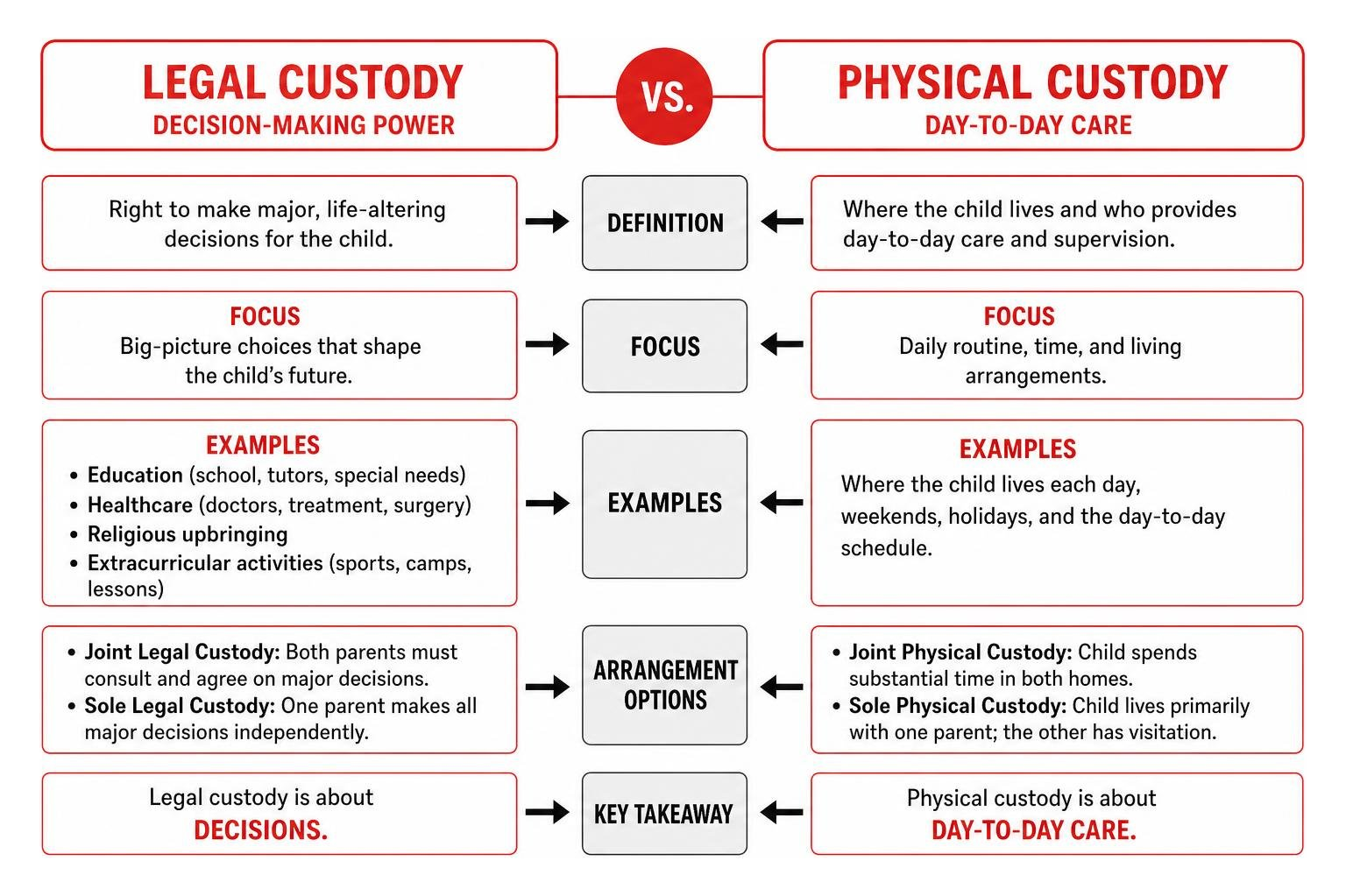
When we talk about child custody in Alabama, we are actually talking about two completely different legal concepts: legal custody and physical custody. It is incredibly common for parents to confuse these two, but understanding the difference is vital when building a parenting plan or preparing for court.
To make things simple, think of legal custody as brainwork (decisions) and physical custody as footwork (where the child actually sleeps at night). Under Alabama Code Title 30, Chapter 3, Article 7 (2025) – Joint Custody, courts can divide these responsibilities in several ways.
Legal Custody: The Decision-Making Power
Legal custody determines which parent has the right to make major, life-altering decisions for the child. These decisions generally fall into four main categories:
- Education: Which school or preschool the child will attend, tutoring needs, or special educational accommodations.
- Healthcare: Choosing doctors, dentists, therapists, and making decisions regarding elective surgeries, vaccinations, and major medical treatments.
- Religious Upbringing: Deciding which religious faith, if any, the child will be raised in and what religious milestones they will participate in.
- Extracurricular Activities: Enrolling the child in long-term sports leagues, camp programs, or music lessons that require significant time or financial investment.
Legal custody can be joint or sole. In a joint legal custody arrangement, both parents must consult each other and agree on these major decisions. If they cannot agree, they may have to return to court or use a designated tiebreaker method. In a sole legal custody arrangement, one parent has the unilateral right to make these decisions without the other’s consent.
Physical Custody: Where the Child Lives
Physical custody refers to the physical care and supervision of the child on a day-to-day basis.
- Sole Physical Custody: The child lives primarily with one parent (the custodial parent), while the other parent (the non-custodial parent) has rights to visitation according to a set schedule.
- Joint Physical Custody: The child spends frequent and substantial amounts of time living with both parents. This does not necessarily mean a perfect 50/50 split down to the minute, but it ensures the child maintains a regular, deeply rooted daily life in both households.
Here is a quick reference table to help you visualize how these roles interact:
| Custody Type | Joint Arrangement | Sole Arrangement |
|---|---|---|
| Legal Custody (Decision-Making) | Both parents must mutually agree on major school, medical, and religious choices. | One parent makes all major decisions independently; no consent is required from the other. |
| Physical Custody (Living Arrangements) | Child spends substantial, split time living in both households (e.g., alternating weeks). | Child lives primarily with one parent; the other parent receives scheduled visitation. |
Joint Custody Presumption and HB53
A major legal shift occurred in Alabama family law recently. Under the legislative act HB53 ENGROSSED, which took effect on October 1, 2025, the state established a rebuttable presumption that joint legal custody and substantial parenting time with both parents is in the child’s best interest.
This means that when you walk into an Alabama courtroom, the judge starts with the assumption that the child should have active, robust relationships with both parents. However, a “rebuttable presumption” means this starting point can be challenged. If one parent can present a preponderance of evidence showing that joint custody would harm the child—due to abuse, neglect, or extreme conflict—the judge can rule otherwise.
When evaluating Who Gets Custody?, courts will look closely at each parent’s history and ability to cooperate. If both parents actively request joint custody, the presumption becomes even stronger, and the court is highly likely to grant it unless specific, documented evidence proves it would be detrimental to the child.
How Alabama Courts Determine the Best Interest of the Child
If parents cannot agree on a custody arrangement, the decision falls to an Alabama circuit court judge. The guiding star for every single custody decision in our state is the “best interest of the child” standard.
Judges do not care about rewarding one parent or punishing the other. They are solely focused on creating an environment where the child can feel safe, loved, and stable. Under Alabama Code §30-3-152 (2024), the court must evaluate several statutory and common-law factors to determine what arrangement serves the child’s best interests:
- The Primary Caretaker History: Who has historically handled the daily tasks of parenting? The court looks past sudden, last-minute bursts of involvement during litigation. They want to know who was actually packing lunches, scheduling doctor appointments, helping with homework, and managing bedtime routines before the custody battle began.
- The Mental and Physical Health of Each Parent: The court evaluates whether a parent is physically and mentally fit to care for a child. It is important to note that seeking help for situational depression or anxiety during a divorce is normal and is generally not held against a parent, provided they are actively managing their health.
- Stability and Continuity: Children thrive on routine. Judges prefer arrangements that cause the least amount of disruption to the child’s school, friendships, and community ties.
- The Child’s Preference: While there is no magic age in Alabama at which a child can choose where they want to live, the court may consider the preference of a child if they are of “sufficient age and maturity.” However, this is only one factor among many, and judges are highly skilled at spotting when a child has been coached or is simply choosing the more permissive parent.
- Parental Cooperation: Can the parents communicate civilly? A judge is far less likely to award joint physical custody if the parents cannot exchange simple text messages about the child without starting a war.
The Impact of Domestic Violence and Parental Fitness
Certain factors act as immediate red flags for family court judges. When issues of safety and parental fitness arise, Alabama law steps in with strict guidelines to protect children from harm.
According to Alabama Custody | WomensLaw.org, a finding of domestic or family violence creates a rebuttable presumption that it is not in the child’s best interest for the abusive parent to have sole or joint custody.
Here are some other critical rules regarding parental fitness in Alabama:
- Absence Due to Abuse: If a parent flees the family home or relocates specifically to escape domestic violence, the court cannot use this absence against them as “abandonment” or a lack of interest in the child.
- Sex Crime Convictions: Any parent convicted of rape in the first degree, sodomy in the first degree, or incest will have their parental rights terminated under Alabama law.
- Abandonment: If a parent completely abandons a child for a continuous period of four months, Alabama law establishes a rebuttable presumption that the parent is either unwilling or unable to care for the child, paving the way for the other parent (or a guardian) to seek sole custody.
- Substance Abuse: Active drug or alcohol dependency is a major factor. Courts frequently order drug testing and will require a documented record of treatment and long-term sobriety before allowing unsupervised visitation.
Who Can Seek Custody and Visitation in Alabama?
Generally, biological or adoptive parents have the primary right to seek custody. However, the legal landscape looks slightly different depending on your relationship status or your biological connection to the child.
Unmarried Parents
When a child is born to unmarried parents in Alabama, the mother automatically holds sole physical and legal custody at birth. For a father to establish custody or visitation rights, he must first legally establish paternity.
If you are navigating this process, working with a Family Lawyer in Mobile AL: Your Legal Rights as Unmarried Parents is crucial. Once paternity is legally established, the father has the exact same legal standing as a married father, and the court will apply the standard “best interest” test to determine custody and visitation schedules.
Non-Parents and Grandparents
Can someone other than a parent get custody? Yes, but the legal hurdle is incredibly high. Under Alabama law, a non-parent (such as an aunt, uncle, or adult sibling) must prove by clear and convincing evidence that the biological parents are legally unfit to care for the child.
Grandparents often seek visitation rights, especially after a divorce or the death of a parent. However, the U.S. Supreme Court has ruled that fit parents have a fundamental right to decide who interacts with their children.
According to Custody – Families and Children | AlabamaLegalHelp.org, Alabama allows grandparents to file for visitation, but they must overcome a strong legal presumption that the parent’s decision to deny visitation was reasonable. Furthermore, to prevent parents from being constantly dragged into court, a grandparent can only file a petition for visitation once every two years, unless they can demonstrate “good cause” to file more frequently.
Navigating the Legal Process and Court Procedures

Entering the court system can feel like stepping onto another planet. Understanding the procedural roadmap can help demystify the experience and lower your anxiety.
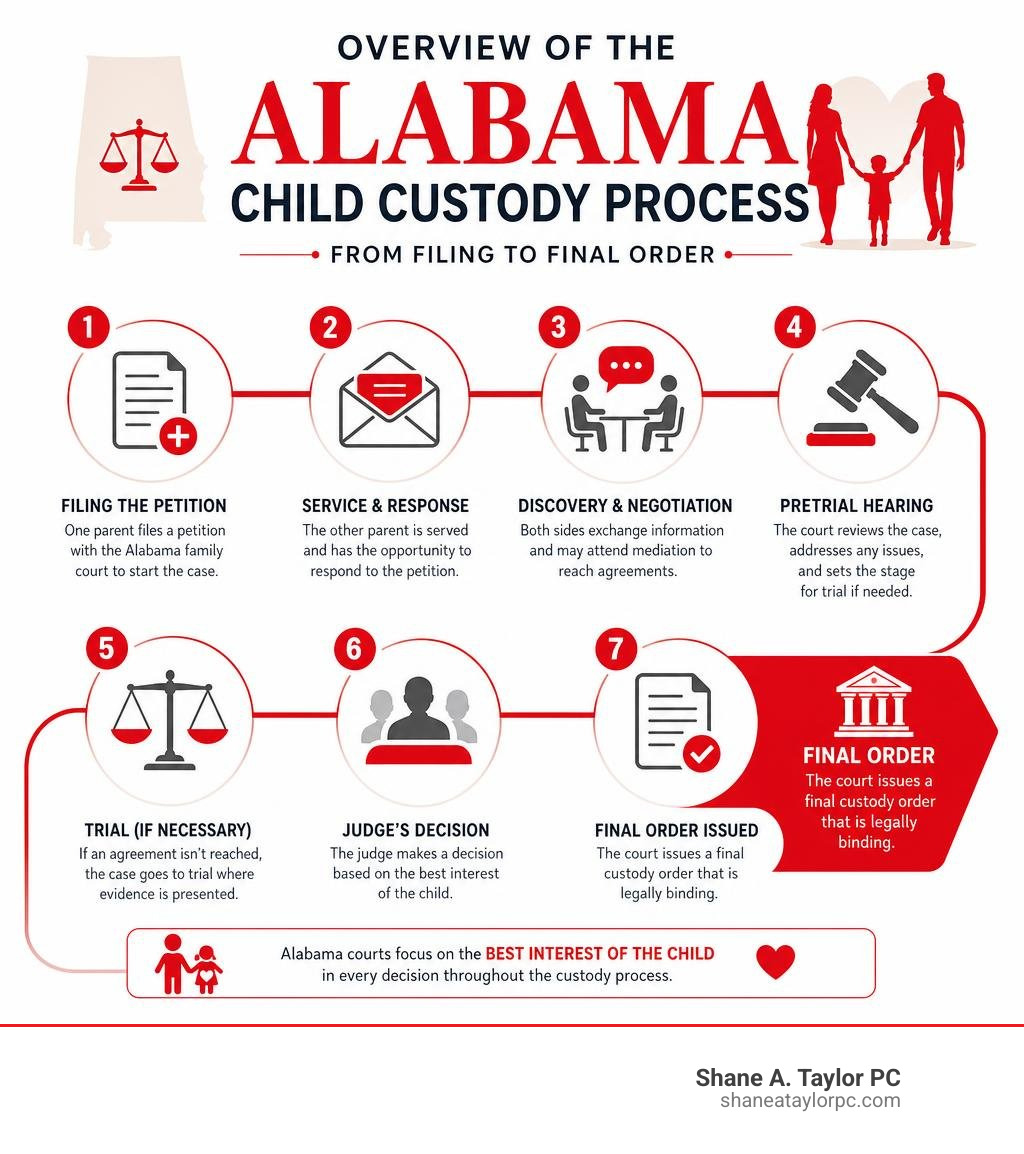
Initiating Your Alabama Child Custody Case
To kick off an initial child custody case, you must file an official petition. Under Alabama rules, if this is the very first time custody is being addressed for the child, you must use Form PS-05 (First Petition for Child Custody).
- Where to File: You must file this petition in the circuit court of the county where the child currently resides.
- The Home State Rule: Under the Uniform Child Custody Jurisdiction and Enforcement Act, found in the Code of Alabama – Alabama Legislature, a state only has jurisdiction to make an initial custody determination if it is the child’s “home state”—meaning the child must have lived in Alabama with a parent for at least six consecutive months immediately before the filing of the case (or since birth if the child is less than six months old).
When you file, you are also initiating a broader legal action. If you are also seeking a divorce, custody will be handled as part of that larger proceeding. For a detailed look at how these processes overlap, read our guide So You Want a Divorce?.
The Role of Court-Appointed Professionals
In highly contested cases, the judge may bring in objective professionals to protect the child’s interests:
- Guardian Ad Litem (GAL): A GAL is an attorney appointed by the court specifically to represent the child. They will interview you, the other parent, teachers, and doctors, and make a formal recommendation to the judge regarding what custody arrangement is truly in the child’s best interest.
- Forensic Psychologists: A judge may order both parents and the child to undergo a family psychological evaluation. While judges are not legally bound by the psychologist’s final report, they rely heavily on these findings.
Temporary and Emergency Custody Orders
Sometimes, you cannot wait months for a final trial. If your child is in immediate danger of physical harm, or if the other parent is threatening to abduct the child and flee the state, you can seek immediate relief.
According to Alabama Child Custody Laws (2026), a parent can request temporary emergency custody through:
- An Ex Parte Emergency Motion: This is a request to the judge to grant temporary custody immediately without a full hearing, usually decided within 24 to 48 hours based on written affidavits showing immediate, irreparable harm.
- A Protection from Abuse (PFA) Order: If there is a history of domestic violence, a parent can file for a PFA order. A judge can award temporary custody of the minor children to the protective parent as part of the PFA to ensure their safety until a formal custody hearing can be scheduled.
Any emergency order is strictly temporary. The court will always schedule a follow-up hearing shortly after to allow both sides to present their full cases.
Modifying Custody Orders and Relocation Rules
Life changes. Jobs are lost, parents relocate, and children grow older. Because of this, child custody orders are never truly “permanent” until the child reaches the age of 19. However, changing a court order requires navigating strict legal hurdles.
Modifying an Alabama Child Custody Agreement
If you want to change an existing custody order, you must file Form PS-07 (Petition for Modification). Simply wanting a change is not enough; you must satisfy the rigorous McLendon standard, which is one of the toughest legal standards in Alabama family law.
To win a custody modification, the parent seeking the change must prove three things:
- There has been a material change in circumstances since the last custody order was signed.
- The proposed change in custody will materially promote the child’s welfare and best interests.
- The benefits of the custody change will outweigh the disruptive disruptive impact of uprooting the child from their current routine.
Child Support Adjustments
A custody modification almost always triggers a recalculation of child support under Rule 32 of the Alabama Rules of Judicial Administration.
- The 10% Threshold: A child support order can be modified if there is a material change in circumstances, which is legally presumed if the newly calculated support amount under the guidelines differs by 10% or more from the current ordered amount.
- Shared Custody Adjustments: If the court awards shared physical custody where the child spends equal time with both parents, the court utilizes Form CS-42-S, which applies a 150% multiplier to the basic support obligation to account for the duplicate household expenses of both parents.
Relocation and the Parent-Child Relationship Protection Act
If you have primary physical custody or joint physical custody, you cannot simply pack up and move away with your child. Alabama’s Parent-Child Relationship Protection Act governs relocations.
If a parent intends to move the child’s principal residence more than 60 miles away (or across state lines, regardless of distance), they must follow strict rules:
- Written Notice: The relocating parent must send a detailed written notice to the other parent via certified mail at least 45 days before the proposed move.
- The Right to Object: The non-relocating parent has 30 days from receiving the notice to file a formal objection in court.
- The Burden of Proof: If an objection is filed, the court will hold a hearing. The relocating parent must show that the move is made in good faith and is in the child’s best interest. If they fail to prove this, the judge may deny the relocation or transfer custody to the non-moving parent.
Frequently Asked Questions About Alabama Child Custody
At what age can a child choose which parent to live with in Alabama?
There is no specific age at which a child can make this choice. In Alabama, a child remains a minor until they turn 19. While a judge will listen to the preference of an older, mature teenager, the child’s preference is never the deciding factor. The judge will evaluate the child’s reasoning to ensure they aren’t simply being manipulated or choosing the parent who has fewer rules.
What are the typical visitation rights for non-custodial parents?
If one parent has sole physical custody, the other parent is typically granted a standard visitation schedule. While schedules vary by judge, a common framework includes:
- Alternating weekends (usually Friday evening to Sunday evening)
- Alternating major holidays (Thanksgiving, Christmas, Spring Break)
- Several weeks of uninterrupted time during the summer school break
- The 150-Mile Rule: If the non-custodial parent lives more than 150 miles away, the weekly alternating schedule becomes impractical, and the court will transition to a schedule focused on longer, consolidated blocks of time during school breaks.
- Supervised Visitation: If there is a history of substance abuse, domestic violence, or severe neglect, the judge may order that all visitation take place under the direct supervision of a professional supervisor or a trusted family member.
What are the most common child custody mistakes parents make?
In our years of practicing family law in Mobile, we have watched well-meaning parents make critical errors that severely damaged their custody cases. The most common mistakes include:
- Using Children as Weapons: Withholding visitation to punish the other parent or bad-mouthing them in front of the children. Judges despise parental alienation and will quickly strip custody from a parent who tries to destroy the child’s bond with the other parent.
- Allowing Emotions to Control Decisions: Sending angry, impulsive text messages or emails. Remember: every single text, email, and social media post you write can be printed out and handed to the judge.
- Failing to Prepare: Going into a custody dispute without documentation of your daily involvement in your child’s life.
- Assuming Maternal Preference: Some fathers assume the court will automatically favor the mother. Alabama law is completely gender-neutral; the old “tender years” doctrine has been abolished, and fit fathers have an equal right to seek primary custody.
To avoid these pitfalls, it is vital to know What to Look for in a Good Divorce Attorney who understands how to build a clean, evidence-based case.
Conclusion
At the end of the day, your children are your entire world. Navigating the complexities of alabama child custody laws is not something you should ever attempt to do alone. The legal choices you make today will shape your child’s environment, routines, and relationships for years to come.
At Shane A. Taylor PC, we are proud to serve families throughout Mobile, AL, and the surrounding areas. Our highly praised, client-focused team is dedicated to providing professional, responsive, and deeply compassionate representation. We know how much is on the line, and we are here to deliver the strong results you need to protect your family’s future.
If you are facing a custody dispute, preparing for a divorce, or need to modify an existing custody order, let us stand in your corner. Contact us today to learn more about our Family Law Services and schedule a consultation.