


Choosing a Family and Estate Lawyer When Your Family Is Changing
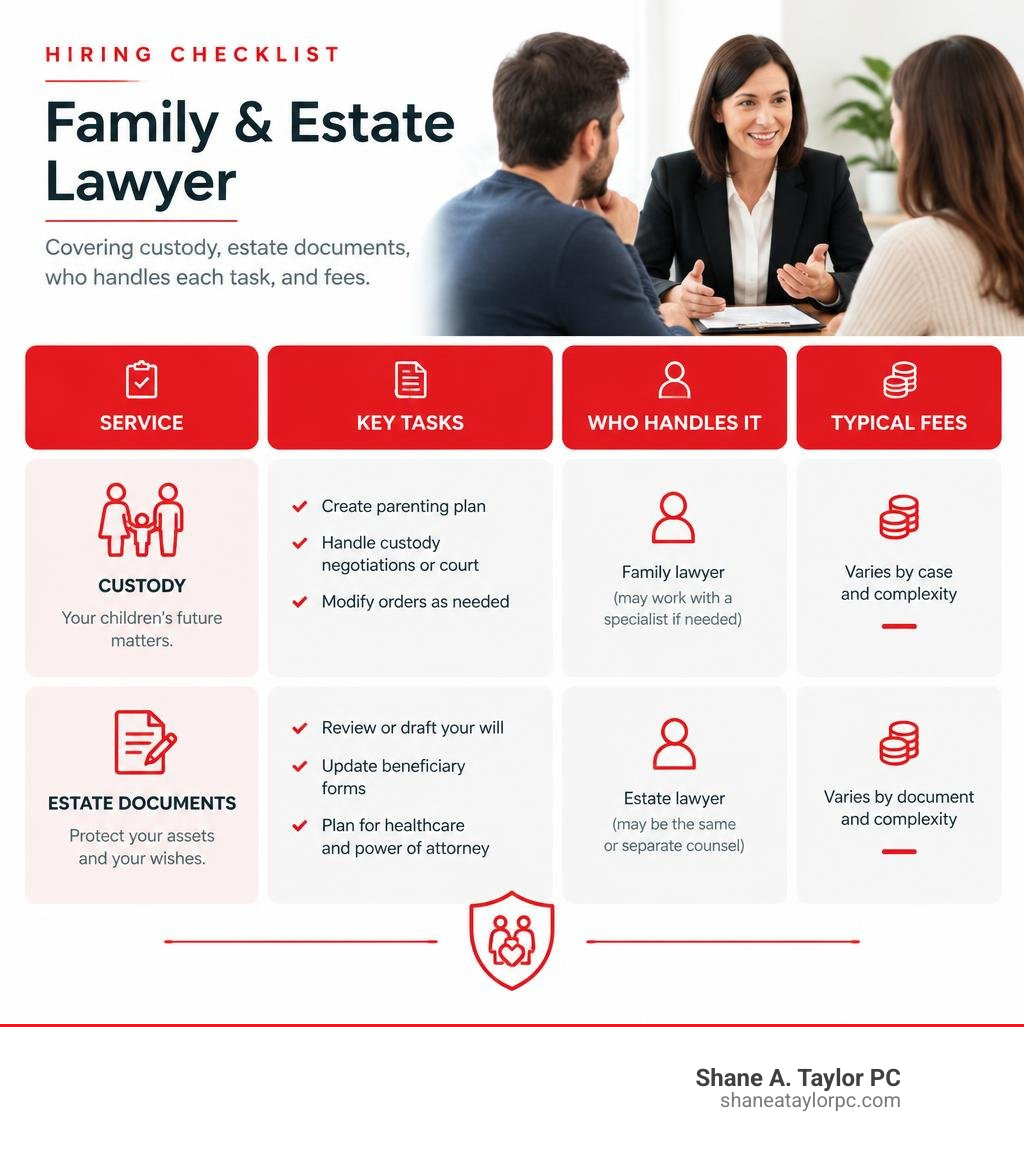
If you are facing divorce or a custody dispute, a family and estate lawyer can help you consider both your parental rights and what happens to your assets if you die. Before hiring one, ask who will handle your family case, who will review your will and beneficiary forms, whether estate work needs separate counsel, and what each service will cost.
I’m Shane A. Taylor, an attorney at Shane A. Taylor PC in Mobile, where our team handles divorce and custody cases. My years working in Alabama courts inform the practical questions I suggest asking a family and estate lawyer as you plan for your children’s future.
Learn more about family and estate lawyer:
Why You Need a Dual Family and Estate Lawyer for Complete Protection

When major life transitions hit—whether welcoming a child, navigating a difficult split, or remarrying—family dynamics and property rights collide. Handling these legal matters separately often creates dangerous blind spots. A family law order might resolve child support or divide retirement accounts, but if your estate documents still name an ex-spouse as your primary beneficiary or health care surrogate, your true intentions remain vulnerable.
By coordinating marital decisions with estate goals, you protect your children, your wealth, and your peace of mind under one cohesive strategy. If inheritance disputes or custody fights escalate into courtroom litigation, navigating court battles with a probate family lawyer ensures that your parental authority and property rights are actively defended.
Resolving Custody, Support, and Divorce with a Family and Estate Lawyer
Divorce and separation fundamentally reshape your family’s financial and legal foundation. During a contested divorce or child support determination, you must address immediate concerns like parenting schedules and spousal maintenance alongside long-term legacy considerations.
For comprehensive strategies regarding custody disputes and support orders, our family law attorney guide outlines key benchmarks used by Alabama courts. Furthermore, establishing paternity and securing parenting time requires an understanding of your legal rights as unmarried parents, ensuring that both custodial and inheritance rights for your children are preserved from day one.
Protecting Marital Assets with Valid Prenuptial Agreements and Mediation
A prenuptial agreement is one of the most effective tools for protecting family-owned businesses, separate property, and inheritances before entering a marriage. To be legally binding, a prenuptial agreement must satisfy specific legal requirements:
- It must be in writing and signed voluntarily by both parties.
- It must be executed without fraud, misrepresentation, duress, or undue pressure.
- Both spouses must provide a fair, full, and accurate disclosure of all assets, debts, and income streams.
When family disputes arise, mediation serves as an alternative dispute resolution method that saves time, lowers legal expenses, and keeps sensitive financial matters out of public records. Mediation allows spouses to negotiate customized parenting plans and property divisions with the help of a neutral mediator before stepping into a courtroom.
Integrating Business Entities and Family Limited Partnerships into Family Law
When entrepreneurs and property owners build family wealth, choosing the right business entity directly impacts divorce settlements and legacy transfers:
- Corporations vs. General Partnerships: Starting a business as a corporation or limited liability company (LLC) provides vital liability shields that protect personal family assets from company creditors, unlike general partnerships where partners share unlimited personal liability.
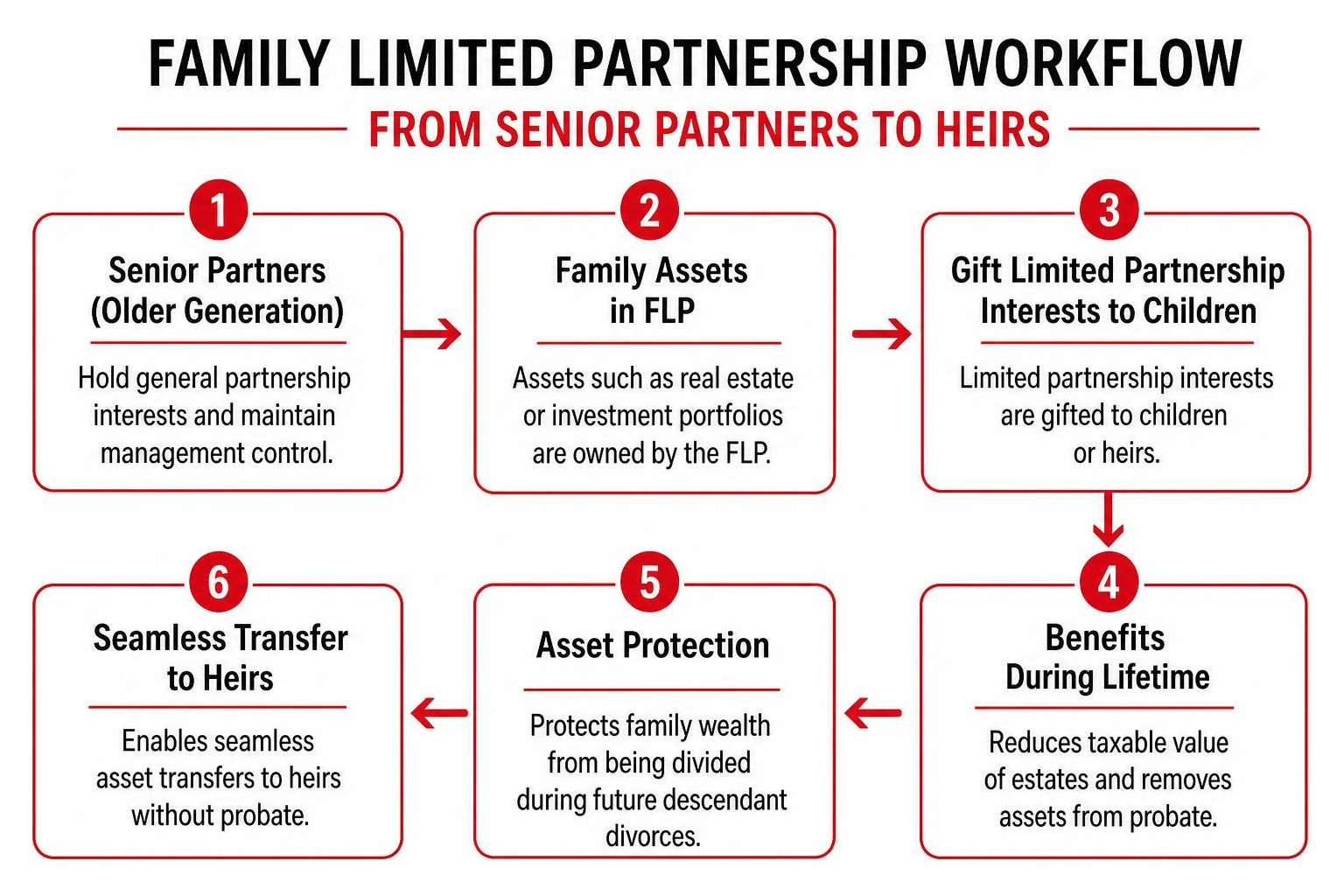
- Family Limited Partnerships (FLPs): In an FLP, older generations hold general partnership interests to maintain management control over family assets (such as real estate or investment portfolios), while gifting limited partnership interests to children or heirs. This structure allows seamless asset transfers without probate, reduces the taxable value of estates, and protects family wealth from being divided during future descendant divorces.
Comprehensive Estate Planning: Essential Documents, Trusts, and Property Transfers

Estate planning is not solely about what happens after you pass away; it also protects your family if you experience sudden incapacity. Ensuring your documents adhere to state bar standards for estate planning guarantees that your instructions remain enforceable in court.
Key Documents: Wills, Durable Powers of Attorney, and Healthcare Directives
A solid estate plan consists of several complementary legal instruments:
- Last Will and Testament: Outlines who receives your property, names an executor (personal representative) to administer the estate, and nominates guardians for your minor children. To be legally valid, a will must be in writing, signed by the testator (or signed at their direction), and executed in the presence of at least two competent witnesses who also sign the document.
- Durable Power of Attorney: Appoints a trusted agent to manage financial, banking, real estate, and legal matters on your behalf if you become incapacitated, remaining effective even during cognitive decline.
- Healthcare Surrogate and Living Will: Appoints a medical proxy to make healthcare decisions on your behalf and provides clear directives regarding life-prolonging procedures, palliative care, and end-of-life treatments.
Wills vs. Revocable Living Trusts: Choosing the Right Asset Protection Vehicle
Choosing between a will and a revocable living trust depends on your family structure, privacy goals, and asset complexity.
| Feature | Last Will & Testament | Revocable Living Trust |
|---|---|---|
| Probate Requirement | Must go through probate court before assets transfer | Bypasses probate completely for funded assets |
| Privacy | Becomes a public court record upon filing | Remains entirely private and confidential |
| Incapacity Management | Does not manage assets during lifetime incapacity | Successor trustee manages assets immediately if incapacitated |
| Upfront Cost | Lower initial drafting cost | Higher initial setup and funding cost |
| Asset Administration | Subject to statutory creditor claim delays | Immediate distribution according to trust terms |
A revocable living trust allows the grantor to retain complete control over property during their lifetime while designating successor trustees to distribute assets seamlessly upon death. Pairing a trust with a “pour-over will” ensures any overlooked property is automatically transferred into the trust.
Lady Bird Deeds, Homestead Exemptions, and Long-Term Care Medicaid Planning
Transferring real estate efficiently requires specialized property deeds and elder care strategies:
- Enhanced Life Estate Deeds (Lady Bird Deeds): These deeds allow homeowners to retain full rights to use, sell, or mortgage their property during life, while automatically transferring title to named beneficiaries upon death without going through probate court.
- Homestead Protection: Homestead exemptions shield primary residences from forced sales by certain creditors and preserve housing stability for surviving spouses and minor children.
- Medicaid & Long-Term Care Planning: Nursing home care costs can deplete a lifetime of savings. Medicaid planning structures personal assets, income limits, and lawful look-back transfer strategies to help seniors qualify for assisted care benefits while preserving an inheritance for their heirs.
Navigating Probate Administration, Estate Litigation, and Multi-State Property
When an individual passes away holding property titled solely in their individual name, their estate must be settled through court-supervised probate administration.
Formal Administration, Summary Probate, and Intestate Succession Rules
The probate path depends on the value of the estate and the presence of a valid will:
- Formal Probate Administration: Required for larger estates, complex assets, or contested inheritances. It involves appointing a personal representative, issuing formal creditor notices, filing comprehensive accountings, and receiving court approval before final asset distributions.
- Summary Administration: A streamlined, cost-effective alternative available for smaller estates (or when the decedent has been deceased for more than two years), allowing heirs to receive assets within weeks rather than months.
- Intestate Succession: If someone dies without a valid will, state intestacy statutes dictate how assets are divided. Default distribution laws pass property to surviving spouses, biological or adopted children, parents, and siblings based on a rigid statutory hierarchy, regardless of personal wishes or blended family dynamics.
Executor Duties, Creditor Claims, and Ancillary Probate for Out-of-State Assets
Serving as a personal representative carries strict fiduciary obligations. Executors who mismanage funds or fail to provide transparent accountings face personal financial liability.
- Managing Creditor Claims: Executors must publish notice to creditors in a local newspaper and send direct notice to known creditors. Creditors have a strict statutory window to file formal claims against the estate; claims submitted after this deadline are permanently barred.
- Vehicle and Personal Property Titles: Resolving vehicle ownership after a death requires submitting estate documentation to licensing authorities, as outlined in official procedures on how to apply for title if the owner is deceased.
- Ancillary Probate: If a decedent owned real estate in multiple states (such as a vacation home or rental property), an ancillary probate proceeding must be opened in each respective jurisdiction to clear title and transfer real property lawfully.
Resolving Contested Wills, Undue Influence Claims, and Trust Disputes
Probate disputes often occur during times of grief. Common grounds for challenging a will or trust include:
- Lack of Testamentary Capacity: Demonstrating the decedent suffered from dementia or mental incapacity and did not understand the nature of their estate when executing the document.
- Undue Influence: Proving a caregiver, relative, or advisor exerted improper pressure, overriding the testator’s free will to alter inheritance shares.
- Improper Execution or Fraud: Challenging documents that lack required witness signatures, show signs of forgery, or were procured through fraudulent misrepresentations.
Choosing the Best Legal Representation for Family and Estate Matters
Resolving overlapping family and estate matters requires legal counsel with courtroom readiness and deep local knowledge. When evaluating potential advocates, review our resources to find local family law attorneys and consult this practical cheat sheet to choosing family court attorneys before making your decision.
Key Factors When Selecting a Family and Estate Lawyer
- Trial Experience: Look for attorneys who are comfortable inside the courtroom and prepared to litigate contested custody battles or probate disputes if negotiations stall.
- Local Court Familiarity: Attorneys who regularly practice before local judges understand regional filing procedures, judicial preferences, and evidentiary standards.
- Responsive Communication: Choose a legal team that prioritizes clear communication, providing direct updates and transparent case roadmaps from your first consultation.
Evaluating Fee Structures, Consultations, and Cross-Practice Experience
Legal billing should be transparent from the start:
- Fee Arrangements: Routine estate drafting (such as wills and powers of attorney) is often billed on a flat-fee basis, while complex divorce litigation, contested guardianships, and formal probate administration are typically billed hourly.
- Cross-Practice Coordination: Ensuring your family law attorney understands criminal defense, asset protection, and estate rules prevents costly conflicts between marital settlement agreements and estate distribution plans.
Frequently Asked Questions About Family and Estate Law
Do I Need to Update My Estate Plan After Moving to a New State or Getting Divorced?
Yes. While wills executed out-of-state may remain valid if they met the legal requirements of that jurisdiction, state-specific rules governing homestead exemptions, spousal elective shares, and power of attorney execution differ.
Additionally, a final divorce decree typically revokes provisions in your will that benefit your ex-spouse, but it does not automatically update your revocable trusts, transfer-on-death (TOD) deeds, or direct beneficiary designations on life insurance and retirement accounts. Updating your plan immediately after relocation or divorce prevents unintended distributions.
How Does a Reverse Mortgage Affect My Heirs and Estate Distribution?
A reverse mortgage allows homeowners aged 62 and older to convert home equity into tax-free cash without making monthly mortgage payments. However, upon the borrower’s death, the total loan balance—including accrued interest and fees—becomes due.
Heirs typically have three options:
- Pay off the reverse mortgage balance to keep the family home.
- Sell the property, pay off the loan balance, and keep any remaining net proceeds.
- Sign a deed-in-lieu of foreclosure to surrender the property without personal financial liability beyond the home’s value.
How Much Does Full Estate Planning and Probate Representation Typically Cost?
Costs depend on the complexity of your estate, family structure, and whether proceedings are contested:
- Basic Estate Plans: Standard packages including a will, durable power of attorney, and healthcare directives generally range from moderate flat fees for individuals to slightly higher rates for couples.
- Trust-Based Estate Plans: Comprehensive plans featuring revocable living trusts, pour-over wills, and property deed transfers involve higher initial costs due to the detailed asset structuring required.
- Probate Administration: Summary administration for uncontested, smaller estates carries predictable flat or low hourly costs, whereas formal probate administration for contested estates involves court filing fees, publication costs, and hourly litigation billing.
Conclusion
Securing your family’s future requires balancing immediate parental responsibilities with long-term asset protection. Whether you are navigating a divorce, establishing custody, drafting a comprehensive trust, or administering a loved one’s estate, having experienced legal counsel protects your rights at every step.
At Shane A. Taylor PC, our legal team delivers client-focused representation across Mobile, Alabama. We help you navigate complex family transitions, resolve contentious disputes, and safeguard your wealth for future generations. Contact us today to explore our family law practice and schedule a consultation to protect your family and legacy.