


Core Legal Matters Handled by a Family Law Attorney
To find and vet the right family law attorney, focus on three primary criteria: proven local courtroom experience within your specific jurisdiction, dedicated focus or board certification in domestic relations, and transparent fee structures during initial consultations. Evaluating an attorney’s conflict resolution style, communication standards, and track record in complex financial or custody matters ensures your legal representation aligns directly with your case objectives.
The best attorney-client relationship also depends on practical fit. You should feel comfortable asking direct questions, sharing sensitive financial and parenting information, and receiving candid feedback about the strengths and weaknesses of your position. Domestic relations cases often move through several stages, including pleadings, temporary hearings, discovery, mediation, settlement drafting, and, when necessary, trial. A lawyer who explains each step clearly can reduce uncertainty while helping you make informed decisions instead of reacting emotionally to every new development.
Domestic relations cases involve more than just filing standard legal paperwork; they reshape your daily family structure, parental relationships, and long-term personal finances. When resolving complex domestic matters, an attorney evaluates the entire picture to safeguard your personal stability today and in the years ahead. If you are currently navigating the divorce process, you must account for intricate property dynamics, ranging from real estate equity and marital debt allocation to identifying and protecting separate property acquired prior to the marriage or received via individual inheritance.
Beyond traditional dissolution proceedings, domestic relations law encompasses urgent matters of personal safety and proactive marital planning. In high-conflict or volatile family situations, establishing emergency domestic violence protections and court-enforced protective orders is critical to secure safety before addressing property distribution or parenting schedules. For couples preparing for marriage or seeking to safeguard individual business equity and family assets during a marriage, a skilled practitioner also drafts postnuptial agreements and comprehensive prenuptial agreements designed to prevent prolonged disputes in the future. These agreements can clarify how assets, debts, income streams, retirement savings, and business interests should be treated if the marriage later ends, provided the agreement is prepared with full disclosure and proper legal formalities.
Resolving Child Custody, Visitation, and Parental Rights
Child custody disputes are often the most emotionally challenging part of any domestic relations case. In Alabama courts, judges prioritize the best interests of the child above all other competing factors. This judicial evaluation requires establishing two distinct types of custody arrangements:
- Legal Custody: The decision-making authority to make major life choices regarding a child’s education, medical care, religious upbringing, and general welfare.
- Physical Custody: The actual residential arrangements and day-to-day living schedule that dictate where the child resides throughout the week, holidays, and school breaks.
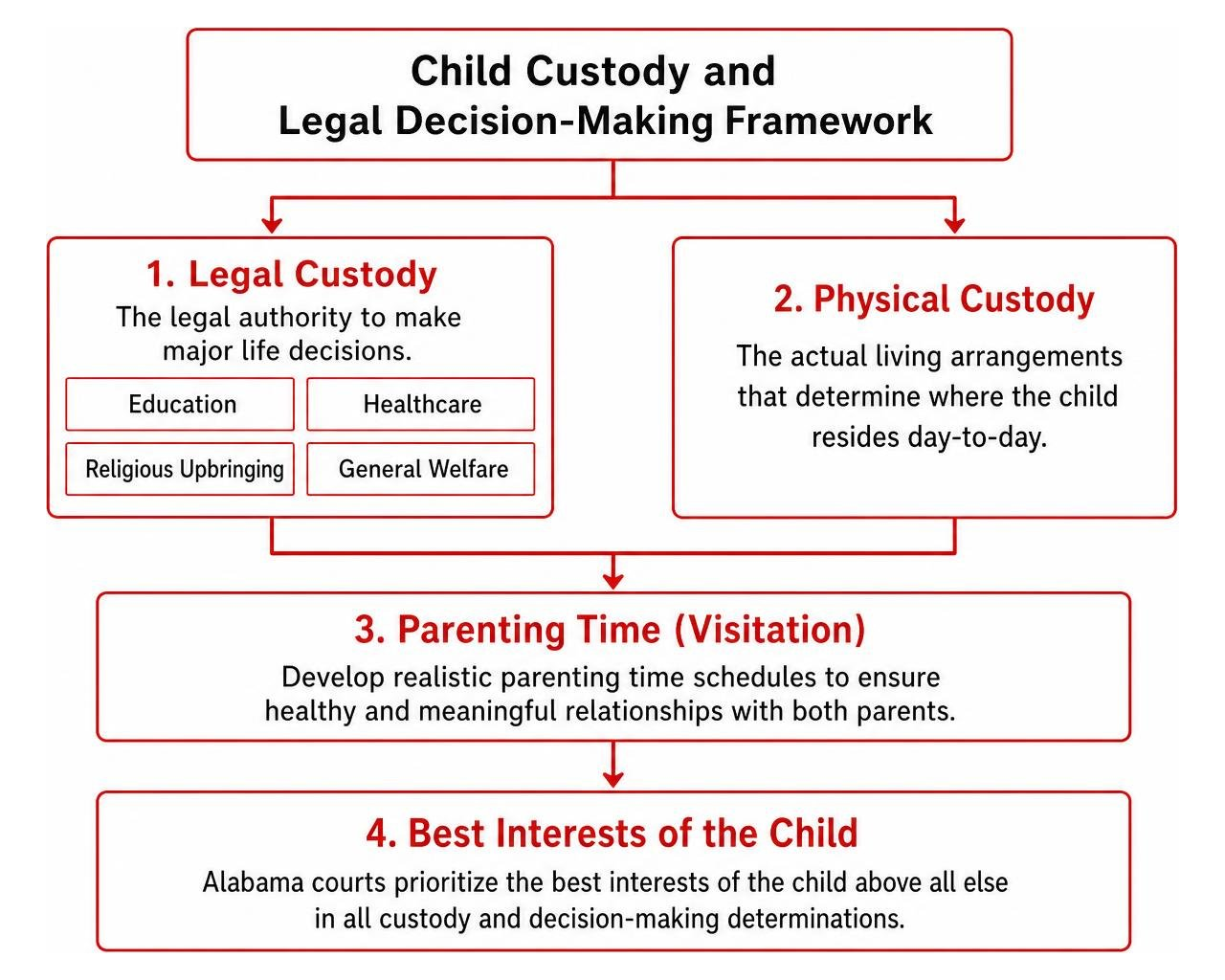
Developing realistic parenting time schedules ensures that children maintain healthy, consistent bonds with both parents whenever safe and feasible. If you are currently facing questions regarding determining child custody rights, it helps to have experienced counsel who understands local judicial standards and statutory requirements. Dedicated advocates assist clients through understanding state custody statutes, handling sensitive parental relocation requests, and establishing clear parental rights for unmarried parents through paternity actions.
A strong custody strategy should also address practical details that commonly create conflict after a decree is entered. Examples include transportation responsibilities, school-year and summer schedules, holiday rotations, communication methods, extracurricular activities, access to records, and rules for introducing new romantic partners. Addressing these issues in advance can make the final order easier to follow and reduce the likelihood of repeated post-divorce disputes.
Navigating Support Obligations and Complex Asset Division
Financial arrangements in domestic relations must be accurate, equitable, and enforceable under state law. Alabama utilizes statutory child support guidelines based on combined parental gross income, mandatory healthcare expenses, work-related child care costs, and physical custody timeshare percentages. When calculating spousal maintenance, courts examine multiple statutory factors like the length of the marriage, each spouse’s earning capacity, age, health, and standard of living established during the marriage. Reviewing spousal support and alimony guidelines provides helpful clarity on how financial need and ability to pay are evaluated by presiding judges.
For families with substantial marital estates, asset division requires rigorous financial analysis and discovery. Business valuation, forensic accounting to identify undisclosed or hidden holdings, stock option appraisals, and the proper distribution of retirement accounts via Qualified Domestic Relations Orders (QDROs) are critical components of a comprehensive financial decree. Experienced counsel can also help determine which records must be gathered early, including bank statements, mortgage documents, credit card records, business ledgers, pension statements, and insurance policies, so that negotiations begin from a complete financial picture rather than estimates or assumptions.
| Approach | Best For | Typical Timeline | Cost Level |
|---|---|---|---|
| Mediation | Couples seeking mutual agreements with lower conflict | 1 to 4 months | Lower |
| Collaborative Law | Parties committed to resolving complex issues without court | 3 to 6 months | Moderate |
| Litigation | High-conflict disputes, contested assets, or protective orders | 6 to 18+ months | Higher |
Essential Criteria for Vetting Family Legal Representation
Vetting legal representation requires evaluating whether an attorney’s courtroom experience matches the specific challenges and nuances of your case. Local jurisdiction experience is invaluable. A lawyer who appears regularly in Mobile County courtrooms understands how local judges interpret statutory factors, manage their motion dockets, and handle evidentiary disputes during hearings.
Equally important is an attorney’s overarching conflict resolution philosophy. While the goal is often to achieve cost-effective resolutions through constructive negotiation or mediation, high-stakes matters occasionally demand unyielding courtroom advocacy. Choose an advocate whose communication standards, responsiveness, client support staff, and strategic philosophy align directly with your legal priorities.
General Practitioner vs. Board-Certified Family Law Attorney
While a general practitioner handles a wide variety of unrelated legal areas ranging from traffic citations to simple wills, domestic relations law involves nuanced statutes, intricate financial discovery rules, and unique local courtroom procedures. Board certification or an exclusive focus on domestic relations indicates that an attorney has completed advanced legal training, undergone rigorous peer review, and demonstrated verified trial competency in contested domestic matters. When evaluating prospective counsel, review our tips for finding a qualified divorce lawyer to make sure your legal team possesses the depth of trial experience your case requires.
How to Interview and Evaluate a Family Law Attorney
The initial consultation gives you the opportunity to evaluate a law firm’s transparency, responsiveness, and overall competence. Inquire about fee structures upfront—whether they utilize flat-rate retainers, phased fee agreements, or traditional hourly billing. A reputable attorney will provide a candid case assessment rather than making unrealistic promises simply to secure your business.
To get the most out of your consultation, evaluate whether the attorney possesses the critical qualities in family legal counsel necessary for success: patience, strategic vision, trial readiness, and transparent billing practices. You can also research regional legal directories like verified family law practitioners on Justia to confirm bar standing, professional peer ratings, and disciplinary history.
Managing High-Conflict Disputes, Post-Judgment Modifications, and Enforcement
When domestic disputes cannot be settled through alternative dispute resolution or structured negotiation, you need a trial-tested team capable of handling contested divorce actions. High-conflict litigation requires meticulous evidence collection, expert witness testimony, comprehensive subpoena preparation, and strict adherence to formal civil rules of procedure.

Court orders are legally binding, but life circumstances naturally evolve over time. When a party experiences a substantial, material change in circumstances—such as an involuntary job loss, a significant medical diagnosis, or career-driven parental relocation—attorneys assist with petitions for support modification and custody revisions. Furthermore, if an ex-spouse willfully refuses to comply with existing court orders regarding child support payments, visitation schedules, or property transfers, filing a formal contempt of court action becomes necessary to secure judicial enforcement, attorney’s fee awards, and remedial sanctions.
Frequently Asked Questions About Family Law Representation
What should I bring to an initial legal consultation?
To make your initial legal consultation as productive as possible, bring comprehensive financial disclosures, your last three years of state and federal income tax filings, recent pay stubs, current court orders or existing decrees, detailed parenting communication records, and a concise written timeline of key factual events relevant to your dispute.
When are prenuptial and postnuptial agreements necessary?
These agreements are valuable legal tools for asset protection, shielding privately held business equity, protecting family inheritances, and pre-defining debt division before or during a marriage. A properly drafted agreement ensures marital contract validity under state statutory requirements and prevents costly, drawn-out litigation in the event of an unforeseen separation or divorce.
What warrants a post-judgment modification of custody or support?
A formal post-judgment modification requires proving a substantial, material, and ongoing change in circumstances that was not contemplated at the time the original decree was entered. Common legal grounds include involuntary income reduction, major career relocation, significant shifts in a child’s developmental and medical needs, or credible evidence that a child’s current living environment no longer serves their best interests.
Conclusion
Navigating domestic legal matters requires a focused, proactive case strategy designed to protect your parental rights and preserve your long-term financial security. Having seasoned trial attorneys on your side provides indispensable clarity, peace of mind, and procedural confidence during difficult life transitions. At Shane A. Taylor PC, we provide compassionate, straightforward, and aggressive legal advocacy tailored to your unique family goals. When you are ready to protect what matters most, consult an experienced family law attorney with our team to schedule your private consultation.