


When Your Divorce Becomes a Legal Battle: What You Need to Know
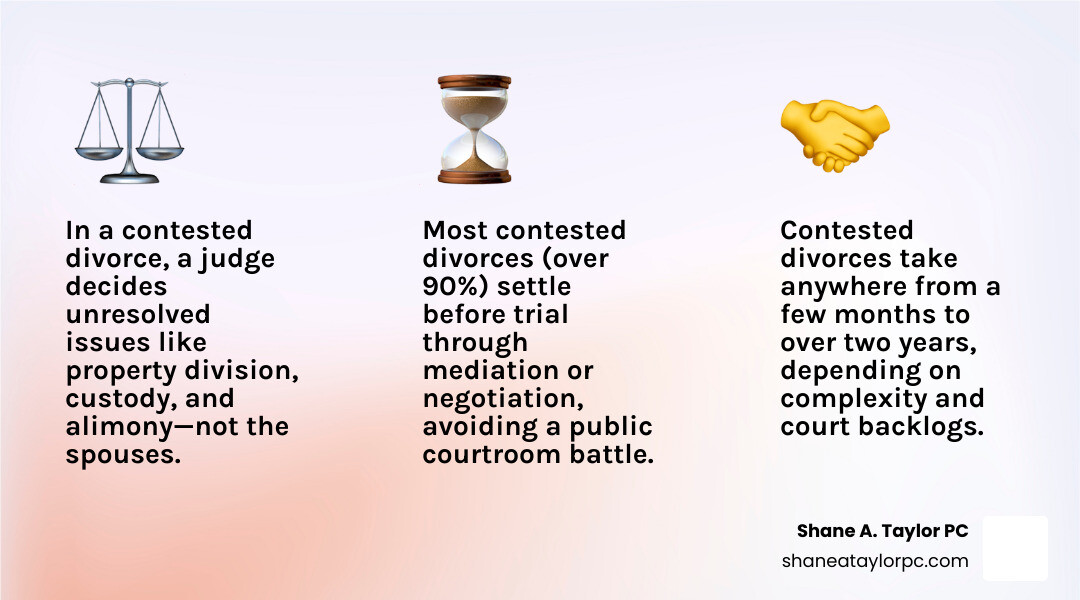
A contested divorce attorney is a family law lawyer who represents you when you and your spouse cannot agree on one or more key issues — and a judge must decide for you.
Here’s what that means at a glance:
| Question | Quick Answer |
|---|---|
| What is a contested divorce? | A divorce where spouses disagree on at least one issue requiring court resolution |
| What makes it different from uncontested? | A judge decides the unresolved issues instead of the spouses |
| What issues get contested? | Property division, child custody, alimony, debt, business assets |
| Do I need an attorney? | Yes — procedural mistakes and missed deadlines can permanently damage your outcome |
| How long does it take? | Anywhere from a few months to two or more years, depending on complexity |
| Can it settle without a trial? | Yes — most contested divorces settle before trial through mediation or negotiation |
Divorce is never easy. But when you and your spouse can’t agree, it becomes something else entirely — a structured legal proceeding with strict deadlines, mandatory financial disclosures, and a judge who has the final say over your property, your finances, and your children’s lives.
Most people want to stay out of court. A trial is a public proceeding. It exposes personal matters. It costs more and takes longer than a negotiated settlement. But when cooperation breaks down — or when one spouse is hiding assets, refusing to engage, or using the legal process as a weapon — litigation becomes necessary to protect what matters most.
The stakes are high, and the process is unforgiving for anyone who isn’t prepared.
I’m Shane A. Taylor, a trial attorney based in Mobile, Alabama, with a background in military service and over a decade of law enforcement experience — both of which shaped my approach to high-conflict legal disputes, including cases requiring a contested divorce attorney. My litigation training at Cumberland School of Law and my years in courtrooms across Alabama and Mississippi mean I understand what it takes to fight for your rights when a divorce turns adversarial.
Understanding Contested vs. Uncontested Divorce
To navigate a divorce successfully, we must first understand the fundamental fork in the road: contested versus uncontested. If you are asking yourself, “What path is my marriage dissolution taking?” the answer lies in whether you and your spouse can sit down and agree on every single detail of your separation.
An uncontested divorce means you and your spouse agree on everything. You have divided your assets, agreed on child custody, settled on child support, and determined if anyone is getting alimony. You present a signed agreement to the court, and a judge signs off on it. It is relatively quick, inexpensive, and keeps your private life out of the public record. If you are just starting to contemplate this path, our guide So You Want a Divorce can help you weigh your initial options.
A contested divorce, on the other hand, is any divorce where there is a disagreement on even a single issue. You might agree on who gets the house and how to split the bank accounts, but if you cannot agree on who gets physical custody of the kids on Thanksgiving, your divorce is legally contested.
| Feature | Uncontested Divorce | Contested Divorce |
|---|---|---|
| Decision Maker | The spouses (by mutual agreement) | A family court judge |
| Court Intervention | Minimal (administrative review) | Extensive (hearings, discovery, trial) |
| Average Timeline | A few weeks to a few months | 1 to 2+ years |
| Cost | Low, predictable flat fees | Higher, driven by hourly billing and litigation |
| Privacy | High (settlement details often kept private) | Low (courtroom trials are public record) |
When a case is contested, the court must step in. This transition completely changes the rules of engagement. Instead of informal kitchen-table negotiations, your life becomes subject to formal legal discovery, rules of evidence, and court-mandated mediation.
Grounds for Divorce: No-Fault vs. Fault-Based Options
In Alabama, when you file for a contested divorce, you must state the legal grounds for the split. Alabama law allows for both no-fault and fault-based divorces. For the statutory list of recognized grounds, see Alabama Code Section 30-2-1.
- No-Fault Grounds: The most common path is filing under “irretrievable breakdown” of the marriage or “incompatibility of temperament.” Essentially, you are telling the court that you and your spouse no longer get along, the marriage is broken beyond repair, and there is no hope for reconciliation. No one has to prove that the other person did something wrong.
- Fault-Based Grounds: If you choose to file on fault-based grounds, you are accusing your spouse of a specific wrongdoing that caused the end of the marriage. These grounds include adultery, physical cruelty or reasonable apprehension of violence, voluntary abandonment for at least one year, habitual drunkenness or drug addiction, and imprisonment.
While fault-based grounds can sometimes influence how a judge decides to divide property or award alimony, they are highly expensive and difficult to prove. For this reason, most experienced family law attorneys prefer to file on no-fault grounds while still presenting evidence of misconduct during the asset division and custody phases of the litigation.
Common Issues That Lead to a Contested Divorce
Why do divorces become contested? It rarely comes down to simple stubbornness. Usually, spouses have fundamentally different views of their financial contributions, their roles as parents, or their post-divorce needs.
The most common issues that drive couples into a courtroom include:
- The Marital Estate: Deciding who gets the family home, how to split retirement accounts, and what happens to valuable personal property.
- Debt Allocation: No one wants to walk away with the credit card debt. Deciding who is responsible for joint and individual debts accumulated during the marriage is a frequent battleground.
- Business Equity: If one or both spouses own a closely held business, determining its value and whether the other spouse is entitled to a portion of its equity is incredibly complex.
- Retirement and Pension Accounts: Splitting 401(k)s, IRAs, and military or state pensions requires specialized court orders (such as QDROs) and often leads to intense disagreement.
- Communication Breakdown: When trust is entirely gone, spouses are often unable to negotiate in good faith, turning even minor issues into major legal battles.
Child Custody and Protecting the Children
Nothing gets more emotional or fiercely contested than child custody. In Alabama, the courts operate under the “best interests of the child” standard. The judge does not care about parental grievances; they care about which parent can provide the most stable, loving, and supportive environment.
To understand how the court evaluates these situations, it helps to distinguish between the two types of custody:
- Legal Custody: The right to make major decisions about the child’s life, including education, healthcare, and religious upbringing.
- Physical Custody: Where the child physically resides.
We always advise our clients to shield their children from the legal battle as much as possible. High-conflict custody disputes can leave deep emotional scars. If you want to dive deeper into how Alabama judges make these heavy decisions, read our detailed guides on Who Gets Custody and Demystifying Alabama Child Custody Laws.
Alimony and Asset Division Disputes
Alabama is an equitable distribution state. This does not mean a strict 50/50 split of your assets. “Equitable” means fair, and what a judge deems fair depends on several factors, including the length of the marriage, the earning capacity of each spouse, who was at fault for the breakdown of the marriage, and the financial needs of each party.
This is very different from community property states like California, where assets are split down the middle. For comparison, while other states may have rigid formulas or unique alimony structures, Alabama courts look at the big picture of your financial life to determine spousal support.
Alimony (or spousal support) is designed to prevent a lower-earning spouse from falling into financial ruin post-divorce. Whether you are seeking alimony or trying to protect yourself from excessive support demands, you can learn more in our resource Spousal Support 101.
The Step-by-Step Process of a Contested Divorce
A contested divorce is not a single court date; it is a marathon. Knowing what steps lie ahead can demystify the process and help you maintain your peace of mind.
- Filing the Complaint: The process officially begins when one spouse (the plaintiff) files a Complaint for Divorce with the court.
- Serving the Papers: The complaint must be legally served to the other spouse (the defendant), often by a deputy sheriff or a private process server.
- The Response Window: Once served, the responding spouse has a strict window (typically 30 days in Alabama) to file a formal Answer. Failing to respond can result in a default judgment, where the court grants everything the filing spouse asked for.
- Temporary (Pendente Lite) Hearings: If immediate issues like child custody, child support, or who gets to live in the marital home need to be settled while the divorce is pending, the court will hold a temporary hearing.
- The Discovery Phase: This is the longest phase, where both sides gather and exchange information.
- Settlement Conferences & Mediation: Most counties in Alabama require the parties to attempt mediation before a trial date can be set.
- The Trial: If mediation fails, the case goes to trial, where a judge (not a jury) will hear testimonies, review evidence, and issue a final divorce decree.
The Role of a Contested Divorce Attorney in the Discovery Phase
The discovery phase is where a contested divorce attorney earns their keep. Discovery is the formal legal process of forcing both parties to lay all their cards on the table.
During discovery, we use several critical tools:
- Financial Disclosures: Both spouses must submit sworn financial affidavits detailing their income, assets, expenses, and debts.
- Interrogatories: Written questions that the other spouse must answer truthfully under oath.
- Depositions: Out-of-court oral testimonies where your attorney questions your spouse (or vice versa) under oath in front of a court reporter.
- Subpoenas: Legal orders sent to banks, employers, and businesses to obtain financial records directly from the source.
If we suspect a spouse is hiding assets, we may collaborate with forensic accountants to trace cash flows, evaluate business holdings, and uncover hidden accounts.
Pendente Lite Orders and Temporary Relief
Divorce litigation can take a year or more. You cannot put your life, your bills, or your parenting schedule on hold while waiting for a final trial. That is where pendente lite (Latin for “pending the litigation”) orders come in.
These temporary orders establish the ground rules for the duration of the lawsuit. A judge can issue temporary orders to determine:
- Who pays the mortgage and utility bills.
- Who has temporary primary custody of the children and what the visitation schedule looks like.
- How much temporary child support or alimony must be paid.
- Who gets exclusive use of the family vehicle or marital home.
These orders preserve the status quo and prevent one spouse from cutting off financial support or withholding the children out of spite.
Why You Need a Contested Divorce Attorney to Protect Your Rights
Attempting to represent yourself in a contested divorce is incredibly risky. Family law is complex, and the emotional weight of a divorce makes it difficult to make objective, strategic decisions. A single procedural mistake — like missing a discovery deadline or failing to properly draft a subpoena — can permanently damage your financial future or your custody rights.
An experienced family law attorney acts as your shield and your voice. We know the local court rules, we understand how local judges tend to rule on specific issues, and we know how to present evidence in a way that aligns with the law.
If you are currently searching for representation, we highly recommend reading our guides What to Look for in a Good Divorce Attorney and 7 Tips for Finding a Qualified Divorce Attorney.
How to Choose the Right Contested Divorce Attorney for Your Case
The attorney you choose will be your partner through one of the most challenging chapters of your life. When searching for the right match, keep these factors in mind:
- Trial Experience: While most cases settle, you want an attorney who is a seasoned trial lawyer. If your spouse’s attorney knows your lawyer always backs down to avoid court, you will receive worse settlement offers.
- Communication Style: You need an attorney who is responsive, direct, and speaks to you in plain English, not complicated legalese.
- Local Court Familiarity: An attorney who regularly practices in Mobile County or Baldwin County knows the local judges, the court staff, and the local procedures. If you live in South Alabama, our Foley Daphne Fairhope Divorce Guide offers excellent local insights.
To begin your search, you can use our resource Find Local Family Law Attorneys Near Me to find advocates in your area.
Timeline, Costs, and Resolving High-Conflict Obstacles
Let’s talk about the hard truths of a contested divorce: how long it takes and what it costs.

In Alabama, the mandatory waiting period for a divorce is 30 days from the date of filing. However, a contested divorce will take much longer. On average, a contested divorce in Mobile, AL, takes anywhere from 6 to 18 months, though high-asset cases or severe custody battles can easily stretch past two years.
To put this in perspective, let’s look at how timelines compare across different jurisdictions. While some states might resolve contested cases in six to twelve months, other highly populated areas can see timelines that easily exceed a year due to court backlogs. In some complex jurisdictions, a fully litigated trial can take 18 to 24 months.
The primary drivers of both time and cost are the level of conflict between the spouses and the complexity of the marital estate. Most family law firms work on a retainer basis, where you pay an upfront fee, and the attorney bills their hourly rate against that retainer. The more you and your spouse argue over minor assets, the more billable hours accumulate.
What Happens When a Spouse Hides Assets or Refuses to Cooperate?
It is unfortunately common for a spouse to try to games the system by hiding assets, underreporting income, or refusing to answer discovery requests.
When this happens, we do not simply sit back. We file a Motion to Compel, asking the judge to order your spouse to comply. If they continue to refuse, the court can issue severe sanctions, including:
- Ordering them to pay your attorney’s fees.
- Fining them for contempt of court.
- In extreme cases, granting a default judgment in your favor, meaning the court accepts your version of the financial state and divides assets accordingly.
Sustained obstruction almost always backfires on the obstructing party once they stand before a judge.
Can a Contested Divorce Become Uncontested?
Yes! In fact, the vast majority of contested divorces eventually become uncontested before a trial takes place.
As the discovery phase progresses and both sides see the evidence, expectations usually align. Mediation is a powerful tool for this. A neutral third-party mediator helps both sides find common ground. Even if you cannot agree on everything, you can reach partial agreements (for example, settling custody but leaving property division to the judge), which significantly reduces your trial time and legal expenses.
Frequently Asked Questions About Contested Divorces
How long does a contested divorce typically take?
The timeline varies depending on your county’s court backlog, the complexity of your assets, and how cooperative your spouse is. In Alabama, expect a contested divorce to take anywhere from 6 months to over a year. If child custody is heavily disputed, it can take even longer.
How much does a contested divorce cost, and who pays for it?
The cost is determined by the hourly rates of the attorneys and the number of hours required to resolve the case. Generally, each spouse is responsible for their own legal fees. However, if there is a massive income disparity, or if one spouse acts in bad faith (such as hiding assets or dragging out the litigation unnecessarily), the judge can order one spouse to pay a portion of the other’s attorney’s fees.
Do I have to go to trial if my divorce is contested?
No. Only a small percentage (about 5% to 10%) of contested divorces actually end in a full courtroom trial. Most are settled during mediation, settlement conferences, or ongoing negotiations between the attorneys. However, the best way to secure a favorable settlement is to prepare your case as if you are definitely going to trial.
Conclusion
A contested divorce can feel like a battleground, but you do not have to walk through it alone. At Shane A. Taylor PC, we provide client-focused, compassionate, and highly responsive representation to families in Mobile, AL, and the surrounding areas. Whether you are facing a complex property division dispute or fighting to protect your parental rights, our team is dedicated to delivering strong results.
If you are ready to speak with a dedicated family law attorney about your situation, visit our Family Law Practice Area page or Contact us today to schedule your consultation. We are here to help you protect your future and move forward with confidence.