


When Marriage Ends: Finding the Right Divorce Attorney in Foley, AL
Finding a divorce attorney in Foley, AL is often the first and most important step when a marriage reaches its breaking point. Whether you’re dealing with a straightforward split or a complicated custody battle, the right local attorney can make a real difference in your outcome.
Here are the top things to know right away:
- Baldwin County divorce cases are handled at the Baldwin County Circuit Court in Bay Minette
- Alabama requires at least 6 months of state residency before you can file
- Divorces can be uncontested (both spouses agree) or contested (disputes require court involvement)
- Key issues include property division, child custody, child support, and alimony
- Uncontested divorces can wrap up in a few months; contested cases may take a year or more
Divorce is never just a legal event. It reshapes your finances, your time with your children, and your daily life. For families in Foley, Daphne, and Fairhope, navigating Baldwin County’s courts without experienced guidance can leave you at a serious disadvantage.
The stakes are real — and getting the right help early matters.
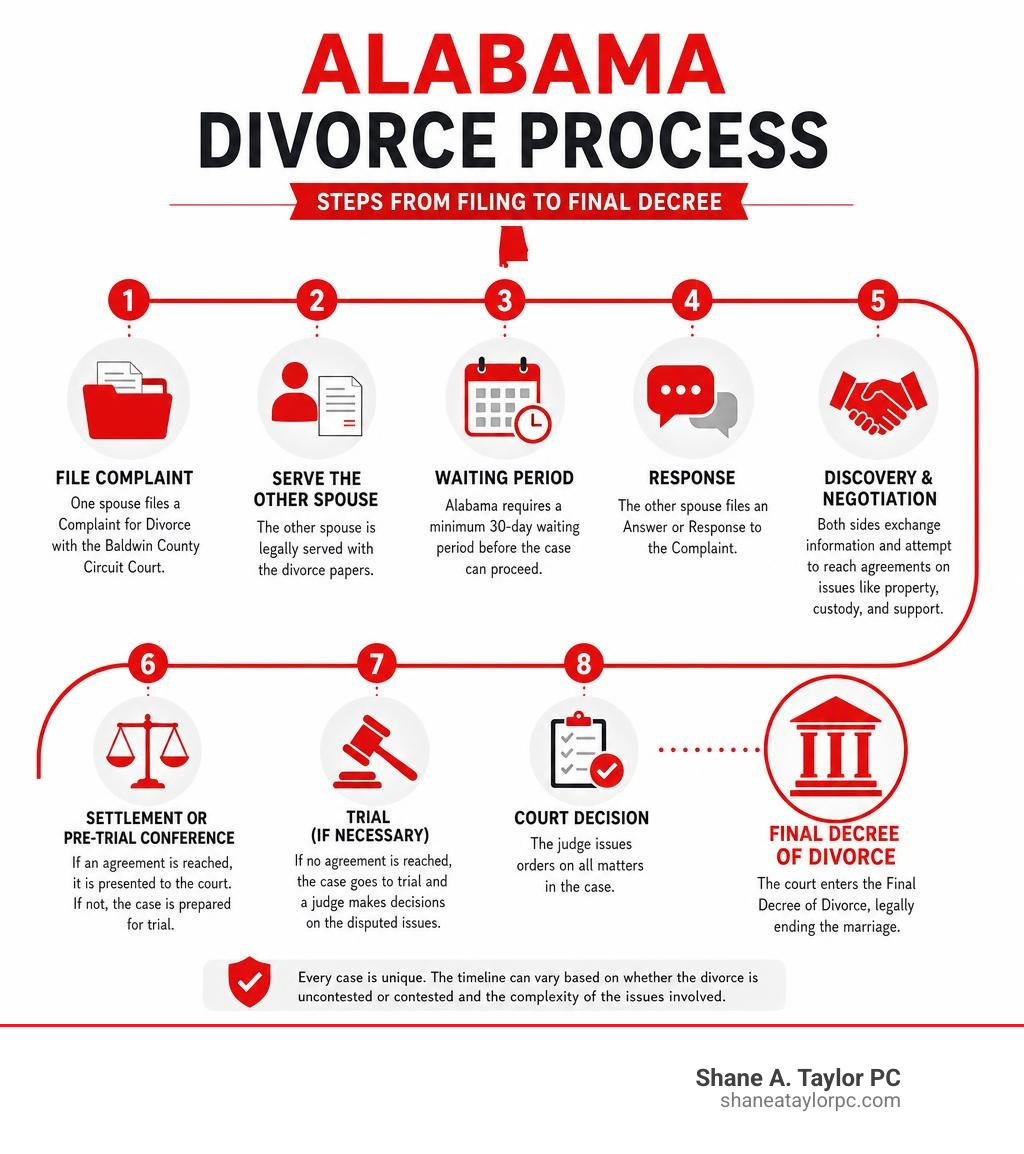
Navigating the Legal Landscape: Contested vs. Uncontested Divorce
When you decide to take the step toward ending a marriage, you will find yourself on one of two legal paths: contested or uncontested. Understanding the difference between these paths is crucial, as it dictates how long your case will take, how much it will cost, and how much control you maintain over the outcome.
An uncontested divorce occurs when you and your spouse agree on every single aspect of your split. This means there are no lingering arguments about who gets the house, how the bank accounts are split, who pays child support, or how custody is shared. You put everything into a written settlement agreement, sign it, and submit it to the court.
A contested divorce, on the other hand, means you and your spouse cannot agree on one or more of these key issues. Even if you agree on 95% of the terms, if you are stuck on who gets the family dog or how to divide a retirement account, your divorce is legally contested. This path involves filing a formal complaint, going through a discovery phase (where both sides must share financial records and other evidence), attending mediation, and potentially heading to a trial where a judge makes the final decisions.
All divorce cases for Foley, Daphne, and Fairhope residents are handled by the Baldwin County Circuit Court. If you are preparing to take this step, it is highly recommended to read our guide on So You Want a Divorce? to understand the emotional and procedural realities ahead. You can also research local legal options on the directory of Best Divorce Lawyers in Foley, AL – Justia.
To help visualize the differences between these two paths, review the comparison below:
| Feature | Uncontested Divorce | Contested Divorce |
|---|---|---|
| Agreement Level | 100% agreement on all terms | Disagreement on one or more terms |
| Average Timeline | 2 to 3 months | 12 months or longer |
| Court Appearances | Rarely required; paperwork is filed online | Multiple hearings and a final trial are likely |
| Discovery Process | Voluntary and informal | Formal, legally binding exchange of records |
| Cost | Generally lower and more predictable | Higher due to extensive legal hours and trial prep |
Legal Grounds for Filing Divorce in Alabama
Alabama allows spouses to file for divorce under both no-fault and fault-based grounds.
- No-Fault Grounds: The vast majority of modern divorces are filed under no-fault grounds. This means you do not have to prove your spouse did anything wrong to end the marriage. Instead, you cite incompatibility (you simply cannot get along anymore) or an irretrievable breakdown of the marriage (the relationship is broken beyond repair, and further attempts at reconciliation are useless).
- Fault-Based Grounds: If you choose to file on fault-based grounds, you must prove to the court that your spouse’s specific misconduct caused the marriage to end. Alabama recognizes several fault grounds, including adultery, abandonment (for at least one year), substance abuse (habitual drunkenness or drug addiction after marriage), physical violence, and imprisonment. Filing for a fault-based divorce can sometimes influence how a judge decides to divide property or award alimony, but it also makes the legal process more adversarial and expensive.
Timeline and Residency Requirements in Baldwin County
Before you can file for divorce in the state of Alabama, you must meet the six-month residency requirement. This means at least one spouse must have been a continuous, bona fide resident of Alabama for the six months immediately leading up to the filing of the divorce complaint.
Once you file the paperwork at the Baldwin County Circuit Court (located at the courthouse in Bay Minette), the clock starts. Alabama has a mandatory 30-day waiting period (often called a “cooling-off” period) from the date the summons and complaint are filed before the judge can sign the final divorce decree. Even in the most cooperative uncontested divorce, you cannot legally be divorced in less than 30 days.
Under current 2026 court schedules, a standard uncontested divorce in Baldwin County typically takes around two to three months to be finalized by a judge. Contested divorces, however, face the reality of court backlogs and scheduling conflicts. A contested case that goes all the way to trial can easily take a year or more to reach a final resolution.
Key Financial and Family Decisions in a Foley Divorce
A divorce is more than just a certificate of dissolution; it is a complex restructuring of your entire life. The decisions you make during this transition will affect your financial stability and your relationship with your children for decades to come.

When navigating these complex family dynamics, having a clear legal strategy is essential. For a deeper look into how custody decisions are made, check out our resource on Who Gets Custody?.
Equitable Distribution and Property Division Rules
Alabama is an equitable distribution state. This is one of the most common points of confusion for people going through a divorce. “Equitable” does not mean “equal” or a strict 50/50 split. Instead, it means the court will divide your assets and debts in a way that is fair based on the specific circumstances of your marriage.
The court first distinguishes between two types of property:
- Marital Property: Generally, this includes any assets, real estate, debts, and retirement savings acquired by either spouse during the marriage, regardless of whose name is on the title or account.
- Separate Property: This includes assets owned before the marriage, as well as individual gifts or inheritances received during the marriage.
However, separate property can quickly become marital property through a process called commingling. For example, if you receive an inheritance but deposit those funds into a joint bank account used to pay your family’s daily expenses, a judge may rule that the inheritance has lost its separate status and is now subject to division.
When it comes to high-value assets like the family home, the court has a few options. They may award the home to one spouse (often the primary custodian of the children) and award other assets of equal value to the other spouse. Alternatively, they may order the home to be sold and the proceeds split equitably.
Retirement accounts, such as 401(k)s and pensions, are also subject to division if they were contributed to during the marriage. To divide these accounts without triggering massive tax penalties or early withdrawal fees, your attorney must draft a specialized court order known as a Qualified Domestic Relations Order (QDRO), which instructs the plan administrator on how to split the benefits.
Child Custody, Visitation, and Support Calculations
In any divorce involving minor children, Alabama courts prioritize the best interests of the child above all else. The law strongly favors joint legal custody, which means both parents retain equal rights to make major decisions regarding the child’s education, healthcare, and religious upbringing.
Physical custody (where the child actually lives) can be joint, or it can be awarded primarily to one parent with a structured visitation schedule for the other. A comprehensive, detailed parenting plan is essential to prevent future conflicts. This plan should clearly outline:
- Weekly schedules and drop-off locations
- Holiday and summer break rotations
- Communication methods between parents
- Out-of-state travel protocols
Child support in Alabama is calculated using a standardized formula known as the Income Shares model. This model combines the gross monthly incomes of both parents, applies it to a state-established table to find the basic support obligation, and then divides that obligation proportionally based on each parent’s share of the combined income. Adjustments are made for work-related childcare costs, health insurance premiums, and the specific physical custody arrangement.
To understand how parental rights and support structures work outside of marriage, you can read our article on being a Family Lawyer in Mobile AL: Your Legal Rights as Unmarried Parents.
Alimony and Spousal Support Factors
Alimony (spousal support) is not an automatic right in Alabama. Instead, it is awarded at the discretion of the court, primarily based on one spouse’s demonstrated financial need and the other spouse’s ability to pay.
There are two main types of alimony in Alabama:
- Periodic Alimony: Regular monthly payments designed to help a financially dependent spouse maintain a standard of living reasonably similar to what they enjoyed during the marriage. Under Alabama law, periodic alimony is generally limited in duration to no longer than the length of the marriage itself (unless the marriage lasted more than 20 years).
- Alimony in Gross: A lump-sum payment (or a series of fixed payments) intended to settle the property rights between the spouses. This type of alimony cannot be modified later.
When deciding whether to award alimony, Baldwin County judges consider several factors:
- The earning capacity and work history of each spouse
- The duration of the marriage
- The age and physical health of both parties
- Any marital misconduct (such as adultery or abuse) that contributed to the breakdown of the marriage
- The financial contributions each spouse made to the marriage (including homemaking and raising children)
Unique Challenges for a Divorce Attorney in Foley AL
Practicing family law on the Alabama Gulf Coast comes with a unique set of geographic and economic challenges. A skilled divorce attorney in Foley, AL must understand these local dynamics to protect your interests:
- The Seasonal Economy: Many residents in Foley, Gulf Shores, and Orange Beach rely on tourism, hospitality, and seasonal businesses. This means their monthly income fluctuates wildly between the busy summer months and the quiet winter season. Calculating child support or alimony based on a single pay stub can lead to disastrous financial strain.
- Gulf Coast Properties: Local real estate often includes beachfront condos, vacation rentals, and investment properties. Valuing these assets requires specialized knowledge of local market trends, seasonal rental income appraisals, and the high cost of coastal property insurance.
- Agricultural Assets: Just north of the beaches, Baldwin County has deep agricultural roots. Divorces involving family farms present complex challenges, including valuing valuable equipment, separating inherited family land from marital property, and protecting the operational viability of the farm.
- Military and Gray Divorces: With our proximity to military installations, dividing military pensions and understanding federal laws like the Uniformed Services Former Spouses’ Protection Act (USFSPA) is a common necessity. Additionally, Foley’s status as a top retirement destination means we frequently handle “gray divorces” (divorces among retirees), which focus heavily on dividing fixed incomes, pensions, and long-term healthcare considerations.

Why You Need a Local Divorce Attorney Foley AL
It can be tempting to search for cheap online divorce forms and attempt to handle your split yourself. However, the legal system is unforgiving of mistakes. A single error in your paperwork can cost you thousands of dollars in lost assets, result in an unworkable custody schedule, or force you back into court years later to fix the mess.
Hiring a local attorney who routinely practices in Baldwin County offers distinct advantages:
- Familiarity with Local Courts: Every judicial circuit has its own “local rules” and administrative quirks. A local attorney knows exactly how the Baldwin County Circuit Court operates, how specific judges tend to rule on custody and alimony matters, and how to keep your case moving smoothly through the system.
- Objective Advocacy: Divorce is a highly emotional time. It is easy to make impulsive decisions out of anger, guilt, or sheer exhaustion. An experienced attorney acts as your objective voice of reason, ensuring you do not sign away your long-term financial security just to get the process over with.
- The Power of Mediation: Baldwin County judges frequently order couples to attempt mediation before a trial date is set. A local attorney who is skilled in negotiation can help you leverage mediation to reach a customized, private agreement, saving you the stress and expense of a public courtroom battle.
If you are wondering what qualities you should prioritize when choosing your legal representation, please read our guide on What to Look for in a Good Divorce Attorney.
Post-Divorce Modifications and Enforcement
A final divorce decree is a legally binding court order, but life does not stop changing once the ink is dry. As the years pass, the arrangements that worked perfectly at the time of your divorce may no longer fit your family’s reality.
When these changes occur, you may need to file for:
- Modifications: If you experience a “material and substantial change in circumstances,” you can petition the court to modify your existing custody, visitation, or child support orders. Common reasons for modifications include a parent relocating out of state, a significant change in income (such as a job loss or promotion), or a child’s changing educational and medical needs.
- Enforcement and Contempt: If your ex-spouse refuses to follow the court-ordered terms—such as failing to pay child support, denying your scheduled visitation, or refusing to sign over property—you can file a petition for rule nisi (contempt of court). A judge can enforce the original order through various means, including wage garnishment, suspending driver’s licenses, and even ordering jail time for non-compliance.
Frequently Asked Questions about Baldwin County Divorces
How long does a divorce take in Foley, AL?
An uncontested divorce in Baldwin County typically takes two to three months to be finalized after filing. If your divorce is contested, the timeline depends heavily on the complexity of your assets, how cooperative both parties are, and the court’s current backlog. A contested divorce generally takes anywhere from nine months to over a year to resolve.
How is property divided if we cannot agree?
If you and your spouse cannot reach an agreement through negotiation or mediation, your case will go to trial. A Baldwin County judge will hear arguments, review financial evidence, and divide your marital assets and debts under Alabama’s equitable distribution laws. The judge will aim for a fair division, which may not be a simple 50/50 split.
What are the benefits of hiring a divorce attorney foley al?
Hiring a local divorce attorney in Foley, AL ensures your legal rights are fully protected. Your attorney will handle all complex paperwork, accurately value your marital assets, draft a legally sound parenting plan, and advocate for your financial interests. This local expertise reduces your stress and helps prevent costly legal mistakes that could affect you for years.
Conclusion
Divorce is undeniably one of the most challenging chapters a person can face. However, it also represents the opportunity to build a healthier, more stable future for yourself and your children. You do not have to walk this difficult path alone.
At Shane A. Taylor PC, we are proud to serve families across Mobile and Baldwin counties. Our client-focused, highly responsive team is dedicated to providing compassionate guidance and strong representation in divorce, child custody, and all family law matters. We understand the local court systems, and we are ready to stand by your side as your legal champion.
If you are ready to take the first step toward your new beginning, explore our Practice Areas – Family Law page or contact our office today to schedule your confidential consultation.