


What is Alimony and How is Spousal Support Determined?
Finding the best alimony attorney near me can feel overwhelming when you’re already dealing with one of the most stressful events of your life. But the right lawyer makes a real difference — not just emotionally, but financially.
Here are the key qualities to look for in a top alimony attorney:
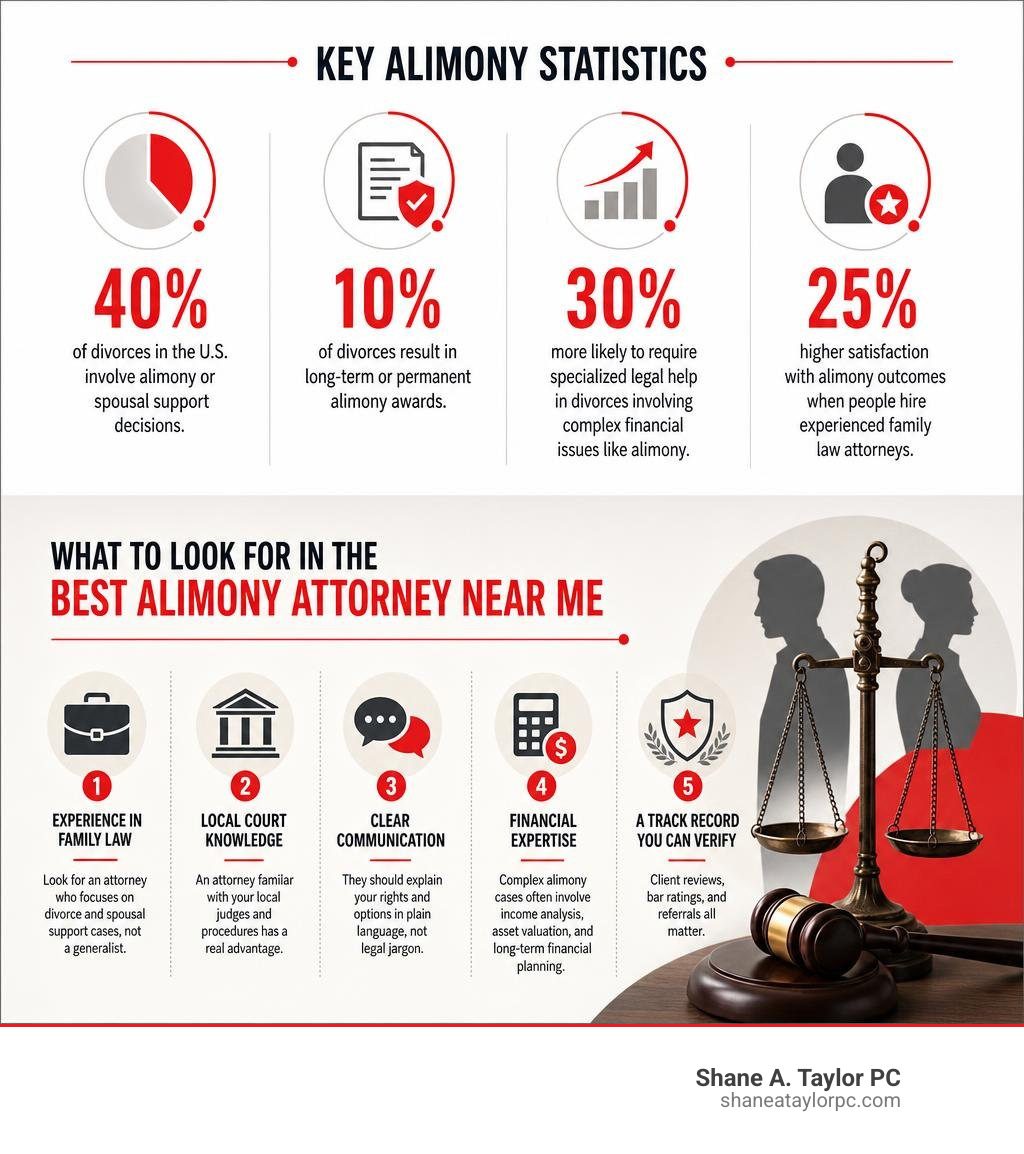
- Experience in family law — Look for an attorney who focuses on divorce and spousal support cases, not a generalist.
- Local court knowledge — An attorney familiar with your local judges and procedures has a real advantage.
- Clear communication — They should explain your rights and options in plain language, not legal jargon.
- Financial expertise — Complex alimony cases often involve income analysis, asset valuation, and long-term financial planning.
- A track record you can verify — Client reviews, bar ratings, and referrals all matter.
Divorce is hard. About 40% of divorces in the U.S. involve alimony or spousal support decisions — and the outcome can shape your financial life for years. Yet only around 10% of divorces result in long-term or permanent alimony awards, which means most cases require careful negotiation backed by solid legal strategy.
Going it alone is risky. Research shows that divorces involving complex financial issues like alimony are 30% more likely to require specialized legal help — and people who hire experienced family law attorneys report 25% higher satisfaction with their alimony outcomes.
Whether you’re the spouse seeking support or the one being asked to pay, getting the right attorney in your corner early is one of the most important decisions you’ll make.
Alimony, often referred to as spousal support or spousal maintenance, is a court-ordered financial payment made by one spouse to the other during or after a divorce. The core purpose of alimony is to limit any unfair economic effects of a divorce by providing an ongoing income stream to the non-earning or lower-earning spouse.
In Alabama, the court does not hand out spousal support automatically. Instead, judges carefully evaluate several key factors to determine if alimony is appropriate. The legal framework rests heavily on two primary pillars:
- Financial Need: The receiving spouse must demonstrate a genuine financial need for support to maintain a standard of living reasonably close to what they enjoyed during the marriage.
- Ability to Pay: The paying spouse must have the financial resources and earning capacity to provide that support without facing undue financial ruin themselves.
When you begin asking yourself, “So You Want a Divorce?“, understanding how these two factors interact is crucial. The court will look closely at your marital standard of living—how you lived, where you shopped, and what your monthly expenses looked like—to establish a baseline. However, because maintaining two separate households is inherently more expensive than maintaining one, judges must balance the ideal standard of living with the practical reality of both parties’ post-divorce income.
Alimony vs. Child Support: Key Differences
It is common to confuse alimony with child support, but they serve completely different legal and financial purposes. While both involve domestic support obligations, child support is specifically designed to cover the basic needs of minor children, whereas alimony is meant solely to assist a former spouse.
If you are navigating a divorce that involves children, determining Who Gets Custody? will directly impact child support calculations, but it is only one of many pieces considered when negotiating spousal maintenance.
| Feature | Alimony (Spousal Support) | Child Support |
|---|---|---|
| Primary Beneficiary | The ex-spouse | The minor children |
| Calculation Basis | Financial need, ability to pay, marriage length, and judicial discretion | Standardized state guidelines based primarily on parental income |
| Tax Treatment (Post-2018) | Not tax-deductible for payer; not taxable income for recipient | Not tax-deductible for payer; not taxable income for recipient |
| Termination Event | Remarriage of recipient, cohabitation, death, or expiration of term | Child reaches the age of majority (19 in Alabama) or becomes emancipated |
The 4 Main Types of Spousal Support in 2026

As of July 2026, the landscape of spousal support emphasizes helping the lower-earning spouse transition to financial independence rather than providing a lifetime guarantee of support. Under current Alabama laws, courts favor structured, time-limited awards.
Depending on your unique circumstances, a judge may award one or more of the following four types of alimony:
- Temporary Alimony (Pendente Lite): This is short-term support awarded while the divorce process is actively moving through the court system. It ensures that the lower-earning spouse can cover basic living expenses and legal fees until a final divorce decree is issued.
- Rehabilitative Support: This is the most common form of alimony awarded today. It is designed to provide financial assistance for a specific, limited timeframe while the receiving spouse obtains the education, job training, or professional skills necessary to re-enter the workforce and become self-sufficient.
- Durational Alimony: Following significant legal reforms, periodic alimony in Alabama is generally capped. Durational alimony provides payments for a set period, which typically cannot exceed the length of the marriage except under extraordinary circumstances. This ensures a fair transition period for marriages that lasted several years but do not justify permanent support.
- Bridge-the-Gap Support: This is an ultra-short-term alimony option designed to address very specific, identifiable transition needs. It helps a spouse adjust from married life to single life by covering immediate, short-term bills, such as moving expenses or purchasing a vehicle.
To understand how these options apply to your specific situation, consulting resources like the Best Divorce Lawyers in Alabama can give you a clearer picture of how local judges typically rule on these categories.
How Courts Calculate Alimony Amount and Duration
Unlike child support, which relies on a strict mathematical formula, alimony calculations in Alabama involve a high degree of judicial discretion. However, judges do not simply guess. They evaluate a specific list of statutory factors to determine a fair amount and duration.
When a judge reviews an alimony request, they examine:
- The Length of the Marriage: Long-term marriages (typically 20+ years) are far more likely to result in longer durational support than short-term marriages.
- Earning Capacity and Employability: The court looks at each spouse’s education, work history, and physical or mental limitations to determine how much they can realistically earn.
- Age and Health: Younger, healthier spouses are expected to become self-sufficient much faster than older spouses or those living with chronic medical conditions.
- Financial Resources and Assets: This includes separate property, the division of marital property, and passive income streams such as investments or retirement accounts.
- Contributions to the Marriage: The court values non-monetary contributions, such as homemaking, child-rearing, and supporting the other spouse’s career or education.
Because these factors are subjective, having a skilled advocate present your financial story is essential. If you are looking for local representation in the Mobile area, browsing directories like the Best Divorce Lawyers in Mobile, AL – Justia can help you find professionals who understand the nuances of local court expectations.
Modifying, Terminating, or Waiving Alimony Orders

Life changes, and an alimony order that made perfect sense at the time of your divorce may no longer be fair or sustainable years down the road. Fortunately, legal mechanisms exist to modify, terminate, or even waive spousal support.
To modify an existing alimony order, the party seeking the change must prove a substantial, material, and lasting change in circumstances. Common reasons for modification include:
- A involuntary loss of employment or a severe reduction in income.
- A serious illness or disability that prevents the paying spouse from working.
- The receiving spouse successfully completing their education and securing a high-paying job.
In Alabama, periodic alimony automatically terminates under specific statutory conditions. If the receiving spouse remarries, the paying spouse’s obligation ends immediately. Additionally, if the receiving spouse enters into a supportive relationship and openly cohabits with a romantic partner, the court will terminate the alimony payments upon proof of the living arrangement.
You can also address spousal support before a divorce ever occurs. Many couples utilize prenuptial or postnuptial agreements to outline, limit, or completely waive alimony rights. As long as these agreements are entered into voluntarily, with full financial disclosure, and are fair and reasonable, Alabama courts will generally enforce them.
To explore how these agreements or modification actions might affect your future, visiting our dedicated Family Law page can provide deeper insights into post-divorce legal strategies.
How to Choose the Best Alimony Attorney Near Me
When your financial stability is on the line, searching for the best alimony attorney near me is about finding a legal partner who can navigate complex financial landscapes while protecting your long-term interests.
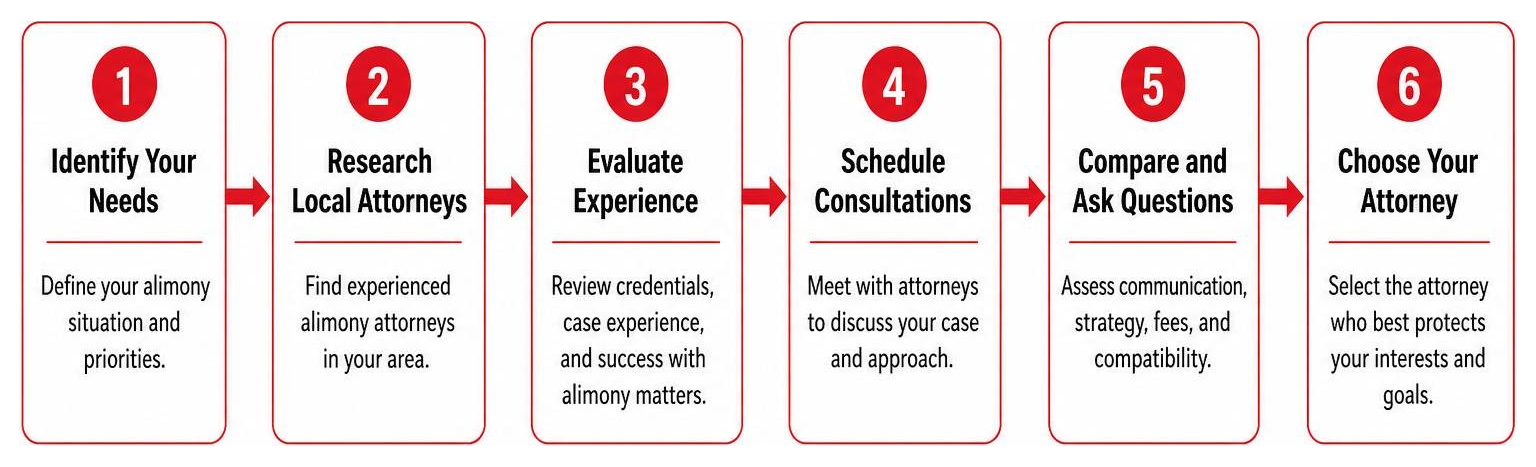
An excellent place to start your search is by reviewing resources like What to Look for in a Good Divorce Attorney. Your ideal attorney should possess a deep understanding of forensic accounting, business valuations, and asset division to ensure your spousal support agreement is built on accurate financial data.
Why You Need the Best Alimony Attorney Near Me to Avoid Costly Mistakes
Trying to handle alimony negotiations without professional legal representation often leads to expensive, irreversible mistakes. Some of the most common errors made by self-represented (pro se) individuals include:
- Failing to spot voluntary underemployment: A spouse may deliberately quit their job or take a lower-paying position to make their income look smaller. An experienced attorney knows how to request vocational evaluations to prove their true earning capacity.
- Inaccurate asset valuation: Miscalculating the value of family businesses, retirement accounts, or real estate can lead to an unfair alimony award.
- Ignoring tax implications: Failing to understand how IRS rules affect the net value of your support payments can leave you with far less money than you expected.
- Forgetting to secure the award: If the paying spouse passes away, the alimony stops. Experienced lawyers know to secure alimony payments with a life insurance policy.
Key Questions to Ask the Best Alimony Attorney Near Me During a Consultation
Your initial consultation is your opportunity to interview the attorney and ensure they are the right fit for your case. When meeting with potential legal counsel, consider asking the following questions:
- How much of your practice is dedicated specifically to family law and complex alimony disputes?
- What is your typical strategy for handling cases involving hidden assets or voluntary underemployment?
- How do your fee structures work, and what can I realistically expect this process to cost?
- Are you comfortable taking my case to trial if we cannot reach a fair settlement through negotiation?
For those in the Mobile area, working with Family and Criminal Lawyers in Mobile Protecting Your Rights ensures you have a dedicated, local team that knows how to present a compelling case to the court.
Frequently Asked Questions About Alimony
Does adultery affect alimony awards?
Yes. In Alabama, marital misconduct—including adultery—can play a significant role in alimony decisions. If a spouse’s misconduct led directly to the breakdown of the marriage, the judge can consider this when deciding whether to award support or how much to award. Additionally, if the unfaithful spouse spent marital funds on their extramarital relationship, the court may adjust the alimony award to compensate for that economic waste.
Can alimony be modified if the paying spouse retires?
Yes, but it is not automatic. The court will look at whether the retirement is reasonable based on the paying spouse’s age, health, and industry standards. If a spouse retires early simply to avoid paying alimony, the court is unlikely to grant a reduction. However, a good-faith retirement at a normal retirement age that results in a legitimate income reduction is a common ground for a petition to modify.
How is alimony taxed under current laws?
For any divorce finalized after December 31, 2018, the tax rules are straightforward: alimony payments are not tax-deductible for the spouse making the payments, and they are not considered taxable income for the spouse receiving them. This represents a major shift from older tax laws, making precise financial planning during your divorce negotiations more critical than ever.
Conclusion
Your financial future is too important to leave to chance. Alimony decisions made during a divorce will impact your lifestyle, savings, and peace of mind for years to come.
At Shane A. Taylor PC, our highly praised, client-focused team is proud to deliver professional, responsive, and compassionate service to families throughout Mobile, AL. We understand the high stakes of spousal support negotiations, and we are dedicated to helping you secure a fair outcome that protects your hard-earned assets.
Protect your financial future with expert Family Law representation by contacting Shane A. Taylor PC today to schedule your consultation. Let us put our experience to work for you.