


What Happens When You’re Accused of Violating Probation?
If you’re looking for probation violation attorneys near me, here is what you need to know right now:
- A violation can trigger an arrest warrant — sometimes within days of your probation officer notifying the court.
- You do not automatically go to jail, but the risk is real and immediate.
- You have legal rights, including the right to a hearing and the right to an attorney.
- Acting fast matters — early legal help can prevent a warrant from being issued in the first place.
- A skilled attorney can negotiate alternatives like modified probation, treatment programs, or community service instead of jail time.
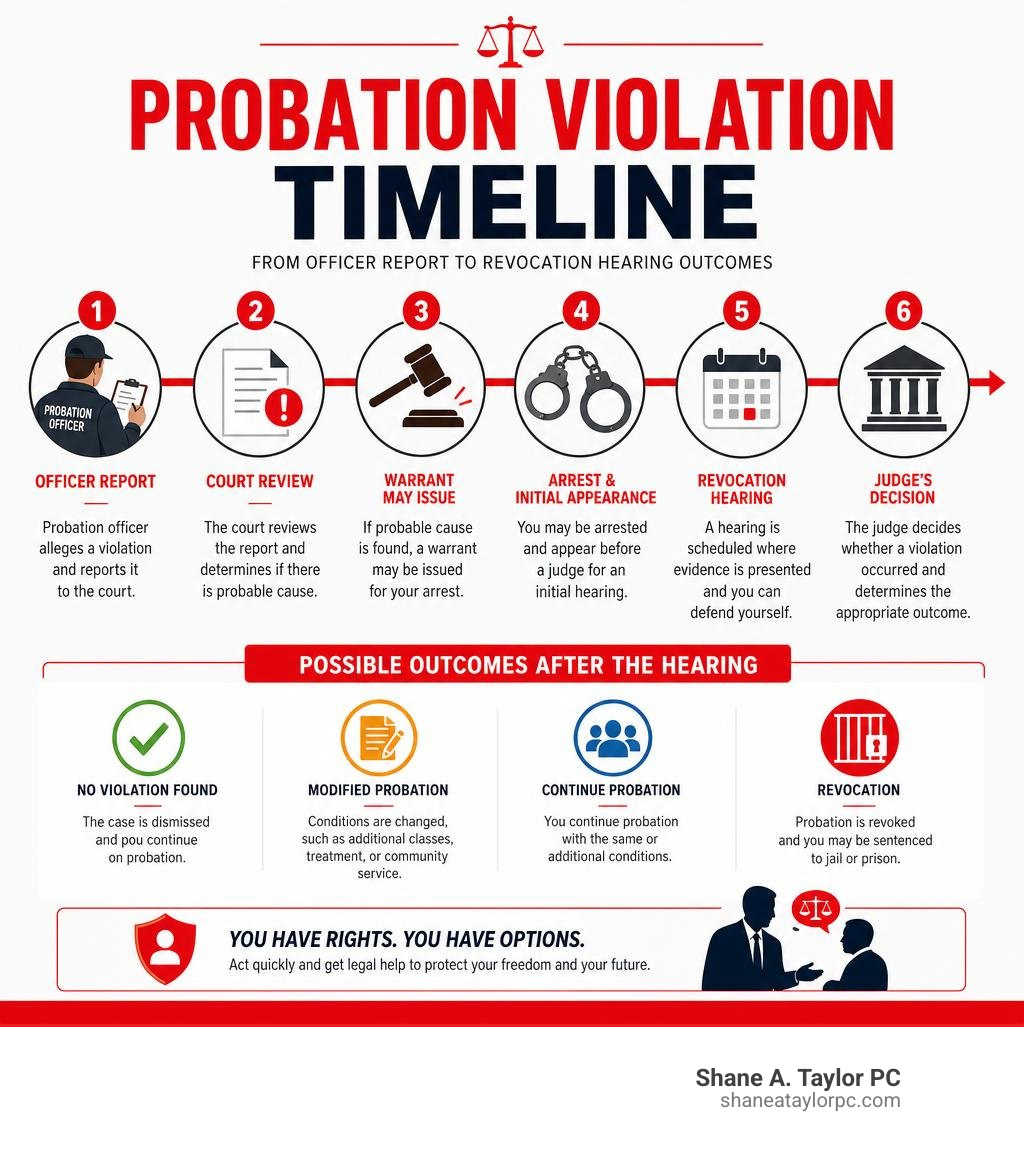
Being on probation means walking a narrow line. A missed appointment, a failed drug test, or a new arrest — even a minor one — can set off a legal process that moves fast and hits hard. Your probation officer notifies the court, a judge may issue a warrant for your arrest, and suddenly your freedom is at risk.
Even a small mistake can have serious consequences. That is not meant to scare you — it is meant to make sure you take this seriously and get help quickly.
I’m Shane A. Taylor, a Mobile, Alabama criminal defense attorney with a background as both a military veteran and a former Birmingham police officer — experience that gives me a ground-level understanding of how the system works on both sides. As one of the probation violation attorneys near me that families across Alabama turn to, I’ve spent my career helping people navigate exactly these high-stakes situations, from initial violations through revocation hearings.
What is Probation and How Do Violations Occur?
Probation — officially referred to in many jurisdictions as community supervision — is a legal arrangement that allows you to remain in your community under the watchful eye of a probation officer instead of serving time behind bars. While it is certainly better than a jail cell, it is not a get-out-of-jail-free card. It comes with a strict set of rules, known as probation conditions, that you must follow to the letter.
These conditions are customized by the judge on a case-by-case basis. They often include reporting regularly to your probation officer, maintaining steady employment, passing random drug and alcohol screenings, paying restitution or court fees, and staying within a designated geographic area.
When you fail to meet any of these requirements, you are considered in violation of your probation. Understanding how these conditions impact your daily life is a critical step in Understanding Consequences in Your Criminal Case.

Understanding the Two Main Types of Probation
In Alabama, the consequences of a probation violation often depend heavily on the specific type of probation you were originally sentenced to. Generally, community supervision falls into two primary categories:
- Deferred Adjudication (or Deferred Prosecution / Pretrial Diversion): With this option, the judge postpones finding you guilty. If you successfully complete all the terms of your probation, the charges against you may be dismissed entirely, keeping your conviction record clean. However, if you violate deferred adjudication, the judge can revoke your status and sentence you to any penalty within the full statutory sentencing range for the original offense.
- Straight Probation (Regular Probation): Under straight probation, you are formally convicted of the crime on day one, but your jail sentence is suspended. If you violate this probation and the judge decides to revoke it, you are typically ordered to serve the original suspended sentence that was set by the judge at your initial sentencing.
Navigating these differences can be confusing, especially when your future hangs in the balance. Understanding the distinct paths of your case is essential, starting from the moment you learn What Happens If You Are Charged With a Crime.
Technical vs. Substantive Violations
Not all probation violations are created equal. The court and your probation officer generally categorize violations into two groups: technical violations and substantive violations.
| Violation Type | Definition | Common Examples | Potential Court Impact |
|---|---|---|---|
| Technical Violation | Failing to follow the administrative rules or conditions set by the court. | Missed appointments, failure to pay fines, failing a drug test, traveling without permission. | Often resolved with modified terms, drug treatment, or short-term jail stays. |
| Substantive Violation | Committing a brand-new criminal offense while on probation. | Being arrested for a new misdemeanor or felony (e.g., a DUI or theft). | High risk of complete probation revocation and consecutive sentencing for the new charge. |
If you are facing a substantive violation, such as a DUI while on probation, the state can prosecute you for the new offense while simultaneously moving to revoke your probation for the original offense.
The Probation Revocation Process and Your Legal Rights
When your probation officer believes you have violated the terms of your supervision, they will submit a formal petition or motion to revoke probation to the court. Once the judge signs off on this motion, a warrant is typically issued for your arrest.
In many probation violation cases, these warrants are issued with a “no-bond” status. This means that once you are taken into custody, you may have to remain in jail until your formal revocation hearing, unless an experienced attorney can successfully petition the judge for a bond. Having dedicated legal representation during this critical phase is why so many trust Family and Criminal Lawyers in Mobile Protecting Your Rights.

How Revocation Hearings Differ from Criminal Trials
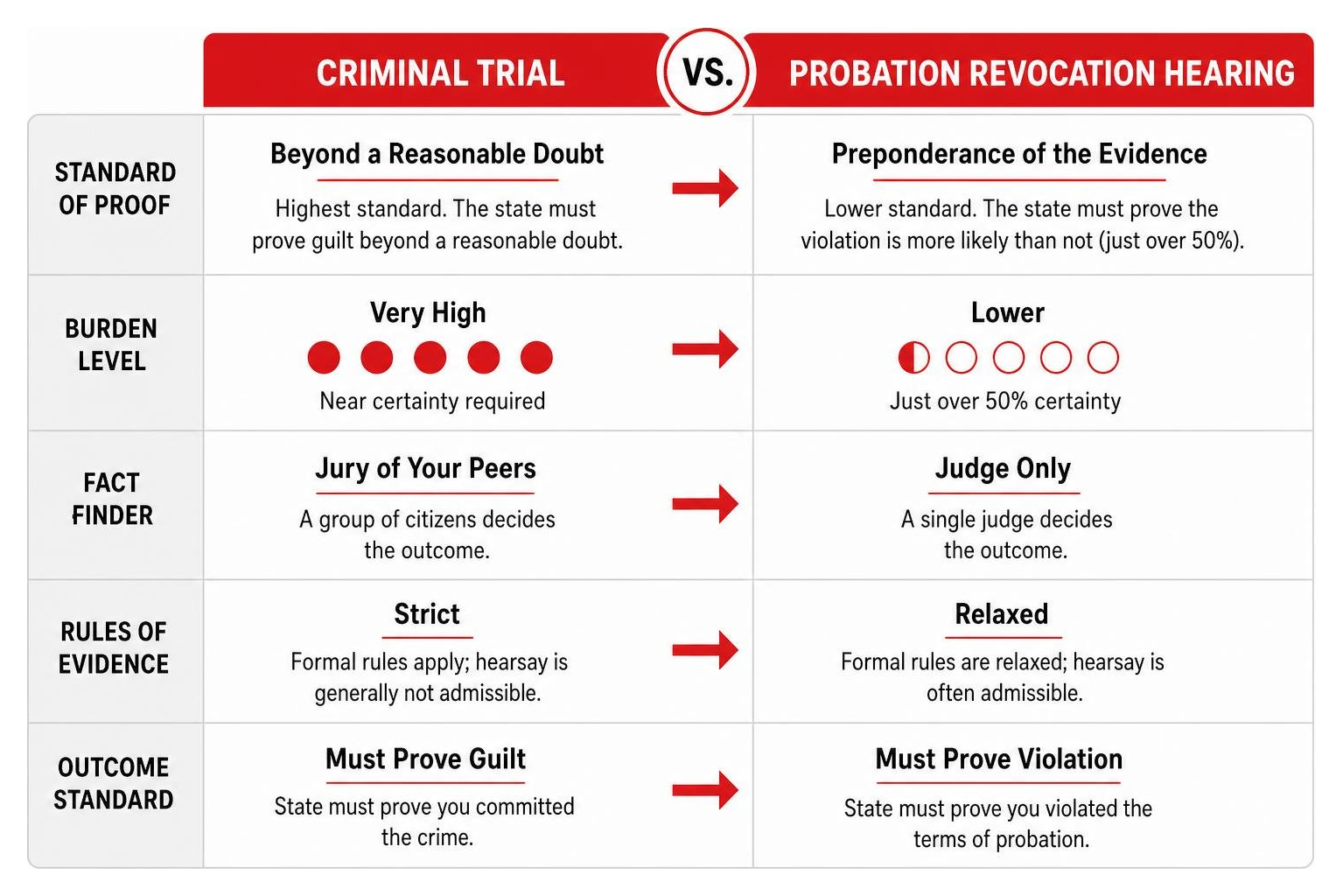
A probation revocation hearing is entirely different from a standard criminal trial. It is highly accelerated, and many of the constitutional protections you enjoy during a regular trial do not apply in the same way:
- No Jury: There is no jury of your peers. A single judge will listen to the evidence and decide your fate.
- Lower Burden of Proof: In a standard criminal trial, the prosecution must prove your guilt “beyond a reasonable doubt.” In a revocation hearing, the standard is much lower: the state only needs to prove the violation by a preponderance of the evidence (meaning it is more likely than not, or roughly a 51% certainty, that you committed the violation).
- Hearsay is Admissible: Unlike standard trials, hearsay evidence (such as a probation officer testifying about what a lab technician or employer told them) is often admissible in revocation hearings, though a judge cannot revoke your probation solely on uncorroborated hearsay.
Because the rules of evidence are relaxed, the state has a much easier path to secure a conviction. This is why we emphasize that Mobile Criminal Lawyers Crime Must Be Paid Beyond Reasonable Doubt does not apply to the relaxed standards of a probation hearing.
Your Constitutional Rights During a Revocation Hearing
Even though the standards are lower, you are not entirely without protection. Under Alabama law and the U.S. Constitution, you retain several fundamental due process rights during a revocation proceeding:
- The Right to Written Notice: You must receive a written copy of the alleged violations before the hearing.
- The Right to a Neutral Judge: Your case must be heard by an unbiased judicial officer.
- The Right to Counsel: You have the right to be represented by a defense attorney.
- The Right to Present Evidence: You can introduce witnesses, documents, and personal records to show compliance or explain mitigating circumstances.
- The Right to Cross-Examine: You have the right to confront and question the witnesses testifying against you, including your probation officer.
Why You Need Probation Violation Attorneys Near Me to Protect Your Freedom
When you are accused of a violation, your relationship with your probation officer changes. While probation officers have a degree of discretion in how they handle minor slip-ups, once they file a formal motion to revoke, the decision-making power shifts entirely to the prosecutor and the judge.
Attempting to represent yourself or simply “explaining your side” to the judge without an attorney is a high-risk strategy. Having professional Criminal Lawyers Can Make a Difference in how your story is framed, ensuring the court sees you as a person striving for rehabilitation rather than a repeat offender.
How Probation Violation Attorneys Near Me Can Negotiate Alternatives to Jail
The primary goal of a skilled defense attorney at a revocation hearing is to convince the judge that incarceration is not the appropriate remedy. We work to build a robust mitigation package that highlights your employment stability, family obligations, and positive steps toward compliance.
Depending on the nature of your violation, we can negotiate alternative sanctions, such as:
- A formal modification of your probation terms (e.g., extending the probation period).
- Enrollment in a supervised drug or alcohol treatment program.
- Additional community service hours.
- A brief “shock” jail stay instead of complete revocation.
When to Contact Probation Violation Attorneys Near Me After an Alleged Violation
The best time to contact an attorney is before you are arrested. If you know you missed a meeting, failed a drug test, or fell behind on payments, reaching out to us early allows us to contact your probation officer proactively. In many cases, we can address the issue directly with the department, coordinate a voluntary court appearance to resolve an outstanding warrant, or negotiate a reasonable bond before you are taken into custody.
If you have been arrested for a new offense, such as a DUI, securing a Mobile DUI Attorney immediately is critical to managing both the new criminal charge and the resulting probation violation simultaneously.
What to Do (and Not Do) If You Are Accused of a Violation
If you suspect or know that a violation has been alleged against you, taking the right steps immediately can dramatically improve your chances of staying out of jail:
- DO gather and organize your records. Keep physical and digital copies of pay stubs, medical excuses, counseling attendance certificates, and receipts for fee payments.
- DO NOT ignore your probation officer. Even if you know you are in violation, failing to report or cutting off communication will only make a warrant more likely.
- DO NOT post about your situation on social media. Prosecutors routinely monitor public profiles for admissions of guilt or evidence of travel violations.
- DO NOT flee the area. Running from a warrant will guarantee jail time once you are caught. If you believe your identity has been mistaken or a clerical error has occurred, let us handle it. We know how to navigate situations involving the Right Name Wrong Man Mobile Criminal Lawyers on Mistaken Identities.
Frequently Asked Questions About Probation Revocation
What is the difference between violating deferred adjudication vs. regular probation?
If you violate deferred adjudication, the judge can revoke your deferred status, enter a formal conviction on your record, and sentence you to any term within the full statutory punishment range for the original crime. If you violate regular (straight) probation, the judge is generally limited to sentencing you to the suspended jail term that was originally set at your initial sentencing.
Can a probation violation warrant be resolved without going to jail?
Yes. Depending on the county and whether the violation is technical or substantive, an experienced attorney can often arrange a voluntary court appearance or petition the judge for a reasonable bond, allowing you to resolve the warrant without spending weeks in custody awaiting a hearing. Working with a dedicated local defense attorney immediately is the best way to protect your rights and secure your release.
What is the standard of proof in a probation violation hearing?
The standard of proof is a “preponderance of the evidence.” This is a much lower threshold than the “beyond a reasonable doubt” standard used in standard trials. The state only needs to convince the judge that there is a 51% or greater chance that you willfully and substantially violated your probation terms.
Conclusion
A probation violation allegation does not have to mean the end of your freedom. With the right legal strategy, clear documentation, and a proactive defense, we can work to keep you out of jail and focused on your future.
At Shane A. Taylor PC, we provide compassionate, aggressive, and highly responsive representation to families throughout Mobile, Alabama. We understand the stress and urgency of a probation revocation proceeding, and we are here to guide you every step of the way.
If you are facing an alleged violation or have an active warrant, do not wait for the system to make the first move. Contact us today to discuss your Criminal Defense options and protect your future.