


Facing Federal Charges? Start With the Right Defense Lawyer
When searching for federal criminal defense attorneys near me, look for a lawyer who handles cases in the federal district where you may be charged. Ask about their experience with your type of case, federal investigations, and trials. If agents contact you, do not answer questions about the case before speaking with a lawyer. Preserve any records that may matter, and do not interfere with an investigation.
Federal cases can move from an investigation to a grand jury, charges, trial, and sentencing. A lawyer can help you understand where you stand and what to do next.
I’m Shane A. Taylor. For people searching for federal criminal defense attorneys near me in Mobile, I bring experience practicing in the Southern and Central Districts of Alabama and federal courts in Mississippi, along with more than 10 years as a Birmingham police officer.
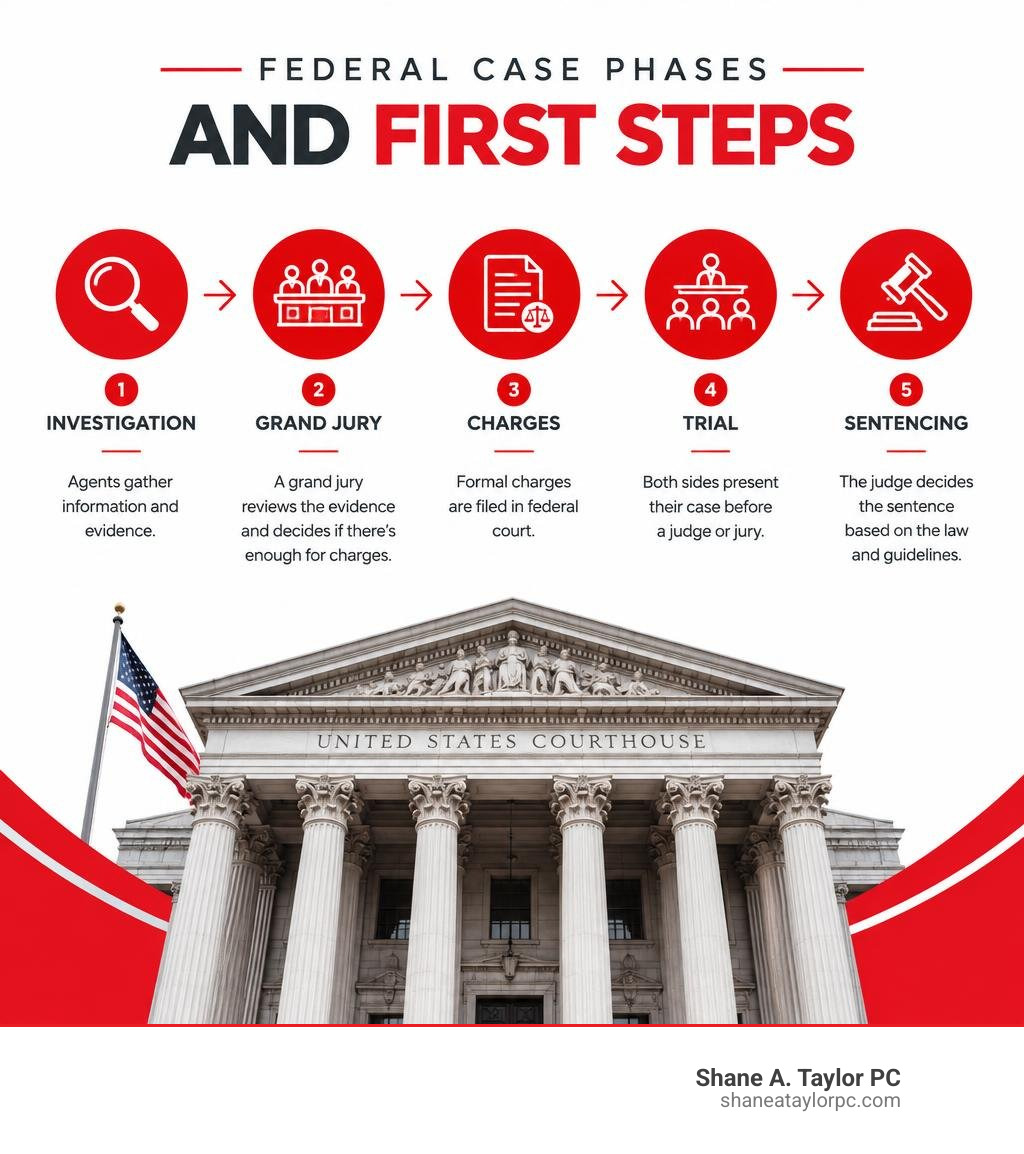
Simple guide to federal criminal defense attorneys near me:
- criminal defense attorneys near me
- lawyers near me for criminal cases
- criminal appeal attorney near me
Federal Crimes vs. State Crimes: Key Differences and Procedural Stakes
When you face legal trouble, recognizing the difference between state and federal court systems is essential. Roughly 95% of all criminal prosecutions across the country occur in state courts. This means the vast majority of local defense attorneys spend their careers handling state matters, appearing only occasionally in federal litigation. When the federal government steps in, the entire playing field changes.
Federal crimes involve alleged violations of statutes passed by the United States Congress or offenses that cross state lines, impact interstate commerce, or occur on federal property (such as military installations, federal courthouses, or national parks). While state prosecutions are handled by local district attorneys and investigated by municipal police or county sheriffs, federal matters are prosecuted by Assistant United States Attorneys (AUSAs) working under the Department of Justice (DOJ).
| Feature | State Criminal Justice System | Federal Criminal Justice System |
|---|---|---|
| Jurisdictional Scope | Local county/municipal boundaries; state statutory violations | National jurisdiction; interstate commerce, federal property, cross-border matters |
| Investigative Agencies | Local Police Departments, County Sheriff’s Offices, State Troopers | FBI, DEA, ATF, IRS-CI, Homeland Security Investigations (HSI), Secret Service |
| Prosecuting Authority | County District Attorney or State Attorney General | United States Attorney’s Office (Department of Justice) |
| Pre-Trial Detention Rules | State bail schedules; cash bonds, property bonds, or signature release | Bail Reform Act; statutory presumptions of detention for specific offenses |
| Sentencing Structure | State criminal codes, indeterminate sentencing, parole eligibility | Federal Sentencing Guidelines, statutory mandatory minimums, no federal parole |
The resources behind a federal prosecution are virtually limitless. Federal agencies spend months—sometimes years—gathering wiretaps, financial records, digital forensics, and grand jury testimony before an arrest is ever made. Understanding what happens after an arrest or criminal charge helps you realize that the government rarely brings an indictment unless they believe they have an airtight case.
Furthermore, procedural rules in federal district courts are governed strictly by the Federal Rules of Criminal Procedure and the Federal Rules of Evidence. Federal judges adhere to formal scheduling orders and stringent evidentiary standards, making specialized experience in federal practice vital to your defense.
Recognizing Federal Investigations and Handling Law Enforcement Contact

Federal criminal charges rarely begin with flashing blue lights in your rearview mirror. More often, you learn about a case through subtle or overt investigative signals. Federal agencies—including the Federal Bureau of Investigation (FBI), Drug Enforcement Administration (DEA), Bureau of Alcohol, Tobacco, Firearms and Explosives (ATF), and Internal Revenue Service Criminal Investigation (IRS-CI)—build cases methodically.
You might discover you are under scrutiny when:
- Federal agents arrive unannounced at your home, job site, or business asking to “clear up a few details.”
- Business associates, financial institutions, or employees notify you that they received grand jury subpoenas seeking your communications or account records.
- You receive a formal “target letter” or “subject letter” from the U.S. Attorney’s Office informing you that you are linked to an active grand jury investigation.
- Federal agents execute a search warrant on your property, seizing electronic devices, filing cabinets, or financial records.
If an agent approaches you, anything you say can and will be used against you. Under 18 U.S.C. § 1001, making a false statement to a federal agent is a felony punishable by up to five years in prison—even if you did not commit the underlying crime being investigated. Knowing the steps defense lawyers take to protect constitutional rights allows you to invoke your Fifth Amendment right to remain silent and your Sixth Amendment right to legal counsel calmly and respectfully. Simply state: “I am asserting my right to remain silent, and I want to speak with my attorney before answering any questions.” Request the agent’s business card and end the conversation immediately.
Why Search for Federal Criminal Defense Attorneys Near Me Early in an Investigation
Engaging counsel during the pre-indictment stage provides your greatest opportunity to shape the trajectory of a case. When you retain a seasoned defense lawyer early, we can step between you and federal law enforcement.
Early intervention enables us to:
- Open Direct Communication with the AUSA: We determine your exact status—whether you are classified as a witness, a person of interest, a subject, or a target.
- Prevent Reckless Self-Incrimination: We handle all inquiries and document requests, removing the risk that you inadvertently violate 18 U.S.C. § 1001.
- Present Exculpatory Evidence: In some instances, presenting our own findings can persuade prosecutors to drop the inquiry, decline prosecution, or explore a non-prosecution agreement.
- Protect Your Business and Assets: We work to limit the scope of subpoenas and shield privileged communications.
Critical Actions Within the First 48 Hours and Responding to Target Letters
The first 48 hours after receiving a target letter or experiencing a search warrant execution are decisive. Taking the wrong steps can escalate your legal jeopardy rapidly.
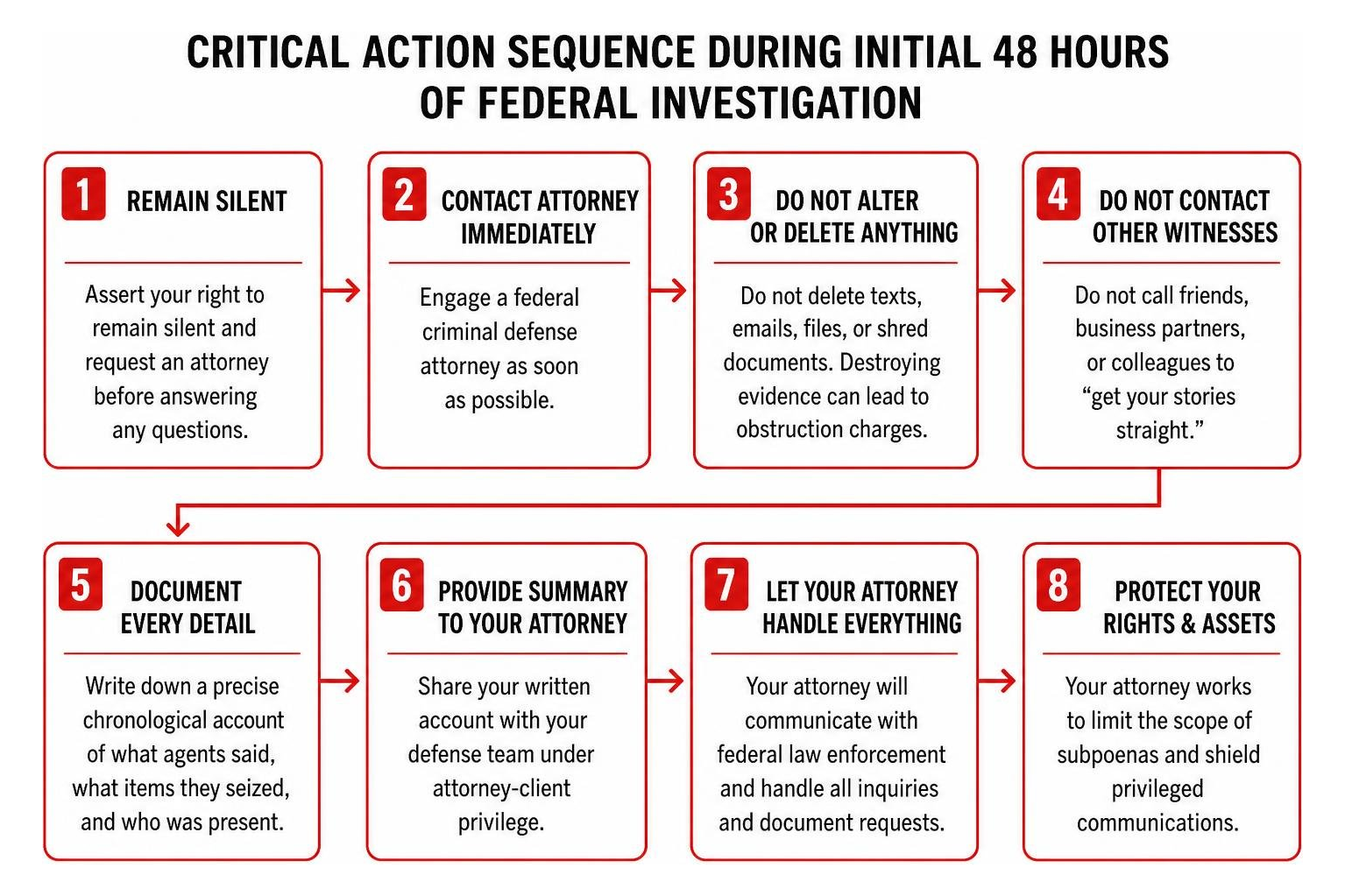
Follow these critical rules:
- Do Not Alter or Delete Anything: Never delete text messages, emails, computer files, or shred documents. Destroying potential evidence can lead to severe obstruction of justice charges under 18 U.S.C. § 1519, carrying penalties of up to 20 years in prison.
- Do Not Contact Other Potential Witnesses: Do not call friends, business partners, or colleagues to “get your stories straight.” Federal prosecutors routinely interpret these conversations as witness tampering or criminal conspiracy.
- Document Every Detail: Write down a precise chronological account of what agents said, what items they seized, and who was present. Provide this summary directly to your defense team under attorney-client privilege.
Common Types of Federal Charges and Statutory Penalties
Federal offenses span a wide spectrum, from complex financial schemes to large-scale interstate drug trafficking and firearms violations. Because federal statutes are drafted broadly, prosecutors possess substantial discretion in stacking charges that carry immense statutory maximums and mandatory minimums.
White-Collar Offenses, Embezzlement, and Fraud Schemes
White-collar prosecutions focus on non-violent, financial misconduct often investigated by the FBI, IRS-CI, or Securities and Exchange Commission (SEC). These cases frequently involve millions of pages of financial ledgers, email trails, and accounting audits.
- Wire and Mail Fraud (18 U.S.C. §§ 1341, 1343): Prosecuted whenever interstate communications or postal services are used to execute a scheme to defraud. Each count carries up to 20 years in federal prison, increasing to 30 years if the fraud affects a financial institution.
- Embezzlement: Stealing or misapplying funds entrusted to your care—such as bank funds or federal program grants—can entail a maximum statutory penalty of 20 years in prison.
- Healthcare Fraud (18 U.S.C. § 1347): Involves defrauding federal programs like Medicare or Medicaid through overbilling, kickbacks, or billing for services not rendered. Convictions carry substantial prison terms, restitution orders, and permanent loss of professional licenses.
- Money Laundering (18 U.S.C. §§ 1956, 1957): Engaging in monetary transactions designed to conceal the source of illegal proceeds carries up to 20 years of incarceration per transaction.
Drug Trafficking, Firearms Violations, and Mandatory Minimums
Federal drug and weapons laws are among the harshest in the American criminal justice system. Unlike state courts, which may offer flexible diversion or early parole, federal convictions require serving at least 85% of your time behind bars.
- Federal Drug Crimes: While simple possession of a controlled substance can lead to a misdemeanor charge and a one-year maximum incarceration sentence, possession with the intent to distribute or conspiracy to distribute can lead to a felony conviction and a statutory maximum of 40 years to life in prison. When you are handling severe controlled substance allegations, the precise weight of the substance determines the application of 5-year or 10-year statutory mandatory minimums.
- Federal Firearms Offenses (18 U.S.C. § 924(c)): Using, carrying, or possessing a firearm in furtherance of a drug trafficking crime or crime of violence carries severe consecutive penalties. You face no less than five years for possession, not less than seven years in prison for brandishing a firearm, and no fewer than 30 years if the firearm in question was a machine gun or equipped with a silencer. Offenders receiving a federal weapons crime conviction received just over 12 years of prison time on average in recent nationwide sentencing reviews.
- Federal Sex Offenses and Child Exploitation: An individual charged with transporting child pornography across state lines faces significant fines and a statutory minimum of 5 years to 20 years maximum in prison. Depending on prior records, receipt, distribution, or production of child pornography can lead to 5- to 40-year sentences, while serious sex abuse offenses can trigger 10-, 15-, or 20-year mandatory minimums.
Strategic Defense Tactics, the Court Process, and Federal Sentencing

Defending against federal charges requires a calculated, multi-tiered approach. We dissect the government’s investigation from the ground up, evaluating whether agents respected your constitutional rights and followed proper legal protocols.
Common defense strategies include:
- Fourth Amendment Motions to Suppress: If federal agents conducted searches without probable cause, exceeded the physical scope of a search warrant, or executed invalid wiretaps, we file motions to suppress. Suppressing key evidence often forces prosecutors to dismiss the indictment.
- Challenging Criminal Intent: Many federal offenses—particularly white-collar fraud and conspiracy—require the government to prove mens rea (specific criminal intent). Demonstrating that you acted in good faith, relied on professional advice, or made an honest accounting error undermines the prosecution’s central premise.
- Entrapment Defenses: In complex undercover operations run by the FBI or ATF, agents sometimes coerce or induce law-abiding individuals into committing crimes they were not predisposed to commit.
- Severance of Charges or Defendants: In multi-defendant drug or conspiracy trials, we frequently move to sever your trial from co-defendants to prevent “guilt by association.”
How Federal Criminal Defense Attorneys Near Me Evaluate Evidence and Build Defenses
A robust federal defense relies on thorough independent investigation. Our team examines government evidence piece by piece:
- Digital and Forensic Analysis: Reviewing metadata, cell phone location records, server logs, and forensic extractions to challenge government surveillance timelines.
- Financial and Accounting Audits: Retaining forensic accountants to trace monetary transactions, identify legitimate income sources, and disprove fraudulent intent.
- Witness Credibility Assessments: Federal cases frequently rely on cooperating co-conspirators seeking sentence reductions under Rule 35. We cross-examine these witnesses, exposing biases, inconsistencies, and self-serving motivations.
Navigating Federal Sentencing Guidelines, Plea Bargains, and Post-Conviction Appeals
If your case does not proceed to trial or an acquittal is not feasible, the focus shifts to federal sentencing advocacy. Sentencing in federal court is governed by the United States Sentencing Guidelines, established by the United States Sentencing Commission.
The Guidelines utilize a numerical grid that cross-references your Base Offense Level (which increases based on loss amount, drug weight, or firearm involvement) with your Criminal History Category (ranging from I to VI). Although the Guidelines have been advisory rather than mandatory since the Supreme Court’s ruling in United States v. Booker, judges rely heavily on them.
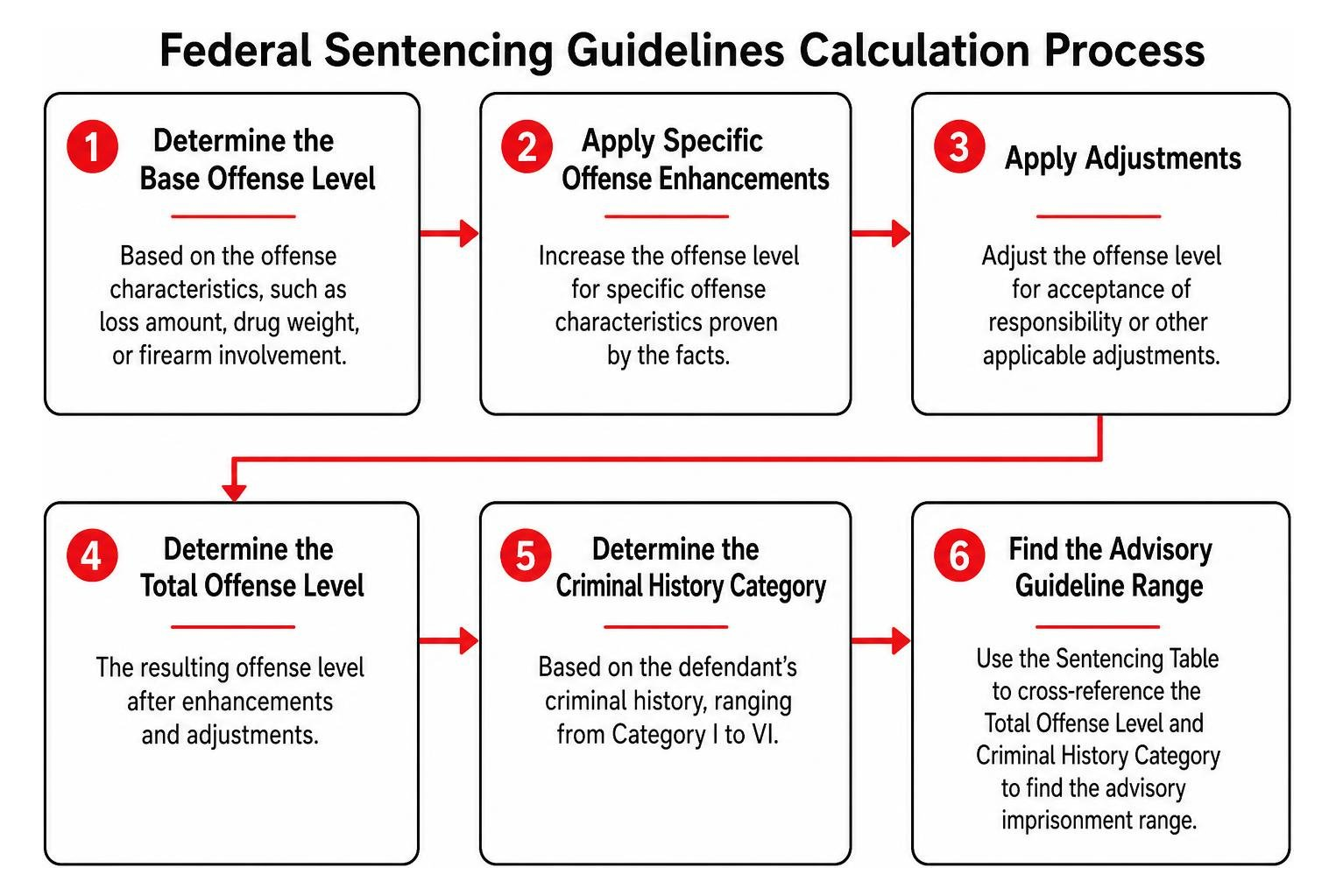
We mitigate sentencing exposure through:
- Downward Departures and Variances: We present comprehensive sentencing memorandums under 18 U.S.C. § 3553(a), humanizing your background, mental health history, family responsibilities, and community contributions to advocate for a sentence below the guideline range.
- The Statutory Safety Valve (18 U.S.C. § 3553(f)): In qualifying non-violent drug cases, defendants with minimal criminal history who meet specific criteria can bypass statutory mandatory minimums, enabling the judge to impose a significantly reduced sentence.
- Rule 11 Plea Agreements: When negotiating pleas, we work to secure favorable charge bargains, dismissals of § 924(c) counts, or agreed-upon sentencing caps under Rule 11(c)(1)(C).
- Post-Conviction Relief and Appeals: If errors occurred during trial, suppression hearings, or sentencing calculations, pursuing post-conviction relief and federal appeals through the United States Court of Appeals provides a path to vacate convictions or secure re-sentencing.
Finding the Right Federal Criminal Defense Attorneys Near Me: Key Qualifications
When your liberty, career, and reputation are on the line, selecting the right legal representative is paramount. You need a dedicated advocate who is admitted to practice before the United States District Court and possesses deep, day-to-day familiarity with local courtroom procedures. When selecting the right counsel for complex litigation, looking beyond general marketing claims ensures you secure true federal courtroom competence.
Assessing Federal Trial Experience Over General Criminal Practice
Do not make the mistake of hiring a lawyer whose practice consists almost entirely of municipal traffic citations or routine state court appearances. Federal practice requires specialized proficiencies:
- Mastery of Federal Discovery Practices: Handling tens of thousands of electronic documents, wiretap audio recordings, and forensic data streams.
- District Court Familiarity: An understanding of local district court rules, standing orders of specific federal judges, and the working methods of the local U.S. Attorney’s Office.
- Courtroom Readiness: A proven track record of taking complex federal cases to a jury verdict rather than automatically accepting the first plea offer presented.
Essential Inquiries to Make Before Retaining Defense Counsel
Before signing a retainer agreement with any attorney, ask these critical questions:
- Are you admitted to practice in the specific U.S. District Court where my case is pending?
- How many federal criminal cases have you handled over the past three to five years?
- Will my case be handled directly by experienced lead counsel or passed down to an associate?
- What experience do you have negotiating with federal agencies such as the FBI, DEA, or IRS-CI?
- What are the potential statutory penalties, mandatory minimums, and guideline ranges applicable to my situation?
- What is your transparent fee structure for pre-indictment representation, pre-trial motions, and trial litigation?
Frequently Asked Questions About Federal Criminal Defense
Can a federal criminal defense lawyer help me avoid an indictment entirely?
Yes. During the pre-indictment phase, your attorney can engage in dialogue with the Assistant U.S. Attorney, present exculpatory evidence, demonstrate factual errors in the agency’s theory, or arrange formal proffer sessions. In appropriate cases, this advocacy leads prosecutors to decline charges or resolve the matter civilly.
What happens if federal agents arrive with a search warrant at my home or business?
Remain calm and do not physically resist, obstruct, or interfere with the agents. Ask to see a copy of the search warrant and the supporting affidavit. Verify the address and the specific areas authorized for search. You have the right to observe the search from a reasonable distance and take notes. Contact your defense lawyer immediately and instruct employees or family members not to answer questions.
How do federal mandatory minimum sentences differ from guideline ranges?
Statutory mandatory minimums are enacted directly by Congress and set a strict legal floor below which a judge cannot sentence, regardless of mitigating factors (unless the defendant qualifies for the Safety Valve or provides substantial assistance under 18 U.S.C. § 3553(e)). In contrast, Federal Sentencing Guidelines are advisory point-based ranges calculated from offense characteristics and criminal history. Judges retain discretion to sentence outside the advisory guideline range.
Conclusion
A federal criminal investigation or indictment is one of the most serious challenges you will ever face. With the boundless investigative resources of the federal government, harsh mandatory minimums, and strict federal procedural rules, you cannot afford to delay your defense or rely on inexperienced representation.
At Shane A. Taylor PC, our legal team provides client-focused, aggressive, and responsive representation tailored to federal court litigation. Whether you have received a target letter, been served with a grand jury subpoena, or are facing an active federal indictment, early and decisive action is critical. Explore our practice areas for comprehensive criminal defense representation and contact us today to schedule a confidential review of your case.