


When a Drug Charge Turns Your World Upside Down
If you need a drug crimes attorney near me, here is what you need to know right now:
Quick Answer: What to do if you’re facing drug charges
- Stay silent. Do not answer police questions without a lawyer present.
- Do not consent to searches. You have the right to refuse.
- Call a criminal defense attorney immediately — before making any other decisions.
- Write down everything you remember about the arrest while it’s fresh.
- Avoid discussing your case with anyone other than your attorney.
A drug charge can hit like a freight train. One moment life is normal. The next, you’re facing potential jail time, a permanent criminal record, and consequences that can follow you for years — affecting your job, your housing, and even your family.
It doesn’t matter if the drugs weren’t yours, if you had no idea they were there, or if you simply made one bad decision. The legal system moves fast, and what you do in the first hours after an arrest can shape everything that follows.
Drug charges range from a misdemeanor possession case all the way to serious felony trafficking charges carrying mandatory minimum prison sentences. The difference between those outcomes often comes down to one thing: having the right legal representation on your side.
I’m Shane A. Taylor — a former police officer with the Birmingham Police Department and a criminal defense attorney who has practiced in Alabama and Mississippi state and federal courts. My background on both sides of the law gives me a distinct perspective when defending clients against drug crimes, and I bring that experience to every case at Shane A. Taylor PC. If you’re facing charges right now, the sections below will walk you through exactly what to expect and how to protect yourself.
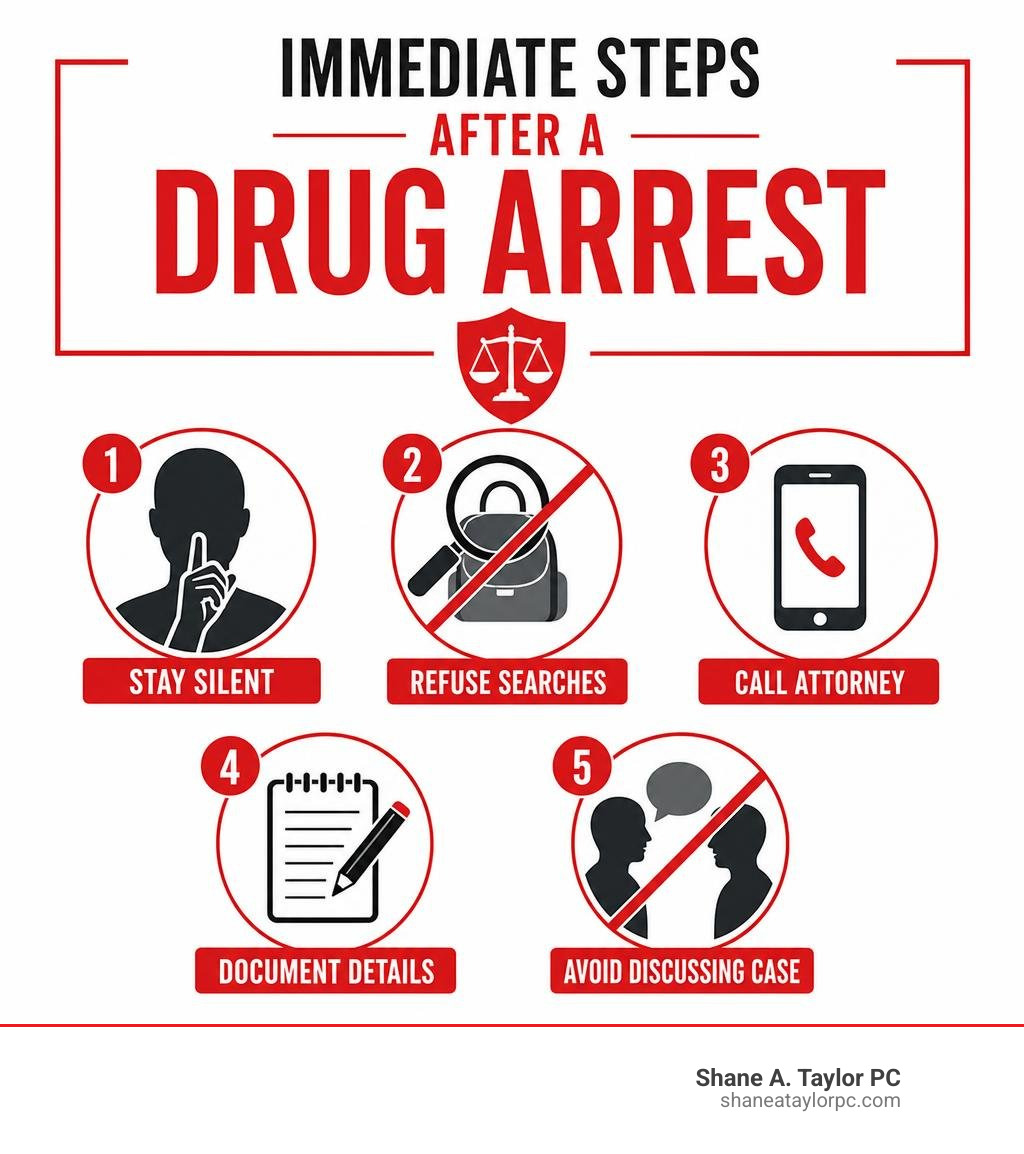
Immediate Steps: What to Do After a Drug Arrest
The moments during and immediately following a drug arrest are incredibly stressful. Your adrenaline is pumping, you are likely scared, and the police may be pressuring you to “help yourself” by answering questions.
However, your actions during this critical window can make or break your defense. If you find yourself in handcuffs, keep these core principles in mind:
- Exercise Your Right to Remain Silent: This is your most powerful tool. You do not have to explain where you were going, who you were with, or what is inside your vehicle or home. Politely but firmly state, “I am exercising my right to remain silent, and I want to speak to an attorney.”
- Do Not Agree to a Search: If law enforcement asks to search your car, your bag, or your home, do not give them consent. Even if you believe you have nothing to hide, consenting to a search waives your Fourth Amendment protections. If they search anyway, your attorney can challenge the legality of that search later—but only if you did not give them permission.
- Observe and Document: Pay close attention to everything the officers do and say. Did they read you your Miranda rights? Did they have a warrant? Did they explain why they pulled you over? As soon as you are able, write down every detail you can remember. These notes will be invaluable to us as we build your defense.
Navigating the immediate aftermath of an arrest requires a clear understanding of the legal process. To learn more about what to expect during this stressful time, read our guide on What Happens If You Are Charged With a Crime?.
Understanding the Types of Drug Charges and Penalties
Alabama classifies controlled substances into five “schedules” based on their accepted medical use and their potential for abuse or addiction. Schedule I drugs (such as heroin or hallucinogens) carry the highest potential for abuse and have no accepted medical use, while Schedule V drugs (such as certain prescription cough syrups) have a low potential for abuse and widely accepted medical applications.
The severity of a drug charge and the resulting penalties depend heavily on the type of substance, the quantity involved, and your perceived intent.
- Simple Possession: Typically, possessing a controlled substance for personal use is charged as a felony in Alabama. However, depending on the substance and your criminal history, certain minor possession offenses may carry alternative sentencing pathways.
- Possession with Intent to Distribute: If law enforcement finds you with scales, packaging materials, large amounts of cash, or a quantity of drugs that exceeds what is typical for personal use, they will likely elevate the charge to possession with intent to distribute. This is a much more serious felony.
- Drug Trafficking: Once the weight of the seized drugs crosses a specific statutory threshold, the charge automatically becomes drug trafficking. Trafficking charges carry extremely harsh mandatory minimum prison sentences, regardless of whether you intended to sell the drugs.
- Manufacturing: Cultivating marijuana, operating a methamphetamine lab, or compounding other controlled substances is prosecuted aggressively and carries severe felony penalties.
To help you visualize how these charges compare, here is a general overview of state versus federal drug prosecutions:
| Charge Type | State Prosecution (Alabama) | Federal Prosecution |
|---|---|---|
| Primary Investigating Agency | Local Police, County Sheriff, State Troopers | DEA, FBI, ATF, Homeland Security |
| Court System | District or Circuit Court | United States District Court |
| Sentencing Guidelines | Alabama State Sentencing Standards | Federal Sentencing Guidelines (very strict) |
| Common Penalties | Probation, local jail, state prison, drug court | Mandatory federal prison time, massive fines |
State vs. Federal Drug Charges
There is a massive difference between being charged by the State of Alabama and being indicted in federal court. Federal drug charges are almost always more severe, carry longer prison sentences, and involve far more resources on the prosecution’s side.
Federal agencies like the Drug Enforcement Administration (DEA) or the FBI typically get involved in cases that cross state lines, involve large-scale distribution networks, or occur on federal property. Unlike state courts, which may offer more flexibility for rehabilitation and probation, the federal justice system is notorious for its rigid sentencing guidelines.
To put this in perspective, data from the United States Sentencing Commission (USSC) shows that federal drug trafficking prosecutions almost always result in prison time. In federal fiscal year 2022, there were 587 federal drug trafficking cases in nearby North Carolina, and 570 of those cases resulted solely in prison time. Federal drug possession cases are rarer but still carry severe consequences, with some resulting in prison, some in probation, and others in heavy fines.
If you are facing federal drug charges, you are dealing with prosecutors who have unlimited resources and a high conviction rate. You need a defense team that understands the complexities of federal courtrooms.
Why You Need a Drug Crimes Attorney Near Me for Serious Charges
When the charges escalate to drug distribution or trafficking, the legal stakes skyrocket. In Alabama, drug trafficking is a Class A felony. If you are convicted, you face a mandatory minimum prison sentence that the judge cannot reduce, even if you are a first-time offender.
These mandatory minimums are triggered strictly by the weight of the substance involved. For example, trafficking thresholds are met at relatively low weights for dangerous drugs. With regional synthetic drug crises growing—such as in Florida, where fentanyl caused 3,224 deaths in 2024—law enforcement across the Southeast, including Alabama, has cracked down heavily on fentanyl, opioids, and methamphetamine.
An experienced drug crimes attorney near me is essential because we know how to challenge the prosecution’s case at every level. We can investigate whether the state accurately weighed the substance (excluding packaging and moisture), challenge the chemical testing methods used by the state lab, and negotiate with prosecutors to reduce charges below the mandatory minimum thresholds.

How a Drug Crimes Attorney Near Me Builds Your Defense

A drug charge is not a conviction. Just because the police found drugs does not mean the state can prove its case beyond a reasonable doubt. When you hire us, we immediately begin dismantling the prosecution’s case by looking for constitutional violations, procedural errors, and factual weaknesses.
We analyze your case using several proven defense strategies:
- Challenging the Initial Stop: Did the police have reasonable suspicion to pull you over or stop you on the street? If the initial encounter was unlawful, everything that followed may be thrown out.
- Challenging the Search: Did law enforcement search your property without a warrant, consent, or probable cause?
- Actual vs. Constructive Possession: Can the state actually prove the drugs belonged to you, or were they simply in a shared space where multiple people had access?
- Testing the Evidence: We demand proof that the substance seized is actually the illegal drug the state claims it is, requiring strict chain-of-custody documentation and reliable laboratory testing.
Challenging Illegal Searches and Seizures
The Fourth Amendment protects you from unreasonable searches and seizures. In many drug cases, the “search is the case.” If the police violated your constitutional rights to obtain the evidence, your attorney can file a Motion to Suppress.
Under the legal doctrine known as the “exclusionary rule,” any evidence obtained through an illegal search cannot be used against you in court. If we successfully argue that a search was illegal, the judge will throw out the physical drug evidence. Without the drugs, the prosecution’s case typically collapses, leading to a complete dismissal of your charges.
We closely examine the details of traffic stops, canine sniffs, and home searches to identify where police may have cut corners or exceeded their authority.
Defending Against Charges When the Drugs Weren’t Yours
It is incredibly common for people to be arrested for drugs that did not belong to them. This often happens in shared environments, such as:
- Riding in a car where a passenger has drugs hidden in the glove box or under a seat.
- Living in an apartment where a roommate keeps controlled substances in a common area.
- Attending a party where drugs are found in a shared room.
In these situations, prosecutors rely on a legal theory called constructive possession. To convict you under this theory, the state must prove two things:
- You had knowledge of the presence of the drugs.
- You had the ability to exercise dominion and control over them.
Simply being near an illegal substance is not enough to convict you. If you did not know the drugs were there, or if you had no control over them, we can build a strong defense to challenge the prosecution’s assumptions and fight for a dismissal.
Alternatives to Incarceration and Long-Term Consequences
A drug conviction carries penalties that extend far beyond immediate jail time. Understanding the full scope of these consequences is vital when deciding how to handle your case. To learn more about how a conviction can reshape your future, read our detailed guide on Understanding Consequences in Your Criminal Case.
Fortunately, for many non-violent offenders, the justice system offers pathways to avoid prison entirely. We work tirelessly to explore these alternatives for our clients.
Drug Courts and Rehabilitation Options
In Mobile County and throughout Alabama, specialized Drug Courts (sometimes called Recovery Courts) focus on rehabilitation rather than punishment. These programs are designed to help individuals struggling with substance abuse get the treatment they need while keeping their criminal records clean.
If you qualify for a diversion program or drug court, you will typically be required to:
- Complete a structured drug treatment program.
- Submit to regular, random drug testing.
- Attend court check-ins and support group meetings.
- Perform community service.
The major benefit of these programs is that upon successful completion, your charges are typically dismissed entirely. This allows you to move forward with your life without the burden of a felony conviction.
Collateral Consequences and Expungement
If you are convicted of a drug crime, the “collateral consequences” can disrupt your life for decades. These are the penalties not written into your court sentence, but enforced by society and federal law:
- Employment: Many employers are legally barred from hiring individuals with felony drug convictions, and others will simply bypass your application.
- Housing: Finding an apartment can be incredibly difficult, as many landlords run background checks and deny tenancy to those with drug records.
- Immigration Status: For non-citizens, even a minor drug conviction can be classified as a deportable offense under federal law, triggering immediate removal proceedings.
- Professional Licensing: A drug conviction can cost you your nursing license, commercial driver’s license (CDL), real estate license, or teaching credentials.
Because these consequences are so severe, clean records are highly valuable. If you have already been convicted of a minor drug offense in the past, you may be eligible to clear your record. To see if you qualify, check out our guide on the New Expungement Law in Alabama.
Frequently Asked Questions About Drug Charges
Can a first-time drug charge be dismissed?
Yes, first-time drug charges are frequently dismissed, but it rarely happens automatically. Dismissals are typically achieved through one of three pathways:
- Pre-Trial Diversion or Drug Court: Completing a court-approved rehabilitation program.
- Constitutional Challenges: Having the evidence thrown out due to an illegal search or arrest.
- Plea Negotiations: Your attorney negotiating with the prosecutor to dismiss the charges in exchange for community service or probation.
What is the difference between actual and constructive possession?
- Actual possession means the illegal substance was physically on your person—for example, in your pocket, in your hand, or in your shoe.
- Constructive possession means the drugs were not on your person, but they were found in an area over which you had control, such as your car’s center console or your bedroom drawer. Constructive possession is much harder for the prosecution to prove because they must establish that you knew the drugs were there and had control over them.
How do I find the right drug crimes attorney near me?
Finding the right attorney is the most important decision you will make. You need someone who understands the local courts, has a deep knowledge of constitutional law, and takes a client-focused approach. For practical tips on how to begin your search, read our article on Smart Ways to Find Criminal Defense Attorneys Near Me.
Conclusion

Facing a drug charge can make you feel isolated, overwhelmed, and uncertain about your future. But remember: a charge is not a conviction, and you do not have to fight this alone.
At Shane A. Taylor PC, we provide compassionate, client-focused representation combined with aggressive, experienced defense strategies. We know how the prosecution operates, and we use our deep understanding of the law to protect your rights, your freedom, and your future. Whether we are fighting to get your charges dismissed, negotiating for a diversion program, or representing you at trial, we are with you every step of the way.
If you or a loved one has been arrested for a drug crime in Mobile, Alabama, or the surrounding areas, time is of the essence. Contact our criminal defense team today to schedule a consultation and take control of your legal roadmap.