


Appealing a Criminal Conviction: What to Do First
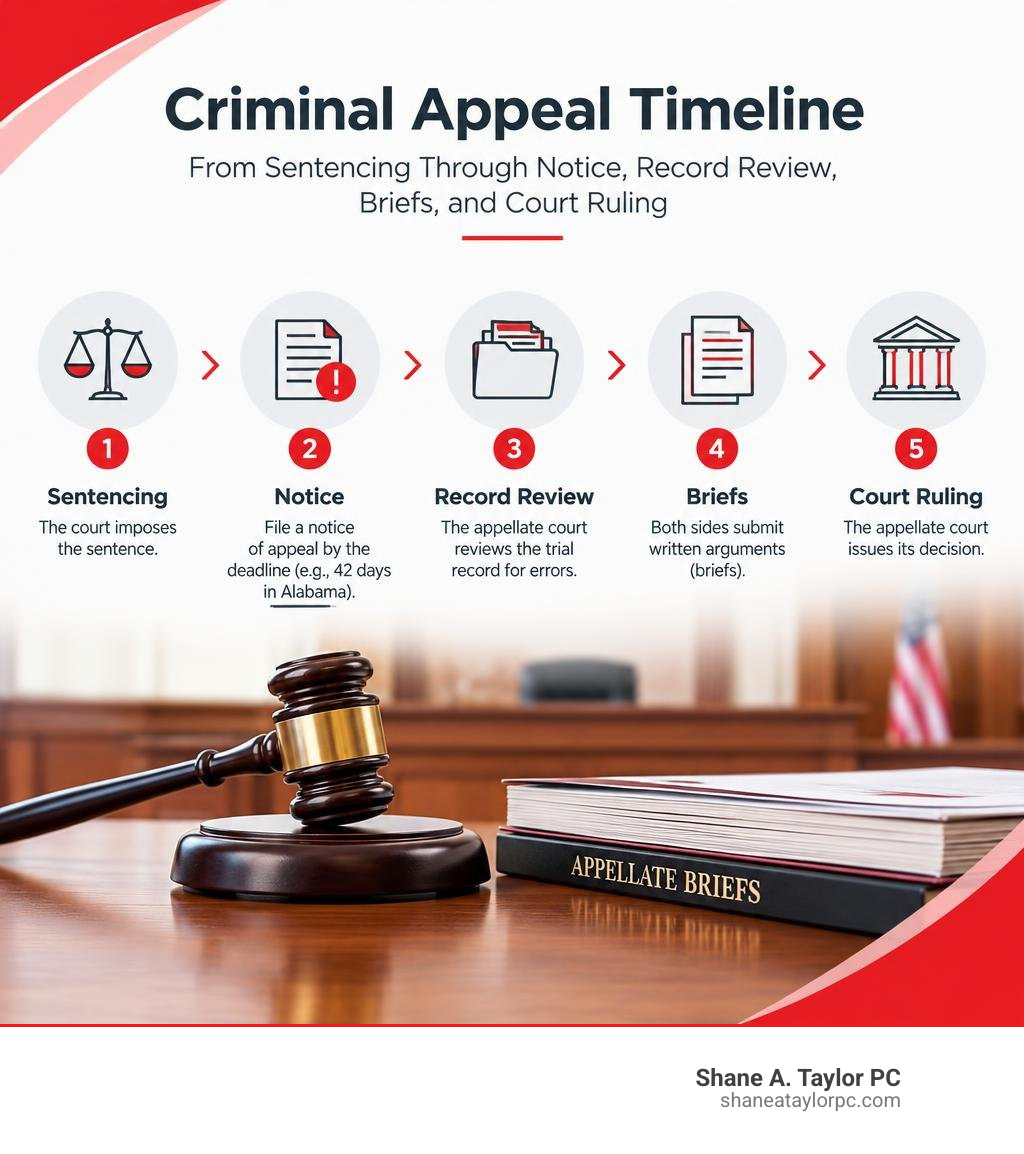
Contact an attorney who handles criminal appeals as soon as possible after sentencing. Ask them to check your filing deadline, obtain the trial record, and look for legal errors that may support an appeal. Do not wait for the transcripts before asking about a notice of appeal. In Alabama state criminal cases, that notice is generally due within 42 days of sentencing, though a timely post-trial motion can affect the deadline. Federal and other state rules differ.
An appeal is not a second trial. The appellate court usually reviews what happened in the trial court, rather than hearing new witnesses or evidence. The Administrative Office of the U.S. Courts explains that an appeal is not a retrial but a review of the trial court’s application of the law.
I’m Shane A. Taylor, a criminal defense lawyer and former Birmingham police officer. If you searched for a criminal appeal attorney near me, I bring experience practicing in Alabama and Mississippi state courts and federal courts in both states to the first question this guide covers: what can you do next?
Key terms for criminal appeal attorney near me:
- criminal defense attorneys near me
- lawyers near me for criminal cases
- assault and battery attorney near me
Understanding the Criminal Appeal Process vs. Trial
When a trial ends in a guilty verdict, the courtroom doors close on one phase of justice and open onto another. Many people believe an appeal means gathering the witnesses, sitting back in front of a jury, and telling their side of the story again. In reality, the appellate process is an entirely different legal battlefield.

While a trial determines factual guilt or innocence, an appeal examines whether the trial court followed the law. The appellate court does not care about witness charisma or dramatic opening statements; it cares about constitutional safeguards, judicial rulings, and statutory rules. When you are understanding consequences in your criminal case, recognizing that the appellate court focuses strictly on legal error rather than factual guilt is crucial for setting realistic expectations.
How a Direct Appeal Differs from a Trial
A trial is a live event driven by testimony, physical exhibits, and jury observation. A direct appeal, by contrast, is an exhaustive, record-based legal critique. Appellate judges do not evaluate witness credibility because they were not in the courtroom to see them testify. Instead, they read transcripts, examine admitted evidence, review written briefs, and occasionally hear oral arguments presented by attorneys.
| Feature | Criminal Trial | Criminal Appeal |
|---|---|---|
| Primary Purpose | Determine factual guilt or innocence | Correct legal errors and constitutional violations |
| Decision Maker | Judge or Jury (Finder of Fact) | Multi-judge Appellate Panel |
| Evidence Evaluated | Live testimony, physical exhibits, new facts | The existing written record and trial exhibits only |
| Primary Medium | Oral examinations, witness questioning, trial motions | Detailed written appellate briefs and oral arguments |
| Possible Outcomes | Acquittal, conviction, or hung jury | Affirm conviction, remand for new trial, or order acquittal |
The entire appeal takes place on paper through carefully structured legal briefs. When you need to challenge an unjust outcome, knowing what does a defense lawyer do to protect your rights at this stage helps you understand how we dissect trial transcripts line by line to identify where the lower court went wrong.
Critical Deadlines: Why You Need a Criminal Appeal Attorney Near Me Immediately
Time is the most unforgiving factor in appellate law. Missing a filing deadline by a single day can permanently extinguish your right to appeal, regardless of how obvious the trial judge’s errors were.
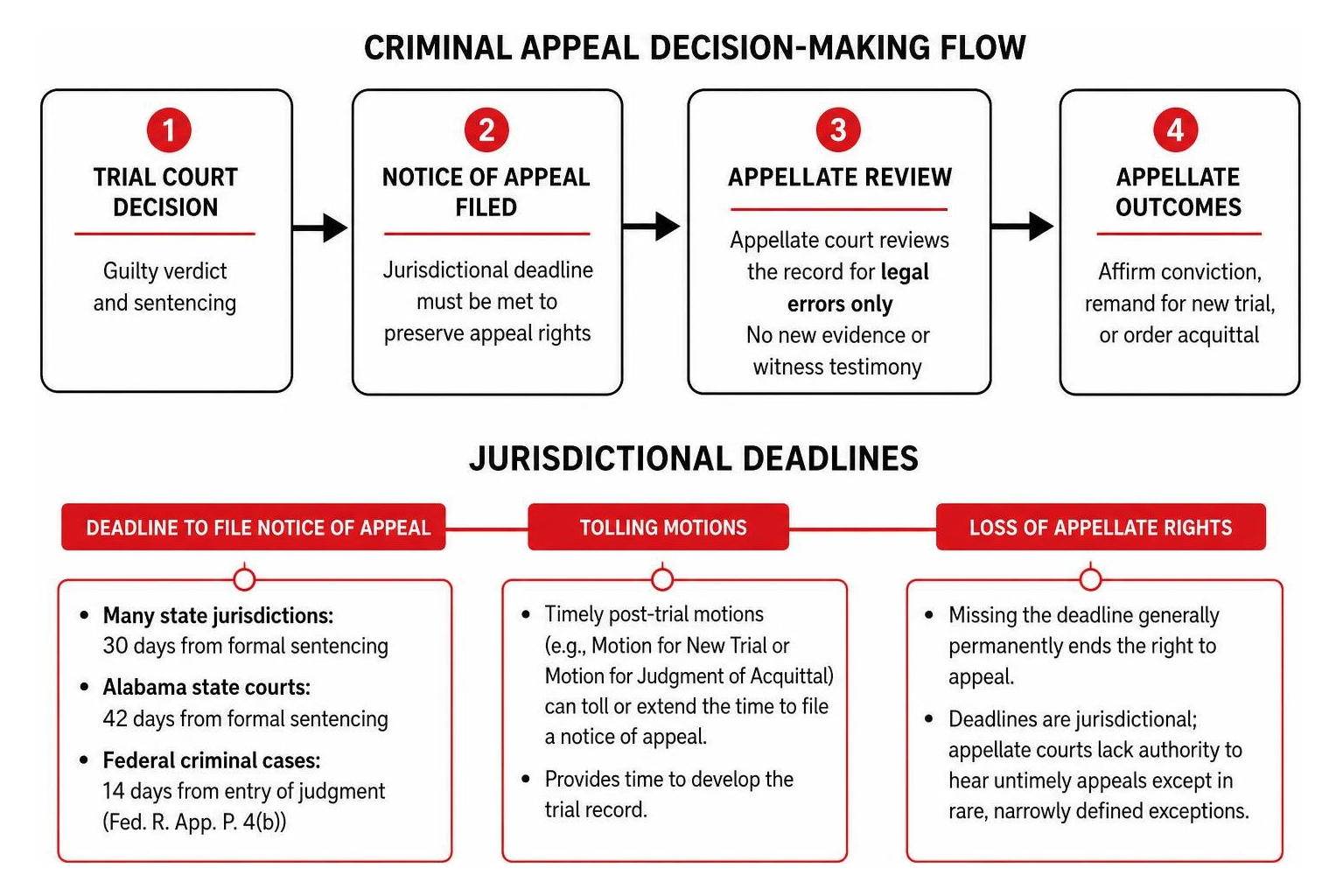
In state and federal courts across the country, strict jurisdictional rules govern notice filings:
- Strict Notice Requirements: In many state jurisdictions, a notice of appeal must be filed within 30 days of formal sentencing. In Alabama state courts, defendants generally have 42 days, while federal criminal appeals must be initiated within 14 days under the Federal Rules of Appellate Procedure.
- Tolling Motions: Filing a timely post-trial motion (such as a Motion for a New Trial or Motion for Judgment of Acquittal) can toll or extend these appellate deadlines, giving counsel time to develop critical trial-level records.
- Loss of Appellate Rights: Because these deadlines are jurisdictional, appellate courts lack the authority to hear untimely direct appeals except under rare, narrowly defined emergency exceptions.
Searching for a qualified criminal appeal attorney near me the moment a verdict is delivered ensures you never forfeit your right to review due to a calendaring error.
Common Grounds for Overturning a Criminal Conviction
An appellate court will not reverse a conviction simply because the outcome feels unfair. To win an appeal, we must demonstrate that a “reversible error” occurred—meaning a legal mistake was made that directly prejudiced your case and affected the final outcome.

Appellate judges frequently apply the “harmless error” doctrine. If the trial judge made a minor mistake that did not change the verdict, the appellate court will let the conviction stand. We focus on uncovering harmful, reversible errors such as judicial abuse of discretion, improper jury instructions, unlawfully admitted evidence, and severe prosecutorial misconduct.
Preserving Errors at Trial and Legal Sufficiency
To raise most issues on appeal, your trial lawyer must have “preserved” the error on the record. Under the contemporaneous objection rule, counsel must object at the exact moment an error occurs, state the precise legal grounds, and obtain a ruling from the judge.
- Preserved Errors: Receive standard appellate review, where we demonstrate how the trial court’s misstep harmed your defense.
- Unpreserved Errors: Forfeited on direct appeal unless they meet the exceptionally high standard of “plain error”—an error so egregious that it undermined the fundamental fairness and integrity of the judicial proceeding.
- Legal Sufficiency Challenges: A claim that no rational jury, viewing the evidence in the light most favorable to the prosecution, could have found every essential element of the crime proven beyond a reasonable doubt. Winning a legal sufficiency claim results in a complete acquittal on appeal rather than just a retrial.
Ineffective Assistance of Counsel and the Strickland Standard
Under the Sixth Amendment, every accused person has the constitutional right to effective legal representation. When a trial lawyer fails fundamentally in their duties, you can challenge the conviction under the landmark Strickland v. Washington framework.
To succeed on a Strickland claim, you must prove two distinct prongs:
- Deficient Performance: Your attorney’s representation fell below an objective standard of reasonableness under prevailing professional norms.
- Prejudice: There is a reasonable probability that, but for counsel’s unprofessional errors, the result of the proceeding would have been different.
Because proving ineffective assistance often requires showing what trial counsel failed to investigate or present (facts outside the existing record), these claims are frequently brought through post-conviction relief petitions rather than direct appeals.
Can New Evidence Be Introduced on Direct Appeal?
A direct appeal is confined strictly to the “four corners of the trial record.” You cannot introduce new witness statements, freshly discovered alibi records, or new forensic reports during a direct appeal.
If new evidence emerges after trial—such as suppressed Brady material (evidence hidden by the prosecution) or newly available DNA results proving actual innocence—it must be introduced through a post-conviction petition or motion for a new trial. This allows a court to hold evidentiary hearings and place the new facts formally into the record.
Direct Appeals vs. Post-Conviction Relief and Habeas Corpus
When direct appeals are exhausted or the issues depend on evidence outside the original trial record, defendants turn to “collateral attacks.”
Common grounds for post-conviction relief include:
- Ineffective assistance of trial or appellate counsel
- Newly discovered evidence of actual innocence
- Prosecutorial suppression of favorable evidence (Brady violations)
- Unlawfully coerced or involuntary guilty pleas
- Sentences that exceed statutory maximums or violate constitutional protections
- Jurisdictional defects in the original trial court
Collateral Attacks: State Rule Motions and Federal Habeas Petitions
State post-conviction motions (such as Alabama Rule 32, Florida Rule 3.850, or New York Article 440 motions) allow defendants to return to the trial court to present evidence outside the original record.
If state avenues fail, federal habeas corpus petitions provide a final layer of constitutional review under 28 U.S.C. § 2254 (for state prisoners) or 28 U.S.C. § 2255 (for federal prisoners). Under the Antiterrorism and Effective Death Penalty Act (AEDPA), federal law imposes a strict 1-year statute of limitations on filing habeas corpus petitions, making prompt legal action essential.
Petitions for Discretionary Review and Higher Court Appeals
If an intermediate appellate court affirms your conviction, you can file a Petition for Discretionary Review (PDR) or petition for a writ of certiorari to the state’s highest criminal court or supreme court.
Unlike direct appeals—which intermediate courts are required to hear—higher courts choose which cases they accept. They typically look for splits in appellate authority, unsettled questions of law, or severe constitutional overreaches. These petitions require concise, highly persuasive briefing, often governed by strict limits such as 4,500 words, to convince the court that your case warrants their limited time.
Why You Should Search for a Specialized Criminal Appeal Attorney Near Me
Appellate practice requires an entirely different legal skill set than trial advocacy. Trial lawyers excel at jury selection, witness cross-examination, and courtroom presentation. Appellate lawyers excel at forensic transcript analysis, complex legal research, and persuasive brief drafting.
Understanding how to choose the right lawyer for your criminal case means recognizing that appellate courts are persuaded by written analysis of statutory construction, evidentiary codes, and constitutional precedent.
Trial Lawyer vs. Appellate Counsel: Fresh Eyes on the Record
Retaining appellate counsel brings an objective perspective to your case. A trial attorney who spent months living with a theory of defense may develop blind spots or struggle to recognize their own errors.
An appellate attorney reviews the cold record just as the judges will. This allows us to identify overlooked trial errors, challenge questionable rulings, and evaluate potential ineffective assistance claims without conflict of interest. When searching for top rated defense attorneys in my area to fight your case, prioritize counsel who understand appellate procedure inside and out.
Securing an Appeal Bond While Waiting for a Decision
A direct appeal can take anywhere from six months to two years to resolve. For qualifying defendants, securing an appeal bond allows them to remain out of custody while the appellate court reviews their case.
- Eligibility Thresholds: Many jurisdictions permit appeal bonds only for non-violent offenses or sentences below specific maximum lengths (such as under ten or twenty years).
- Judicial Discretion: The court considers whether the appeal raises substantial legal questions rather than frivolous delay tactics, as well as flight risk and community safety.
- Stay of Execution: If granted, the execution of the sentence is stayed, allowing you to remain with your family while your legal team fights your conviction.
How to Select the Best Criminal Appeal Attorney Near Me for Your Case
When you look to find local criminal defense lawyers near me for an appellate matter, focus on key qualifications:
- Appellate Experience: Ask about their specific record of drafting appellate briefs and presenting oral arguments before state and federal appellate panels.
- Procedural Mastery: Ensure they understand intermediate court timelines, post-trial preservation rules, and discretionary review petitions.
- Honest Assessments: Avoid attorneys who guarantee reversals. Effective appellate advocates provide clear, realistic evaluations of your trial record and identify the exact issues that offer the highest probability of relief.
Frequently Asked Questions About Criminal Appeals
What are the realistic chances of winning a criminal appeal?
Reversal rates on direct criminal appeals across state and federal courts typically range in the single digits to low teens. Appellate courts apply deferential standards of review to trial judges and juries, meaning they affirm convictions unless a substantial, prejudicial error occurred. Success depends heavily on whether trial counsel preserved errors on the record and the strength of the legal issues raised in the appellate brief.
Can the prosecution appeal if I win my case?
Under the Fifth Amendment’s Double Jeopardy Clause, the prosecution can never appeal a jury or judge’s verdict of acquittal at trial. However, the State can appeal certain pretrial rulings (such as the suppression of critical evidence), dismissals of indictments before trial, or rulings where an appellate court vacates a conviction. In those instances, the State may ask a higher supreme court to review the intermediate appellate court’s reversal.
What happens if my appeal is successful?
The outcome depends on the legal grounds of the reversal:
- Sufficiency of Evidence: The appellate court orders a judgment of acquittal, and you cannot be retried for that offense.
- Trial Errors or Misconduct: The court vacates the conviction and remands (sends back) the case for a new trial with the error corrected.
- Sentencing Errors: The conviction stands, but the case is remanded for a new sentencing hearing.
Conclusion
A criminal conviction is a devastating moment, but it is rarely the end of the legal process. The appellate system exists to ensure trial courts operate within the boundaries of the Constitution and state law. Success requires acting quickly to meet strict jurisdictional deadlines, identifying preserved trial errors, and presenting clear, persuasive arguments in written briefs.
Whether your case requires an immediate direct appeal, a post-trial motion for a new trial, or post-conviction relief, our team provides focused advocacy at every step. If you or a loved one are facing the aftermath of a conviction, contact Shane A. Taylor PC for experienced criminal defense and appellate guidance to evaluate your record and protect your constitutional rights.