


How to Navigate Alabama Family Court
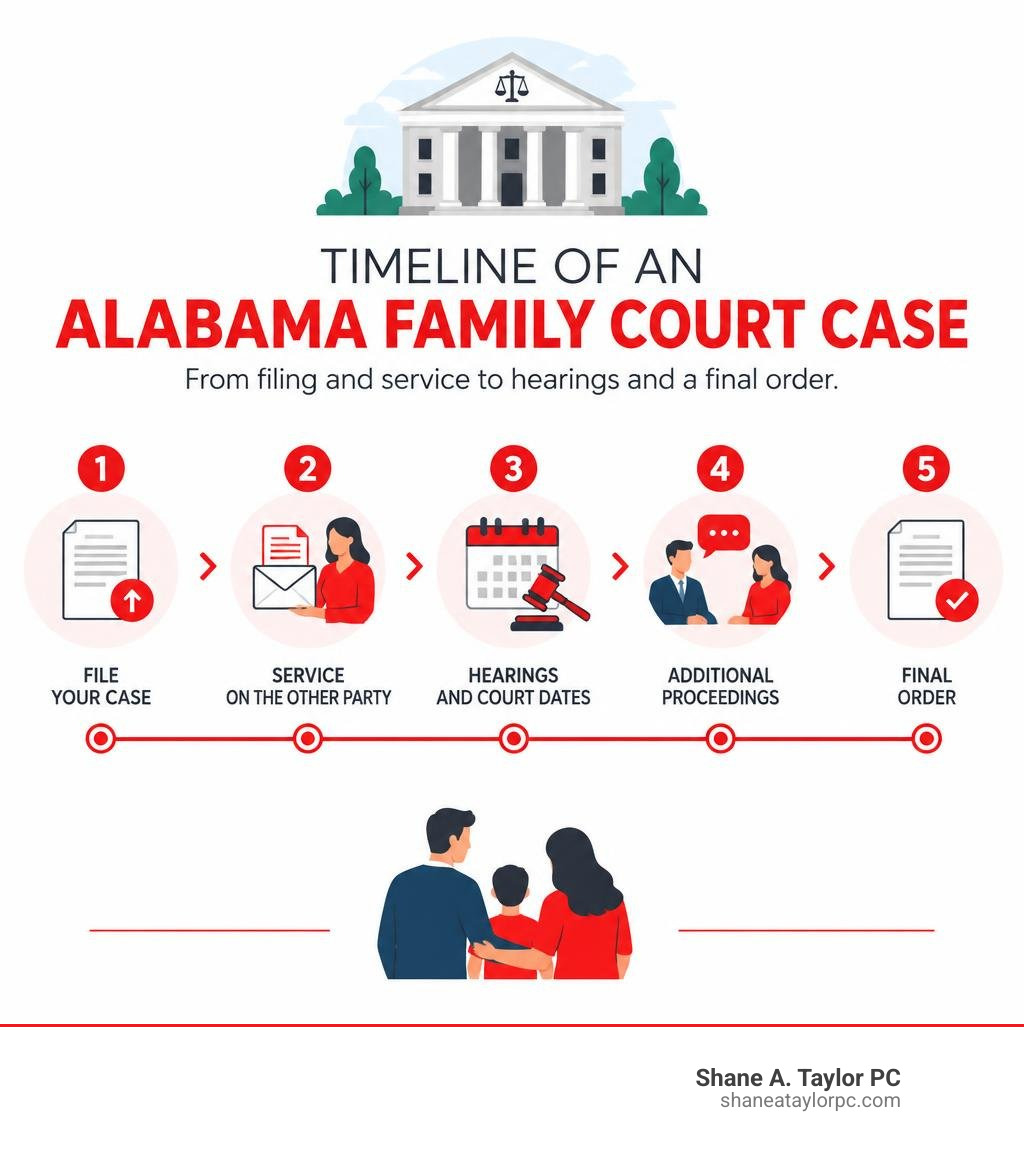
Start with the issue you need the court to decide. For a divorce, file in the proper county’s circuit court. If children are involved, prepare custody and child support paperwork too. To change an existing support order, file a petition for modification. If you need protection from abuse, ask the court about a Protection from Abuse order. The clerk can provide forms and filing information, but cannot give legal advice.
The paperwork and next steps depend on whether your case is agreed or contested. This guide walks through divorce, custody, support, and protection orders so you can see what to prepare.
I’m Shane A. Taylor. My background in law enforcement and practice in Alabama state courts shapes how I approach the difficult choices people face in Alabama family court.
Alabama family court vocabulary:
Understanding Alabama Family Court Structure and Jurisdiction
Navigating the legal landscape of domestic relations starts with understanding where your case belongs. In Alabama, domestic matters operate under the Unified Judicial System, primarily guided by Title 30 of the Code of Alabama. Domestic relations cases—including marriage dissolution, child custody, paternity, and spousal maintenance—fall within the subject-matter jurisdiction of the Circuit Courts.
To handle domestic dockets efficiently, presiding circuit judges possess the statutory authority to designate specialized family court divisions. Under certain judicial frameworks, district judges may be assigned to sit as ex officio circuit judges to hear domestic relations and non-support matters. This structure ensures that time-sensitive domestic disputes receive dedicated judicial attention rather than lingering on general civil dockets.
Legal Framework Under Alabama Code § 12-17-24.1
The creation and operation of dedicated domestic divisions are governed by Code of Alabama Title 12. Under Section 12-17-24.1, a presiding circuit judge may establish a specialized family court division by issuing a formal written administrative order.
Once drafted, the comprehensive implementation plan must be submitted to the Chief Justice of the Alabama Supreme Court for review and approval. By statute, the plan takes effect no later than 90 days after receiving executive approval. While this administrative mechanism allows judicial circuits across the state to establish specialized family courts, several established circuits—including the Sixth, Seventh, Tenth, Thirteenth, Fifteenth, Twentieth, Twenty-Third, and Thirty-Seventh Judicial Circuits—operate under specific statutory exemptions and local court rules that govern their long-standing domestic relations dockets.
Jurisdictional Scope of Circuit and Domestic Relations Divisions
Alabama’s family court and domestic relations divisions possess broad equitable jurisdiction over family-related legal disputes. Their authority covers:
- Absolute divorces (divorce a vinculo matrimonii) and legal separations (divorce a mensa et thoro).
- Annulments and marital property division.
- Child custody determinations, parenting time enforcement, and visitation rights.
- Paternity establishment and interstate child support actions under uniform interstate acts.
- Post-judgment modification and civil contempt proceedings.
In South Alabama, the Mobile County Domestic Relations Division manages domestic filings for the Thirteenth Judicial Circuit, handling both high-conflict marital litigation and simplified domestic filings.
Filing for Divorce: Uncontested vs. Contested Requirements and Forms
Before filing a complaint for divorce in an Alabama circuit court, you must establish proper statutory jurisdiction and residency. If both spouses reside in Alabama, the action can be filed immediately in the circuit court of the county where the defendant resides or where the parties lived when they separated. If the defendant lives outside Alabama, the filing spouse (plaintiff) must have been a bona fide resident of the state for at least six months immediately before filing.

Once filed, Alabama law imposes a mandatory 30-day statutory waiting period from the date of filing before the court can enter a final judgment of divorce. This “cooling-off” period applies regardless of how quickly spouses reach an agreement.
Uncontested Divorce Procedures With and Without Minor Children
An uncontested divorce occurs when both parties agree on every issue: property division, debt allocation, alimony, child custody, and child support. Because there are no disputed facts for a judge to resolve, uncontested divorces proceed via administrative submission and written testimony rather than open-court trials.
When children are involved, state and federal regulations require comprehensive child support disclosures and formal custody frameworks.
| Required Document / Form | Uncontested Without Children | Uncontested With Minor Children |
|---|---|---|
| Complaint for Divorce | Required | Required |
| Summons / Answer and Waiver | Required | Required |
| Testimony of Plaintiff (Affidavit) | Required | Required |
| Marital Settlement Agreement | Required | Required |
| Vital Statistics Certificate of Divorce | Required | Required |
| Domestic Relations Information Sheet (Form CS-47) | Required | Required |
| Child Support Obligation Income Affidavit (Form CS-41) | Not Required | Required (From Both Parents) |
| Child Support Guidelines Form (Form CS-42 or CS-42-S) | Not Required | Required |
| Child Support Notice of Compliance (Form CS-43) | Not Required | Required |
| Mandatory Written Parenting Plan | Not Required | Required |
| Withholding Order / Payment Information | Not Required | Required |
Navigating Contested Divorce Proceedings and Madison County Filing Fees
When spouses cannot reach an agreement regarding custody, asset division, or alimony, the case enters contested litigation. When navigating contested divorce litigation, both parties must engage in formal discovery, temporary hearings (pendente lite motions), settlement conferences, and ultimately a bench trial before a circuit judge.
Filing fees vary by county based on local judicial administration surcharges. For example, in the Madison County Family Division (Twenty-Third Judicial Circuit), the base filing fee for initiating a divorce action is $324.00, payable strictly by cash, money order, or cashier’s check.
In addition to base docket fees, service of process incurs statutory costs:
- Sheriff service of process carries a statutory fee of $20.00.
- Service via certified mail through the circuit clerk’s office costs $10.98.
While uncontested divorces typically conclude in 30 to 90 days, contested domestic litigation often requires 6 to 18 months to reach final adjudication.
Child Custody and Parenting Plans Under 2026 Alabama Law
Child custody determinations in Alabama center strictly on the best interests of the child. When demystifying Alabama child custody laws, it is important to distinguish between legal custody (the authority to make major decisions regarding education, health care, and religious upbringing) and physical custody (the residential schedule outlining where the child lives).
Parents evaluating who gets custody must also complete court-mandated parenting education classes in most Alabama circuits. These programs focus on minimizing emotional stress for children during parental transitions.
The HB 229 Joint Custody Presumption and Mandatory Parenting Plans
Under Alabama custody law, courts apply a statutory rebuttable presumption that joint legal and physical custody serves a child’s best interests. This presumption shifts the burden of proof to any party seeking sole custody, requiring them to demonstrate that shared parenting would cause material harm to the child’s physical, mental, or moral welfare.
Custody actions in Alabama require a detailed, written parenting plan submitted to the court. A compliant parenting plan must establish:
- Legal Custody Designations: Clear protocols defining how joint legal decisions are shared or allocated between parents.
- Physical Custody & Residential Schedules: A calendar outlining weekday routines, weekend rotations, and summer breaks.
- Holiday & Vacation Allocations: A structured schedule alternating major holidays, school vacations, and birthdays.
- Communication Protocols: Defined methods (such as designated co-parenting applications, telephone calls, or email) for parental communication and direct contact with the child.
- Transportation Responsibilities: Clear terms designating exchange locations, pick-up times, and travel cost allocations.
- Alternative Dispute Resolution (ADR): Mandatory mediation or structured negotiation clauses that parents must utilize before filing non-emergency enforcement motions.
Parenting plans must also comply with the Alabama Parent-Child Relationship Protection Act. Under these relocation statutes, a custodial parent seeking to move the child’s principal residence outside the child’s current school district or more than 60 miles away must provide formal written notice at least 45 days prior to the move, giving the non-relocating parent 30 days to file a formal objection.
Resolving Custody and Support Disputes in Alabama Family Court
Custody disputes are not limited to divorce actions. Protecting the rights of unmarried parents in custody actions requires establishing legal paternity through the juvenile or circuit court before enforceable visitation or custody rights can be ordered.
When parents reach an impasse, Alabama family court judges may appoint a Guardian ad Litem (a neutral attorney representing the child’s legal interests) or order formal custody evaluations. Courts assess parental fitness, home stability, emotional bonds, and each parent’s willingness to foster an open relationship with the other parent.
Child Support Calculations, Rule 32 Guidelines, and Modifications
Alabama calculates child support using the statutory Income Shares Model established under Rule 32 of the Alabama Rules of Judicial Administration. This model operates on the principle that a child should receive the same proportion of parental income that they would have enjoyed if the family remained intact.
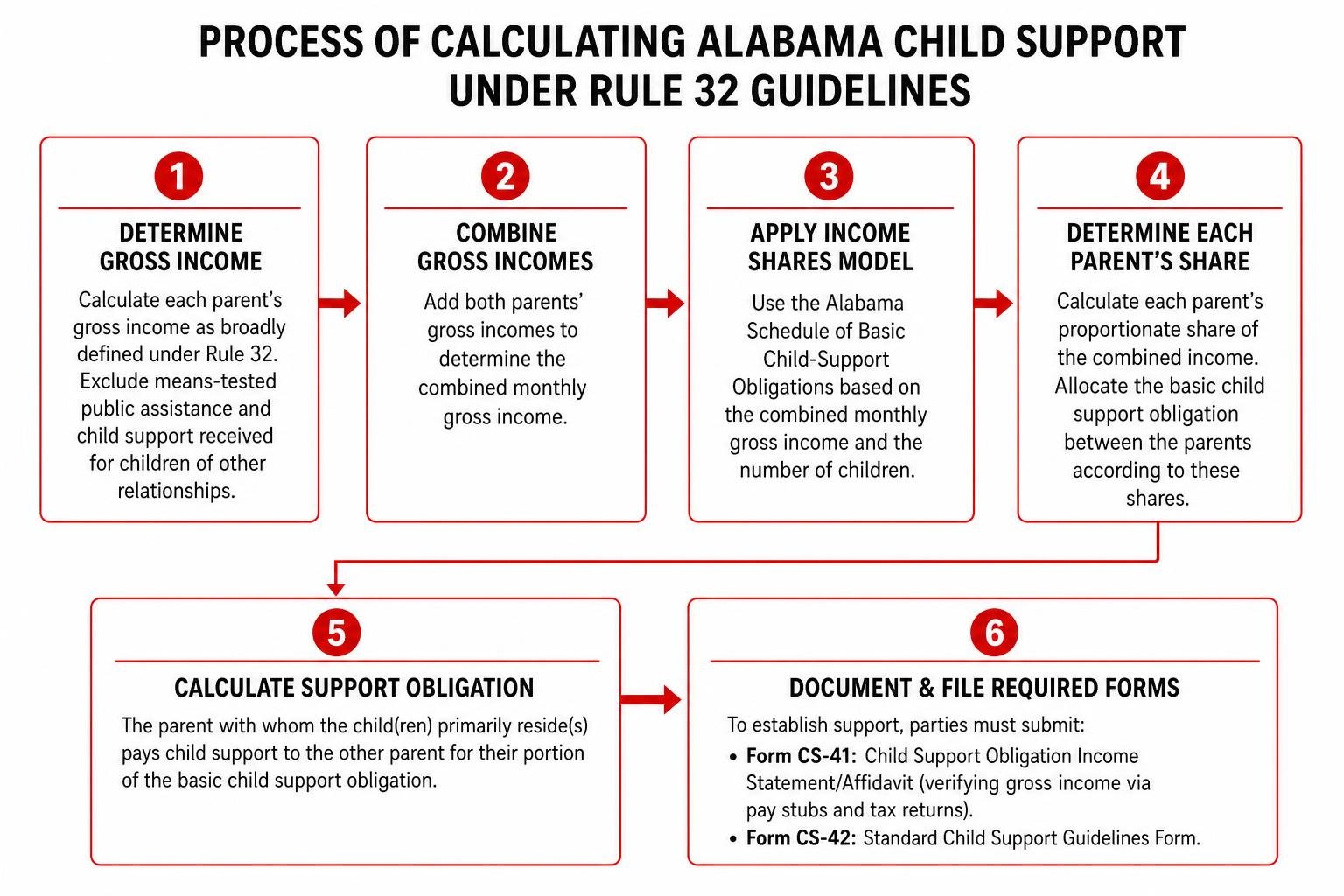
Gross income is broadly defined under Rule 32. It encompasses salary, hourly wages, overtime pay, commissions, bonuses, dividends, severance, pension distributions, workers’ compensation benefits, and self-employment business income (gross receipts minus ordinary and necessary business expenses). Means-tested public assistance and child support received for children of other relationships are excluded.
The Alabama Schedule of Basic Child-Support Obligations establishes standard obligations for combined monthly gross incomes up to $30,000. To establish support, parties must submit:
- Form CS-41: Child Support Obligation Income Statement/Affidavit (verifying gross income via pay stubs and tax returns).
- Form CS-42: Standard Child Support Guidelines Form.
- Form CS-42-S: Child Support Guidelines Form for Shared 50% Physical Custody.
- Form CS-43: Child Support Guidelines Notice of Compliance.
Calculating Support: Income Shares, Self-Support Reserve, and Custody Adjustments
To calculate support under Rule 32:
- Both parents’ gross monthly incomes are combined.
- Each parent’s percentage share of the total monthly income is calculated.
- The basic child support obligation is identified on the statutory schedule based on combined income and the number of children.
- Work-related childcare costs and health insurance premiums paid for the children are added to the basic obligation to determine the total child support obligation.
- Each parent’s final obligation is calculated based on their proportional share of total income.
Alabama incorporates a Self-Support Reserve (SSR) baseline of $981 into its calculations, based on federal poverty standards adjusted for Alabama economic profiles. The SSR protects low-income obligors by ensuring they retain sufficient income for basic subsistence needs.
If the calculated income available for support on Line 12 of Form CS-42 falls below $50, the court applies a rebuttable presumption that a $50 monthly minimum support floor should be entered. In specific circumstances—such as when an obligor has zero gross income and relies exclusively on means-tested disability benefits or is incarcerated for more than 180 consecutive days—the court may enter a zero-dollar child support order.
When parents share equal physical custody (a strict 50/50 residential split), they utilize Form CS-42-S. This form calculates each parent’s theoretical child support obligation to the other, offsetting the amounts so that the higher-earning parent pays the net difference.
Courts may deviate from standard calculations for specific statutory reasons, such as extraordinary travel expenses incurred for visitation or educational expenditures. In divorce proceedings involving significant income disparities, support calculations frequently intersect with spousal support calculations under Alabama’s alimony statutes.
Health-Care Coverage, Disbursement via ACDD, and Support Modifications
Every child support order entered in Alabama must address health-care coverage. A parent will be ordered to provide medical insurance if coverage is accessible and available at a reasonable cost. Under Rule 32, medical insurance or cash medical support is presumed reasonable if the total cost does not exceed 10% of the providing parent’s gross monthly income.
All child support orders require immediate income withholding unless the court finds good cause for an alternative arrangement. Payments flow through a centralized state infrastructure managed by the Alabama Administrative Office of Courts:
- Alabama Child Support Payment Center (ACSPC): Collects and logs all incoming child support withholdings statewide.
- Title IV-D Payments: Routed through the Alabama Department of Human Resources (DHR) Child Support Enforcement Division for cases involving state child support services.
- Non-Title IV-D Payments: Handled by the Alabama Central Disbursement Division (ACDD), which processes and disburses private support funds to recipients on the day they are received.
Child support orders are not permanently fixed. Under Alabama law, a parent can petition for a modification when there is a material and substantial change in financial circumstances. A variation of 10% or more between the existing support order and the newly calculated Rule 32 guideline amount creates a rebuttable presumption that the order should be modified.
Domestic Violence and Protection Orders in Domestic Relations
When family conflict threatens personal safety, the Alabama Protection from Abuse (PFA) Act (Code of Alabama § 30-5-1 et seq.) provides an expedited civil remedy. A Protection Order is an injunction issued by the circuit court restraining an individual from committing acts of abuse, threats, stalking, or harassment.
A person aged 19 or older may file a PFA petition against a current or former spouse, a dating partner, an individual with whom they share a child, or a family member. A parent or legal guardian may also file on behalf of a minor child or incapacitated adult.
Violating a valid protection order is a Class A misdemeanor under Alabama law, carrying penalties of up to one year in a county jail and criminal fines up to $2,000.00, in addition to civil contempt sanctions.
Securing Protection from Abuse Orders Through Alabama Family Court
To obtain a protection order, the petitioner completes and files a Petition for Protection from Abuse with the circuit court clerk. There are no initial filing fees or court costs assessed to a victim seeking a PFA.
If the judge finds an immediate danger of abuse, the court issues a temporary Ex Parte Protection Order without the defendant present. The county sheriff serves the order and summons on the defendant.
Within 14 days of service, the court conducts a formal evidentiary hearing where both parties may present testimony and evidence. Following the hearing, the judge may enter a Final Protection Order providing extensive relief, including:
- Restraining the defendant from committing further abuse, stalking, or contact.
- Granting exclusive possession of the shared marital residence and ordering the defendant to vacate.
- Awarding temporary physical custody and establishing temporary child support.
- Prohibiting the defendant from possessing firearms.
- Ordering the defendant to surrender specific personal property or pay restitution for medical and property expenses.
Final PFA orders are entered into the state and national law enforcement registries and are enforceable across all 67 Alabama counties and nationwide.
Local Crisis Resources in Madison County
Victims of domestic abuse have access to local crisis intervention, legal aid, and emergency shelter resources.
- Emergency Law Enforcement Response: Call 911 for immediate safety intervention.
- Crisis Services of North Alabama: 24/7 Domestic Violence Crisis Line: (256) 716-1000.
- AshaKiran Crisis Line (Huntsville): (256) 509-1882 or (800) 793-3010 (Specialized culturally sensitive crisis support).
- Madison County Circuit Court Clerk’s Office: (256) 532-3300 (Assistance with PFA petition filings).
- Madison County Volunteer Lawyers Program: (256) 539-2275 (Pro bono civil legal representation for qualifying residents).
- Legal Services Alabama (Huntsville Regional Office): (256) 536-9645 or (866) 441-4207.
- Alabama State Bar Lawyer Referral Service: (800) 392-5660.
Frequently Asked Questions About Alabama Domestic Court Practice
What documents are required for an uncontested divorce without children in Alabama?
To file an uncontested divorce without minor children, you must submit:
- Complaint for Divorce (Form PS-01)
- Summons or Answer, Waiver, and Agreement for Taking Testimony
- Testimony of Plaintiff (signed, notarized affidavit establishing jurisdictional grounds)
- Marital Settlement Agreement (resolving division of real estate, personal property, and debts)
- Proposed Final Decree of Divorce
- Certificate of Divorce (Alabama Center for Health Statistics vital records form)
- Domestic Relations Information Sheet (Form CS-47)
How is the Self-Support Reserve applied in Alabama child support calculations?
The Self-Support Reserve (SSR) is a baseline figure ($981 under Rule 32) built into Alabama’s child support calculation to ensure low-income paying parents retain enough income to meet basic subsistence needs.
The calculation subtracts the $981 SSR from the paying parent’s adjusted gross monthly income to determine the actual income available for support. If that amount is calculated at less than $50 on Line 12 of Form CS-42, Rule 32 creates a rebuttable presumption that a statutory minimum support order of $50 per month should be entered, protecting both the child’s basic support rights and the parent’s subsistence.
When can an existing Alabama child support order be modified?
An existing child support order may be modified whenever either parent demonstrates a material, substantial, and continuing change in circumstances since the entry of the last order.
Under Rule 32 of the Alabama Rules of Judicial Administration, a rebuttable presumption for modification exists if applying the current guidelines to the parents’ present financial circumstances results in a child support figure that differs by 10% or more from the existing support order. Common triggers include substantial changes in parental income, significant shifts in work-related childcare costs, changes in health insurance availability, or a child reaching the age of majority (19 in Alabama).
Conclusion
Navigating domestic relations proceedings in Alabama requires thorough preparation, accurate statutory documentation, and strict adherence to statewide procedural rules. Whether you are finalizing an amicable uncontested divorce, establishing an enforceable parenting plan, or protecting your financial and parental rights in contested litigation, understanding the legal framework is essential to protecting your family’s future.
At Shane A. Taylor PC, we provide dedicated, client-focused legal advocacy to guide you through every stage of Alabama family court proceedings. Contact our office today to schedule a confidential consultation with our experienced legal team for comprehensive family law guidance.