


Understanding the Divorce Process: Contested vs. Uncontested Dissolution
A local divorce attorney helps you secure the best legal support by navigating complex court rules, protecting your parental and financial rights, and developing a tailored strategy for your specific circumstances. Whether your case involves an amicable settlement or courtroom litigation, experienced counsel ensures marital assets are accurately identified, custody schedules are properly structured, and statutory filings are completed without costly procedural errors.
Divorce generally breaks down into two distinct paths: uncontested and contested dissolution. Knowing where your situation fits is the first step toward reclaiming peace of mind.
An uncontested divorce occurs when both spouses reach a complete agreement on every major issue before going to trial. This includes the division of marital property, debt allocation, child custody arrangements, visitation schedules, and spousal support. Because both parties agree, these cases bypass prolonged courtroom litigation, saving considerable time, emotional energy, and financial resources. In fact, approximately 95% of divorces across the country are resolved without a trial.
On the other hand, a contested divorce happens when spouses cannot agree on one or more key matters. Whether the dispute involves the valuation of a family business, primary physical custody of the children, or the entitlement to spousal maintenance, these cases require formal legal intervention. When negotiations stall, a family court judge must review the evidence and issue a binding ruling.
If you are thinking, “So You Want a Divorce,” understanding how these paths differ in cost, speed, and procedure will help you set realistic expectations.
| Factor | Uncontested Divorce | Contested Divorce |
|---|---|---|
| Average Timeline | 1 to 3 months (after statutory waiting periods) | 6 months to 2+ years |
| Primary Goal | Formalize a mutually negotiated settlement | Litigate disputed issues before a judge |
| Court Appearances | Rare; often resolved entirely via submitted paperwork | Multiple (hearings, status conferences, trial) |
| Discovery Process | Informal, voluntary exchange of financial disclosures | Formal (interrogatories, depositions, subpoenas) |
| Overall Cost | Lower; often structured around predictable fee arrangements | Higher; dependent on trial duration and complexity |
| Emotional Impact | Lower conflict; collaborative focus | Higher stress; adversarial litigation |
Statutory waiting periods also dictate the minimum timeframe. In Alabama, courts must wait at least 30 days after the initial complaint is filed before granting a final judgment of divorce, though contested proceedings take much longer due to court calendars and necessary preparation.
The Step-by-Step Marital Dissolution Roadmap
Navigating marital dissolution requires following a structured legal process to ensure all rights and assets are fully protected.
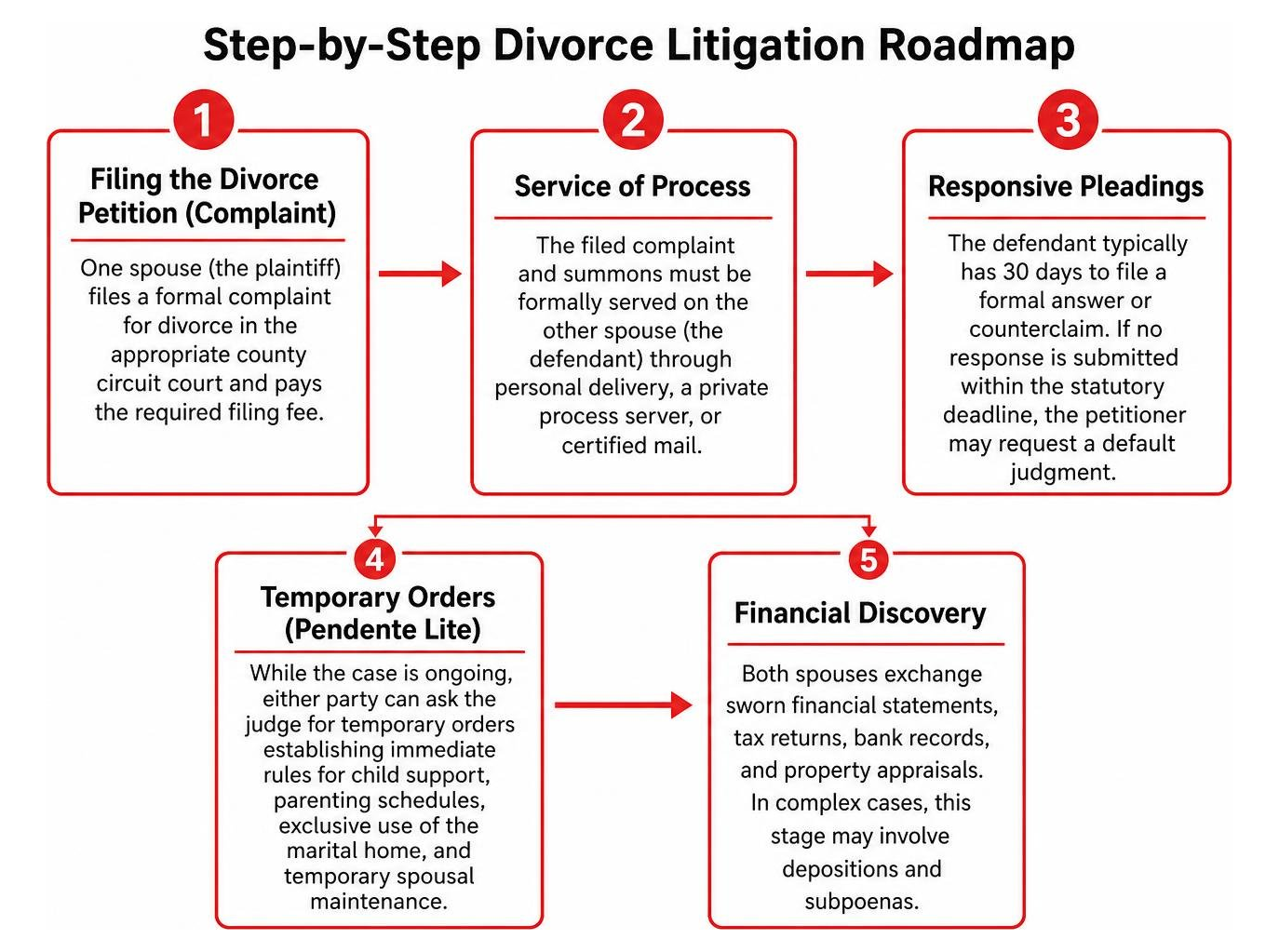
- Filing the Divorce Petition (Complaint): The process officially begins when one spouse (the plaintiff) files a formal complaint for divorce in the appropriate county circuit court and pays the required filing fee. Over 65% of divorce filings are initiated by women—a figure that climbs to roughly 90% among college-educated couples.
- Service of Process: The filed complaint and summons must be formally served on the other spouse (the defendant) through personal delivery, a private process server, or certified mail.
- Responsive Pleadings: The defendant typically has 30 days to file a formal answer or counterclaim. If no response is submitted within the statutory deadline, the petitioner may request a default judgment.
- Temporary Orders (Pendente Lite): While the case is ongoing, either party can ask the judge for temporary orders establishing immediate rules for child support, parenting schedules, exclusive use of the marital home, and temporary spousal maintenance.
- Financial Discovery: Both spouses exchange sworn financial statements, tax returns, bank records, and property appraisals. In complex cases, this stage may involve depositions and subpoenas.
- Negotiation and Mediation: Before setting a trial date, courts frequently encourage or require formal mediation, giving parties a confidential setting to resolve disputed terms with a neutral third party.
- Trial and Courtroom Litigation: If negotiations fail, Navigating the Battleground with a Contested Divorce Lawyer becomes essential. Both sides present evidence, examine witnesses, and present legal arguments before the judge.
- Final Decree of Dissolution: The judge issues a final, written decree legally terminating the marriage, formalizing property division, and establishing permanent custody and support orders.
Key Factors in Divorce: Asset Division, Child Custody, and Spousal Support
When dissolving a marriage, the court’s primary objective is to separate financial lives equitably and ensure the long-term well-being of any minor children.
In Alabama, courts apply the rule of equitable distribution to divide property and debts. “Equitable” means fair under the circumstances, which does not necessarily mean an exact 50/50 mathematical split. The court distinguishes between:
- Marital Property: Assets and debts acquired by either spouse during the marriage, regardless of whose name is on the title. This includes real estate, retirement accounts, vehicles, joint bank accounts, and credit card balances.
- Separate Property: Assets acquired prior to the marriage, or received individually during the marriage via personal gift or inheritance, provided these funds were not commingled with marital assets.
To reach a fair settlement, we prepare a detailed marital balance sheet tracking every asset, liability, and valuation detail.
Spousal support (alimony) is another central financial consideration. Alimony is intended to address significant income disparities and provide financial stability to a spouse who may have sacrificed career advancement for the family.
Courts do not use a rigid formula to determine alimony; instead, they evaluate several factors:
- The length of the marriage
- The standard of living established during the marriage
- Each spouse’s earning capacity, age, health, and employability
- The value of the marital and separate estates
- Marital conduct and fault grounds, when relevant
Whether you are seeking maintenance or facing an unrealistic support claim, reviewing Spousal Support 101 Finding the Best Alimony Lawyer Near Me will help you understand how financial support awards are evaluated.
Protecting Parental Rights and Child Custody Determinations
Child custody decisions are based on the legal standard known as the best interests of the child. Alabama law recognizes two distinct forms of custody:
- Legal Custody: The authority to make fundamental decisions regarding a child’s education, healthcare, religious upbringing, and general welfare. Joint legal custody is frequently awarded so both parents stay involved in major decisions.
- Physical Custody: The determination of where the child primarily lives on a day-to-day basis and the specific schedule for parenting time (visitation).
When setting parenting plans and calculating child support, courts review historical caregiving roles, the emotional bond between each parent and child, home stability, and each parent’s willingness to support the child’s relationship with the other parent. In coastal and surrounding communities, working through a Foley Daphne Fairhope Divorce Guide Finding Your Legal Champion ensures that custody and support arrangements comply with state child support guidelines while safeguarding your parental rights.
How to Choose the Right Divorce Attorney Near Me for Your Case

Selecting the right legal advocate is one of the most critical choices you will make during a domestic dispute. When searching for a qualified divorce attorney near me, you need counsel who pairs deep legal knowledge with an approach suited to your specific goals.
When evaluating potential representation, start by reviewing What to Look for in a Good Divorce Attorney to identify core qualifications, courtroom background, and client responsiveness. Utilizing proven strategies like these 7 Tips for Finding a Qualified Divorce Attorney will help you narrow down practitioners who focus specifically on domestic relations.
Key Qualities to Look for in a Local Divorce Attorney
To ensure your case receives the focused attention it deserves, keep an eye out for these essential qualities:
- Dedicated Family Law Focus: General practitioners who handle everything from traffic tickets to corporate contracts often lack the day-to-day familiarity with local family court judges, evidentiary nuances, and child support formulas.
- Familiarity with Local Courtrooms: Practical familiarity with local circuit judges, domestic referees, and procedural customs helps streamline your case and prevents unnecessary delays. For individuals in our immediate region, The Ultimate Guide to Mobile Alabama Divorce Attorneys offers insight into navigating local judicial expectations.
- Litigation Readiness Paired with Negotiation Skill: Your lawyer should be an adept negotiator who seeks cost-effective settlements, while remaining fully prepared to step into the courtroom and aggressively litigate if the other side refuses to be reasonable. Reviewing resources on Voted Best How to Choose a Top Rated Divorce Attorney Locally can help you assess client satisfaction and courtroom credibility.
- Clear, Direct Communication: A good attorney explains legal principles in plain English, returns messages promptly, and keeps you updated at every stage of your proceedings.
Questions to Ask When Consulting a Local Divorce Attorney
When you schedule an initial case evaluation, come prepared to ask targeted questions to ensure the lawyer’s approach aligns with your needs:
- What percentage of your active caseload is dedicated exclusively to family and divorce law?
- Based on the facts of my case, do you recommend pursuing alternative dispute resolution, or should we prepare immediately for contested litigation?
- How does your office handle client communications, emergency filings, and routine status updates?
- What billing structures do you offer, and what is your policy regarding retainer deposits and itemized statements?
For a deeper look into evaluating legal representation, explore these Insider Tips for Divorce Lawyers Near Me before making a final decision.
Understanding Legal Fees, Retainers, and Divorce Costs
Legal costs can be a major source of stress during a divorce, which is why transparency around fees is essential.
Family law attorneys typically use one of two billing structures:
- Hourly Billing with an Advance Retainer: The most common structure for contested divorces. The client deposits an upfront retainer into a trust account, and the attorney bills against that balance based on the time spent drafting pleadings, conducting discovery, attending hearings, and communicating with the client.
- Flat-Fee Billing: Occasionally used for straightforward, uncontested divorces where both parties have already executed an agreement. A single flat rate covers document preparation and filing.
In addition to attorney fees, standard costs include court filing fees (typically varying by county clerk), process server fees, and, when necessary, expenses for certified real estate appraisers, retirement account evaluators (for QDRO preparation), or forensic accountants.
For individuals facing extreme financial hardship who need help finding low-cost assistance or community resources, checking AlabamaLegalHelp.org | A guide to free and low-cost legal aid … can provide helpful jurisdictional information and public aid guidelines.
Frequently Asked Questions About Hiring a Divorce Lawyer
How long does a divorce typically take from filing to completion?
An uncontested divorce where all agreements are signed in advance can be finalized shortly after the mandatory statutory 30-day waiting period expires, usually taking between 1 to 3 months depending on the judge’s docket. Contested cases requiring extensive discovery, child custody evaluations, or a full trial commonly take between 6 to 18 months, or longer if significant business assets are disputed.
Can I get a free consultation with a local divorce lawyer?
Consultation policies vary by law firm. Some firms provide brief initial screenings at no charge to evaluate basic jurisdictional requirements and check for conflicts of interest, while others charge a standard consultation fee for an in-depth, strategic legal analysis. Be sure to ask about consultation policies when you first contact an office.
What are the main grounds for filing for divorce?
Alabama allows for both no-fault and fault-based divorce filings:
- No-Fault Grounds: Complete incompatibility of temperament such that the parties can no longer live together, or an irretrievable breakdown of the marriage.
- Fault-Based Grounds: Adultery, voluntary abandonment for one year, imprisonment for two or more years, habitual drunkenness or drug addiction, physical cruelty or reasonable apprehension of violence, and incurable insanity. Proving fault can influence how a judge decides property division and spousal maintenance awards.
Conclusion: Securing Experienced Legal Representation for Your Future
Divorce marks the close of one chapter and the beginning of another. The decisions you make during this transition regarding your children, finances, and property will shape your life for years to come. Making rushed, emotionally driven choices without experienced legal guidance can lead to unintended, long-term consequences.
At Shane A. Taylor PC, our team is dedicated to providing clear, responsive, and strategic counsel tailored to your family’s unique situation. Whether you are working toward an amicable, uncontested settlement or need steadfast representation inside the courtroom, we are here to protect your rights and help you move forward with confidence.
Explore our comprehensive family law services by visiting our Practice Areas Family Law page, and contact our Mobile, Alabama office today to schedule a confidential case evaluation.