


What Happens When You Violate Probation — And How to Fix It
If you need the best probation violation lawyers near me, here is what matters most:
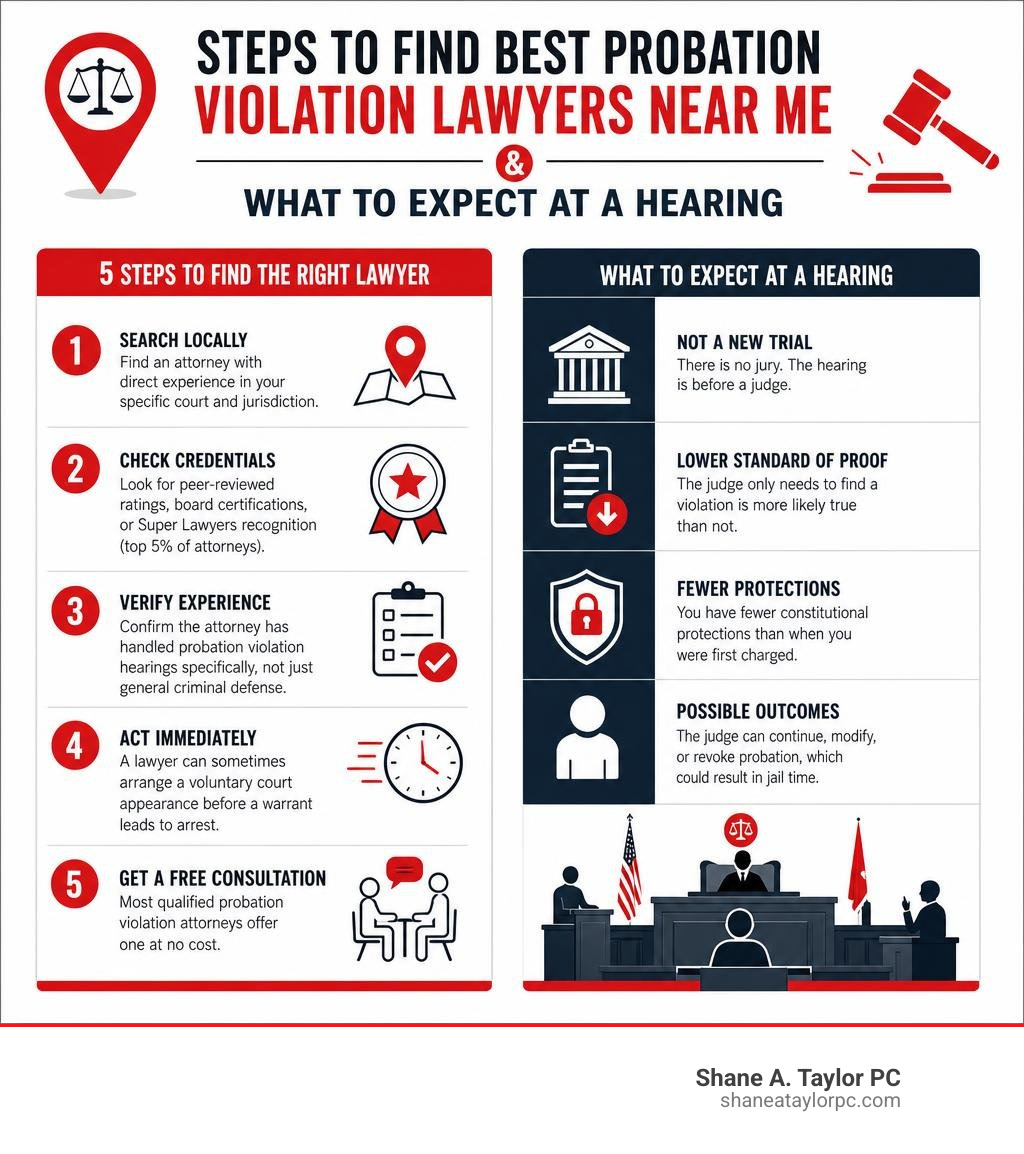
How to find the right probation violation lawyer:
- Search locally — find an attorney with direct experience in your specific court and jurisdiction
- Check credentials — look for peer-reviewed ratings, board certifications, or Super Lawyers recognition (top 5% of attorneys)
- Verify experience — confirm the attorney has handled probation violation hearings specifically, not just general criminal defense
- Act immediately — a lawyer can sometimes arrange a voluntary court appearance before a warrant leads to arrest
- Get a free consultation — most qualified probation violation attorneys offer one at no cost
A probation violation can put your freedom at risk overnight. One missed appointment, one failed drug test, or one misunderstanding with your probation officer can trigger a warrant — and in many states, that means a no-bail hold in county jail until a judge sees you.
What makes this especially serious is that probation hearings are not like regular criminal trials. There is no jury. The standard of proof is lower. And you have fewer constitutional protections than you did when you were first charged.
This guide walks you through exactly what happens, what your rights are, and how to protect yourself.
I’m Shane A. Taylor — a criminal defense attorney based in Mobile, Alabama, with a background as a former police officer and over a decade of experience in Alabama and Mississippi state and federal courts, giving me the inside knowledge needed to find the best probation violation lawyers near me and to defend clients facing exactly this situation. If your family member’s freedom is on the line, understanding the process is the first step toward protecting it.
Understanding Probation Violations vs. New Criminal Charges
To understand how to fight an allegation of non-compliance, we first need to distinguish between a probation violation and a brand-new criminal charge. When you are on probation, you are essentially serving a suspended sentence. The court has allowed you to remain in the community under specific conditions instead of behind bars.
However, this leniency comes with a catch. If you break those rules, you are not facing a new trial with all the standard constitutional bells and whistles. Instead, you are accused of breaching a contract with the court.
If you are hit with a new criminal charge while on probation, you face a double-edged sword. First, you must defend against the new charge itself. Second, that arrest instantly triggers a probation violation.
Understanding these dual tracks is vital. You can read more about how these scenarios unfold in our guides on Understanding Consequences in Your Criminal Case and What Happens If You Are Charged With a Crime.
Technical Violations vs. Substantive Violations
Not all probation violations are created equal. The legal system generally divides violations into two main categories: technical violations and substantive (or physical/new law) violations.
- Technical Violations: These occur when you fail to follow the administrative rules set by the court or your probation officer. Examples include missing a scheduled check-in, failing to pay court costs, failing a drug screen, or traveling outside Mobile County without written permission.
- Substantive Violations: These occur when you are arrested or charged with committing a new crime while on supervision. This is far more serious because it demonstrates to the judge that you are allegedly continuing to break the law despite being given a second chance.
| Violation Type | Definition | Common Examples | Typical Court Reaction |
|---|---|---|---|
| Technical | Administrative rule-breaking | Missed meetings, unpaid fines, positive drug tests, curfew violations | Warning, modified terms, short-term jail “dips” |
| Substantive | Committing a new criminal offense | DUI arrest, drug possession, domestic violence charges | Probation revocation, immediate jail hold, execution of the original suspended sentence |
Common Probation Terms and the Consequences of Non-Compliance
When a judge in Mobile, Alabama, sentences you to probation, they will hand down a long list of conditions. These are not friendly suggestions. They are strict, court-ordered mandates.
Some of the most common terms of probation we see in our Criminal Defense practice include:
- Regular Reporting: You must meet with your probation officer at specified intervals (weekly, bi-weekly, or monthly).
- Random Drug and Alcohol Testing: You must submit to urine, breath, or blood tests upon demand.
- Paying Restitution and Fees: You must pay back victims, cover court costs, and pay monthly probation supervision fees.
- Community Service: Completing a set number of volunteer hours with approved organizations.
- Maintaining Employment: Actively working or proving that you are looking for a job.
- Travel Restrictions: You cannot leave the state of Alabama or your designated county without prior approval.
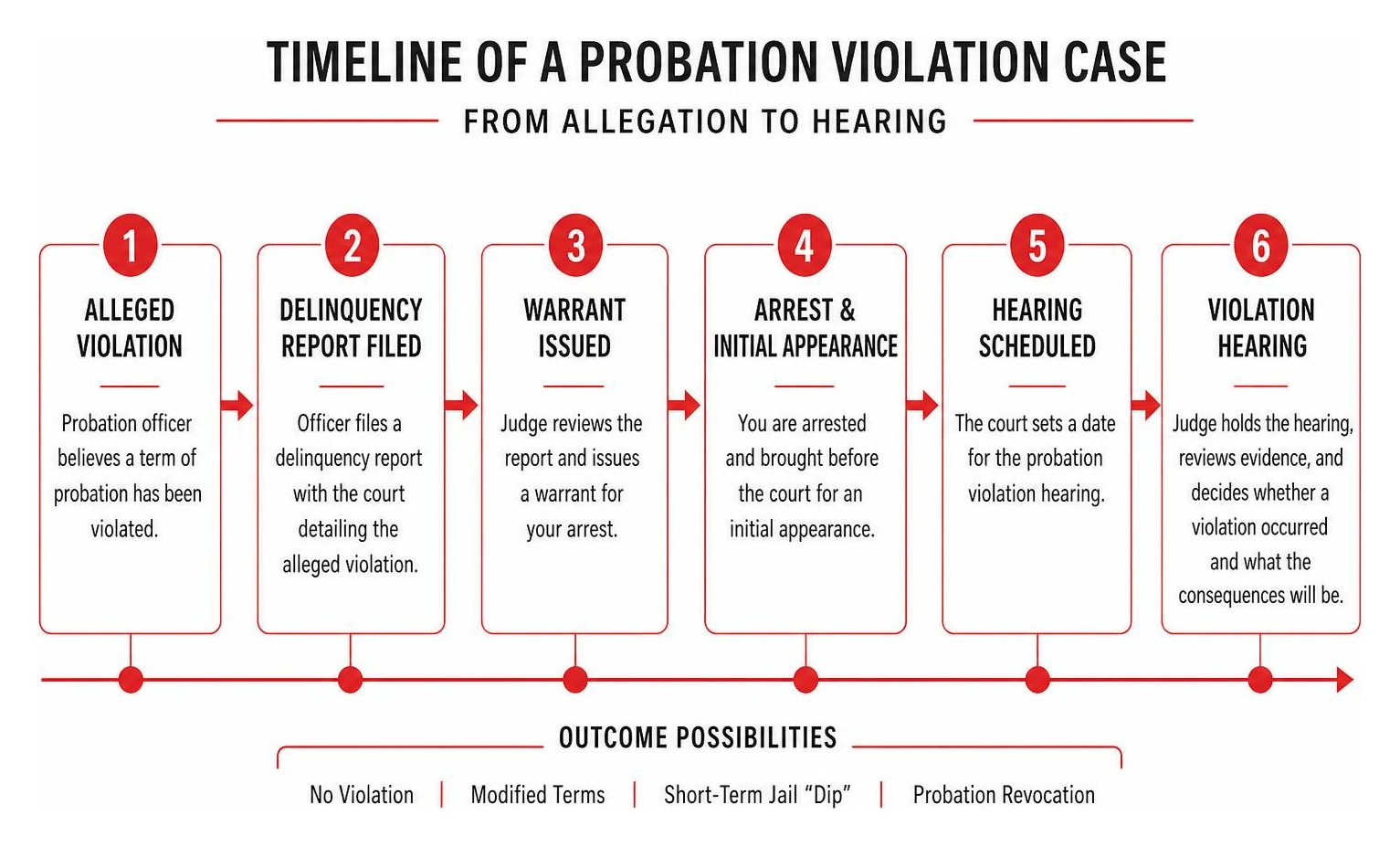
Failure to comply with any of these terms can cause your probation officer to file a formal delinquency report. While probation officers have some discretion, they are under heavy pressure to report non-compliance. If they believe you are willfully ignoring the rules, they will request a warrant for your arrest.
Potential Penalties and State-Specific Consequences
In Alabama, the consequences of violating probation are governed strictly by state law, specifically Alabama Rule of Criminal Procedure 27. Under Alabama law, the penalties depend heavily on whether your violation is technical or substantive.
For technical violations, Alabama has implemented reforms designed to keep people from being sent straight back to prison for minor slip-ups. Instead of full revocation, a judge may order:
- A temporary stay in jail (known as a “dip”): Typically up to 2 to 3 days in the county jail.
- A “dunk” in a state facility: A short-term confinement period of up to 45 days.
- An extension of your probation period or additional terms, such as mandatory drug rehabilitation.
However, if you commit a substantive violation (a new crime) or if you have repeatedly failed to comply with technical terms, the judge has the power to revoke your probation entirely. This means you will be sent to jail or prison to serve the remainder of your original suspended sentence. Furthermore, any “street time” you successfully spent on probation may not count toward your active sentence.
The Probation Revocation Hearing and Legal Standards of Proof
If your probation officer files a formal violation, you will have to appear at a probation revocation hearing. It is crucial to understand that this is not a trial.
- No Jury: The hearing is conducted entirely before a judge. The very same judge who originally sentenced you will decide your fate.
- Limited Fifth Amendment Rights: While you still have the right to remain silent in many contexts, the judge can often take your refusal to testify or explain your actions into account when deciding if you violated your terms.
- Hearsay is Admissible: Unlike in a standard trial where hearsay is strictly excluded, the state can introduce police reports, letters from treatment providers, and statements from your probation officer without them needing to testify in person.
Because the rules of evidence are relaxed, defending yourself without an experienced attorney is incredibly risky. You can read more about how the standard of proof differs in our analysis of why Mobile Criminal Lawyers Crime Must Be Paid Beyond Reasonable Doubt.
The Lower Standard of Proof in Revocation Hearings
In a standard criminal trial, the state must prove your guilt “beyond a reasonable doubt.” This is the highest standard in our legal system.
In a probation violation hearing, that standard is thrown out the window. Instead, the state only needs to prove the violation by a preponderance of the evidence (or that the judge is “reasonably satisfied” that the violation occurred).
This means if the judge believes there is a 51% chance you violated your probation, they can legally rule against you. This lower standard makes it incredibly easy for prosecutors to secure a revocation, which is why having the best probation violation lawyers near me on your side is so critical.
Why You Need the Best Probation Violation Lawyers Near Me Immediately
When the standard of proof is this low, your defense cannot rely on simple denials. We must build a proactive defense strategy that focuses on showing the court either that the violation was not willful, or that there are substantial mitigating circumstances.
For example, if you missed a probation meeting because you were hospitalized, we will gather the medical records to prove it. If you fell behind on restitution payments because you lost your job, we can present evidence of your active job search to show you were not willfully refusing to pay. We know that Criminal Lawyers Can Make a Difference by telling your side of the story in a way that appeals to the judge’s sense of fairness and legal boundaries.
How to Find the Best Probation Violation Lawyers Near Me
If you or a loved one is facing a probation violation in the Mobile, Alabama area, finding the right legal representation is the most important step you can take. You need an attorney who knows the local courts, the local judges, and how the Mobile County probation office operates.

When searching for the best probation violation lawyers near me, keep these directory and peer-review factors in mind:
- Super Lawyers Selection: Look for attorneys recognized by peer-reviewed organizations. The Super Lawyers selection process, for example, evaluates the top 5% of attorneys in each state through independent research and peer reviews.
- Deep Local Roots: An attorney who practices in the same courthouse every day will understand how specific judges view technical violations versus substantive ones.
- State-Specific Expertise: While general legal guides can highlight broad defense strategies, your lawyer must be an expert in Alabama-specific laws and local court procedures, as probation rules vary significantly from state to state.
What to Look For in the Best Probation Violation Lawyers Near Me
As you evaluate your options, look for these key qualifications:
- A Dedicated Criminal Defense Practice: Avoid generalists who handle a little bit of everything but rarely step foot in a criminal courtroom.
- Clear, Responsive Communication: You want a team that returns your calls quickly. When you are facing jail, silence from your attorney is agonizing.
- A Transparent Strategy: During your initial consultation, the lawyer should outline a clear plan of action, explaining the worst-case and best-case scenarios honestly.
Immediate Steps to Take If You Suspect a Violation
If you know you missed a drug test, missed an appointment, or if a warrant has already been issued for your arrest, do not panic — but do not wait for the police to knock on your door either. Take these steps immediately:
- Document Everything: Keep copies of your pay stubs, treatment certificates, medical records, and any text messages or emails between you and your probation officer.
- Avoid Making Statements: Do not call your probation officer to argue or make unadvised admissions. Talk to a lawyer first.
- Plan a Controlled Surrender: If there is an active warrant, your attorney can often coordinate with the court for a voluntary walk-through or a scheduled appearance, which looks much better to a judge than being picked up on a routine traffic stop. This proactive approach helps prevent issues of mistaken identity or unnecessary jail holds, which we discuss in our guide on Right Name Wrong Man Mobile Criminal Lawyers on Mistaken Identities.
Frequently Asked Questions About Probation Violations
Can a probation violation warrant be resolved without going to jail?
Yes. In many cases, an experienced attorney can negotiate with the prosecutor or your probation officer before your court date. If the violation is technical, we may be able to arrange a voluntary court appearance where we present proof of compliance (such as catching up on payments or completing classes), allowing the judge to recall the warrant and reinstate your probation without you spending a single night in jail.
What happens if I fail a drug test while on probation?
Failing a drug test is a common technical violation. In Alabama, judges are increasingly open to rehabilitation rather than purely punitive measures. If the failure is due to an ongoing struggle with substance abuse, we can leverage addiction treatment programs as a proactive defense. With national drug overdose deaths highlighting the severity of the addiction crisis, showing the judge that you are actively seeking help in a structured facility is often the most effective way to avoid jail time.
Do I have a right to bond after a probation violation arrest?
No. Unlike a new criminal arrest where you have a constitutional right to a reasonable bond, there is no automatic right to bond on a probation violation warrant in Alabama. Many warrants are issued with a “no-bond” hold. This means you will sit in the county jail until your revocation hearing unless your attorney successfully petitions the court for a bond hearing to secure your temporary release.
Conclusion
Facing an allegation of a probation violation is incredibly stressful, but it does not have to mean the end of your freedom. By taking fast, proactive legal action and working with a team that understands the local courts, you can present a strong defense and work toward getting your life back on track.
At Shane A. Taylor PC, we provide the aggressive, client-focused representation you need when your future is on the line. We serve clients throughout Mobile, Alabama, delivering responsive service and real results.
If you or a loved one is facing a probation violation, do not wait for the system to make the decision for you. Contact our office today to schedule a consultation, or get experienced representation from our criminal defense team to protect your rights and keep your freedom intact.