


Understanding Mediation vs. Courtroom Litigation
When ending a marriage, couples generally face two distinct paths: private negotiation or courtroom litigation. Litigation is an adversarial contest where each spouse hires legal counsel to battle over assets, debts, and children. In trial, a judge makes final, legally binding rulings based on state statutes. That process can leave both parties feeling stripped of control over their daily lives.
Mediation fundamentally shifts this dynamic. Instead of handing life-altering decisions to a stranger in a black robe, spouses sit down with a neutral third party who facilitates structured conversation. The mediator does not take sides, issue verdicts, or decide who was “right.” Instead, they guide both parties toward compromise.
Confidentiality marks another major difference. Courtroom litigation takes place on the public record. Financial filings, heated allegations, and transcripts become accessible documents. Mediation occurs behind closed doors, protecting sensitive family affairs from public view.
| Key Factor | Divorce Mediation | Courtroom Litigation |
|---|---|---|
| Decision-Maker | Both spouses through mutual agreement | Family court judge |
| Privacy | Completely confidential discussions | Public court records and open hearings |
| Average Cost | 50% to 80% less expensive | Substantial legal retainers and trial expenses |
| Timeline | Weeks to a few months | 12 to 24+ months depending on court dockets |
| Communication Tone | Collaborative and forward-looking | Adversarial, conflict-driven, and formal |
| Outcome Control | High; tailored settlement terms | Low; rigid legal formulas applied by court |
Couples evaluating their options must also consider whether full dissolution is the right immediate step. If you find yourself thinking, “so you want a divorce,” take time to explore whether a legal separation better serves your family’s needs. Legal separation allows spouses to divide property and establish formal custody arrangements while remaining legally married. This path can help families preserve essential health insurance benefits or manage complex tax implications before taking the final step to dissolve the marriage.
Key Benefits of Divorce Mediation for Resolving Marital Disputes
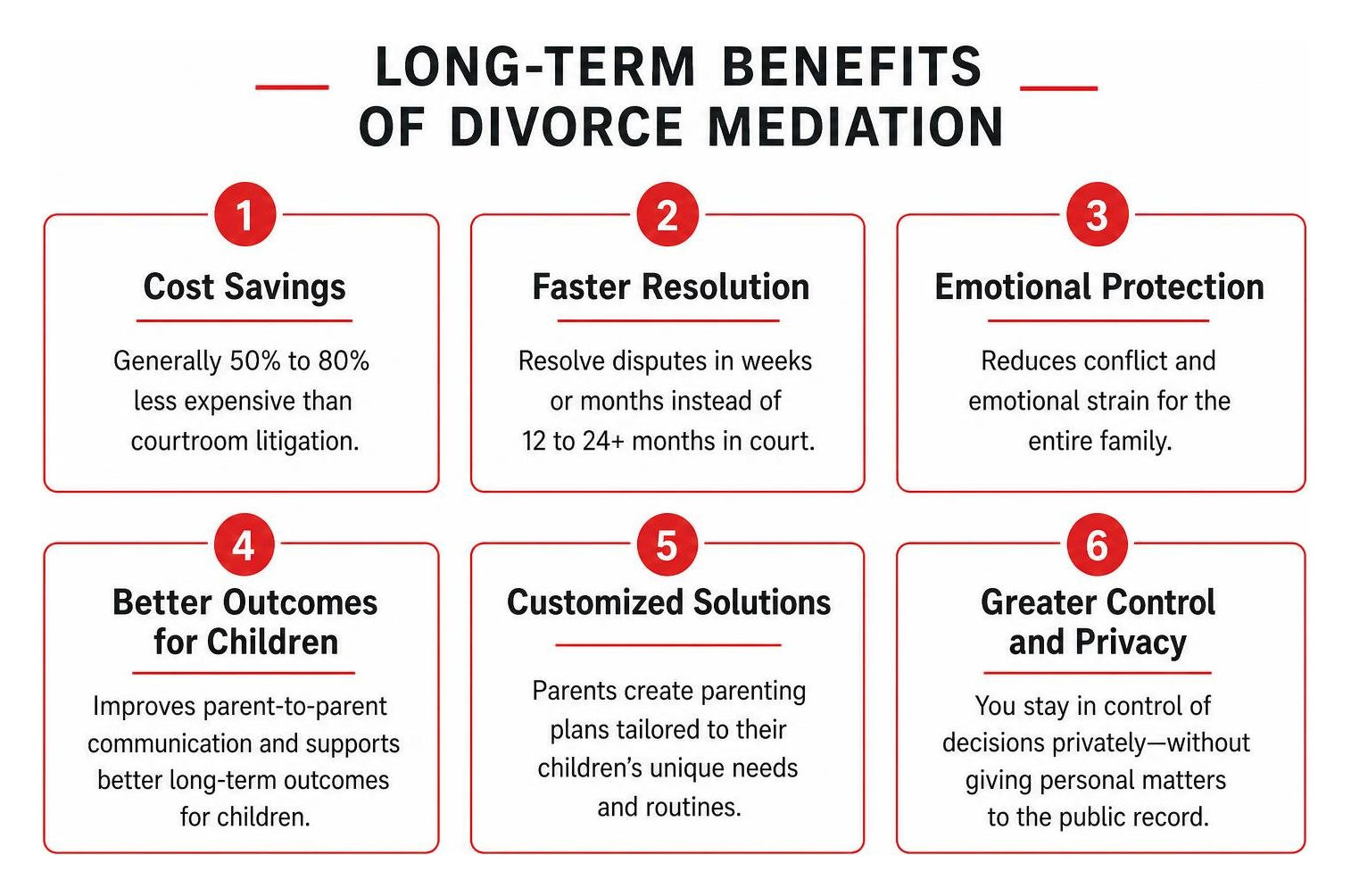
Mediation offers an alternative to the exhausting financial and emotional strain of contested courtroom divorces. One of its clearest benefits is direct cost reduction. Because couples work alongside a single neutral facilitator rather than funding two lawyers for endless trial preparation, mediated divorce is generally 50% to 80% cheaper than litigation.
Families can often explore structured flat fee divorce options that streamline costs into clear milestones instead of draining family savings through unpredictable hourly billing.
Beyond savings, mediation significantly accelerates your timeline. Contested litigation often stalls for a year or more due to packed court dockets, whereas mediation allows you to set your own meeting schedule and resolve disputes in weeks or months. Most importantly, it shields your family from emotional trauma. Studies show that mediation reduces court involvement, improves direct parent-to-parent communication, and links directly to better psychological outcomes for children up to 12 years after separation.
Protecting Children and Establishing Parenting Plans
When parents battle inside a courtroom, custody disputes easily become destructive. Judges evaluate cases through standard statutory guidelines, but they cannot know the daily rhythms, passions, and unique needs of your children.
Mediation keeps child welfare at the center of every conversation. Rather than arguing over rigid labels, parents construct customized parenting schedules that outline:
- Day-to-day residential schedules that balance school routines and extracurriculars
- Alternating holiday rotations and extended summer vacation plans
- Clear transportation and exchange logistics
- Practical guidelines for introducing new partners or handling out-of-state travel
Parents can thoughtfully evaluate who gets custody based on real caregiving dynamics rather than tactical posturing. Gaining clear insight into what every parent must know before hiring a divorce and custody lawyer will help you protect your parental rights while keeping conversations focused on your children’s well-being.
Financial Fairness and Asset Division
Dividing a lifetime of shared assets requires complete honesty and careful valuation. In mediation, couples work through financial division without the posturing typical of courtroom discovery battles.
Both parties identify, value, and equitably allocate:
- Real Estate: Deciding whether to sell the marital residence, execute a buyout, or establish co-ownership terms until children graduate.
- Retirement Assets: Dividing 401(k) accounts, pensions, and IRAs using a Qualified Domestic Relations Order (QDRO) to prevent early withdrawal penalties and tax hits.
- Marital Debts: Allocating credit cards, personal loans, and mortgages cleanly to prevent future credit damage.
- Support Obligations: Calculating appropriate child support figures and exploring clear spousal support guidance based on income disparities, marriage length, and earning potential.
The Mediation Workflow: From Intake to Final Agreement
A successful mediation relies on a clear, well-organized process. The journey begins with an initial consultation where the neutral professional assesses whether mediation fits both parties and outlines ground rules for respectful dialogue.
Spouses then complete intake questionnaires and submit a Financial Disclosure Statement (FDS). Total transparency is required; hiding assets undermines the entire process and will invalidate any resulting agreement. Once documents are compiled, sessions begin using either joint caucuses (conversations with all parties in one room) or shuttle negotiations (the mediator moves between separate rooms) to resolve disputes one by one.
Step-by-Step Stages of Divorce Mediation
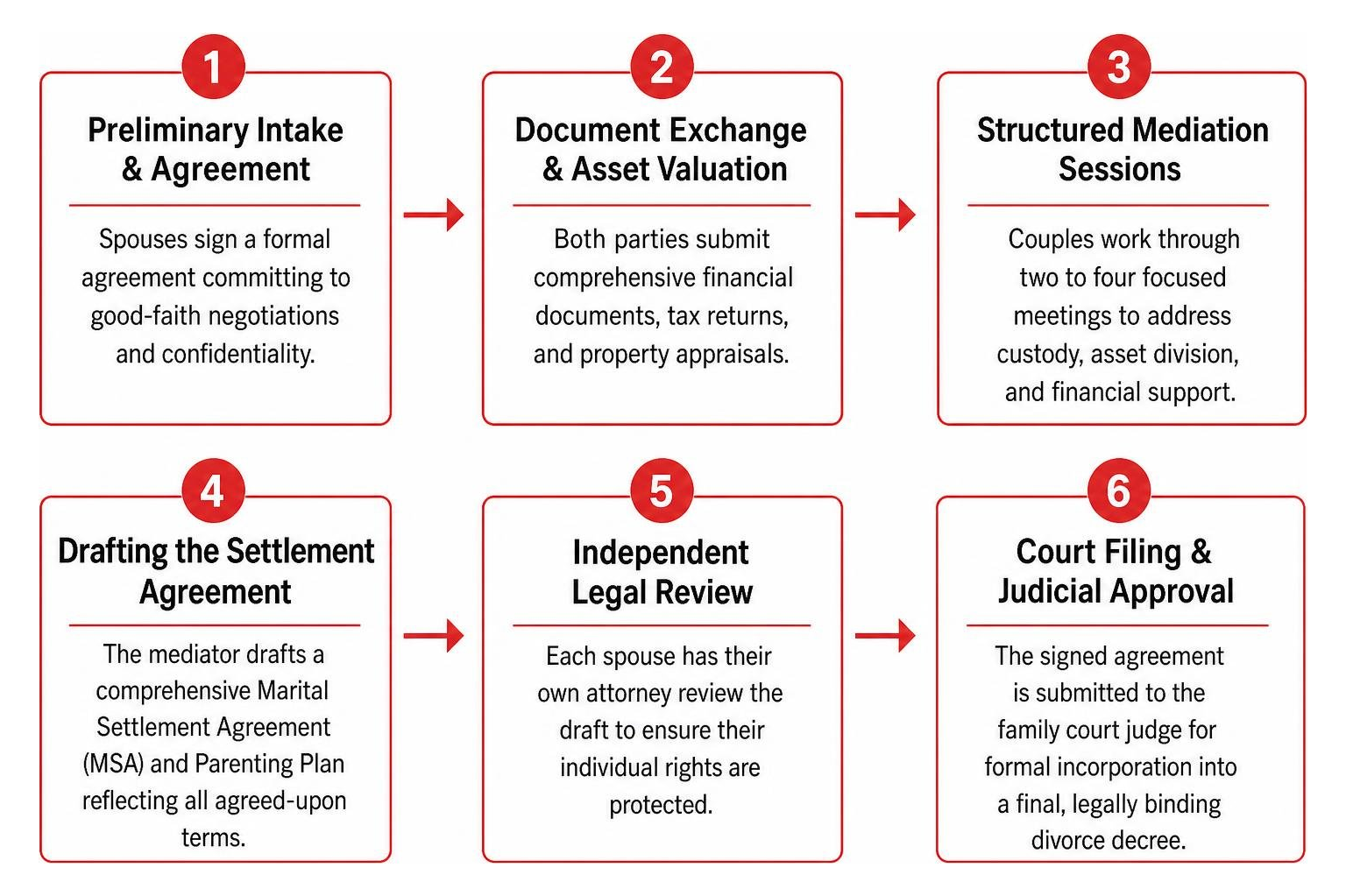
The mediation process moves through predictable stages from first contact to legal finalization:
- Preliminary Intake & Agreement: Spouses sign a formal agreement committing to good-faith negotiations and confidentiality.
- Document Exchange & Asset Valuation: Both parties submit comprehensive financial documents, tax returns, and property appraisals.
- Structured Mediation Sessions: Couples work through two to four focused meetings to address custody, asset division, and financial support.
- Drafting the Settlement Agreement: The mediator drafts a comprehensive Marital Settlement Agreement (MSA) and Parenting Plan reflecting all agreed-upon terms.
- Independent Legal Review: Each spouse has their own attorney review the draft to ensure their individual rights are protected.
- Court Filing & Judicial Approval: The signed agreement is submitted to the family court judge for formal incorporation into a final, legally binding divorce decree.
Is Online Divorce Mediation Effective for High-Conflict Spouses?
Many spouses worry that mediation cannot work if their relationship involves significant tension or poor communication. Fortunately, modern virtual platforms have made mediation practical even for high-conflict couples.
Video conferencing tools like Zoom allow spouses to negotiate safely from separate physical locations. Mediators place parties into private digital breakout rooms, serving as a communication buffer. This format prevents emotional flare-ups, addresses power imbalances, and allows parties to pause and collect their thoughts between proposals.
When searching for a certified mediator, you can verify professional credentials and formal dispute resolution training through official rosters like Find a Mediator. If negotiations break down and one spouse refuses to negotiate in good faith, you can transition your case to a contested divorce lawyer who can step in to advocate for you in court.
Choosing Between Neutral Mediators and Independent Legal Counsel
A common point of confusion is the difference between a mediator and an attorney. A mediator is a neutral facilitator who cannot give legal advice, advocate for either spouse, or ensure an individual deal is in your personal best interest.
For this reason, hiring a consulting attorney alongside your mediator is often wise. An independent lawyer provides confidential legal advice, calculates risk, and performs an objective review of the draft Marital Settlement Agreement before you sign. This step guarantees you sign with full, informed consent.
Mediators typically hold a minimum of 40 hours of approved Alternative Dispute Resolution (ADR) training and have deep experience in family conflict management. As you assemble your professional team, review these strategies for finding a qualified divorce attorney to guide you. Partnering with a dedicated local divorce attorney ensures your final paperwork aligns with regional court requirements and protects your long-term interests.
Frequently Asked Questions About Mediated Divorce
How long does the entire mediation process typically take?
Most couples resolve their issues in two to four mediation sessions, with each meeting lasting between one and two hours. Depending on how quickly both parties gather financial records and schedule follow-ups, the core agreement can be completed within a few weeks to two months. Once submitted, court finalization depends on standard statutory waiting periods and local processing times.
What happens if we cannot reach an agreement on all issues?
Mediation is not an all-or-nothing process. If you reach consensus on parenting schedules and asset division but disagree on spousal support, you can draft a partial agreement for the settled issues. The remaining points can then be resolved through targeted negotiations between attorneys or brought before a judge for a focused ruling.
Is the final mediated agreement legally binding in court?
During negotiations, verbal discussions and working notes remain non-binding proposals. However, once both spouses sign the formal Marital Settlement Agreement and submit it to the court, the judge reviews the terms and incorporates them into the final divorce decree. At that point, the agreement becomes an enforceable court order, and any future violations can be addressed through standard legal enforcement proceedings.
Conclusion

Divorce marks the end of a marital partnership, but it does not have to drain your finances or create lasting bitterness for your children. Choosing mediation allows you to maintain control over your assets, protect your privacy, and build a workable co-parenting relationship for the years ahead.
If you are ready to explore your options or need seasoned legal counsel to review a settlement agreement, we are here to help. Reach out to Shane A. Taylor PC family law services today to schedule an initial consultation and take the first confident step toward your family’s future.