


How to Find a Legal Separation Attorney Near You
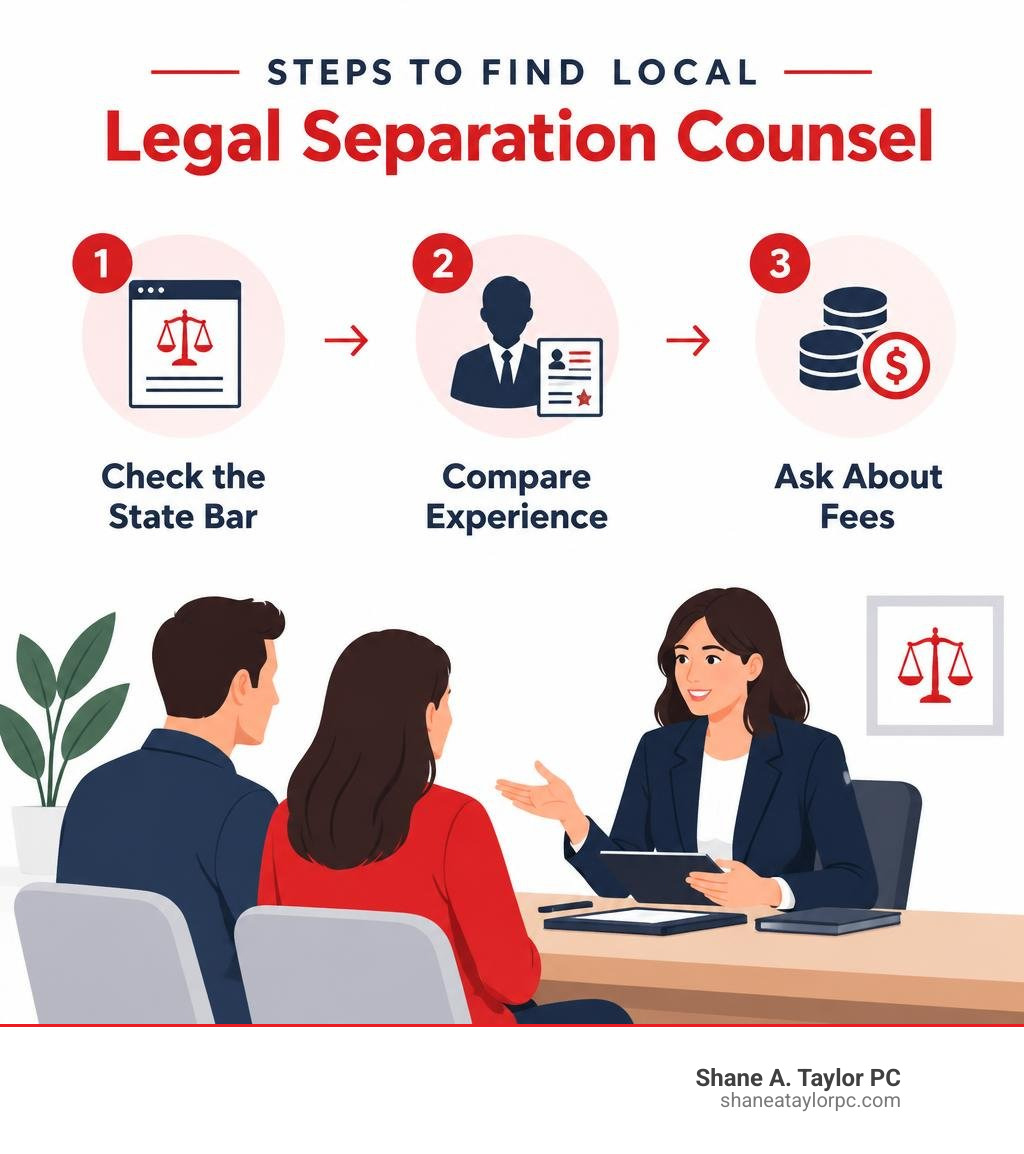
Start with a family law attorney licensed in your state. Check your state bar’s lawyer directory, then speak with two or three attorneys who handle legal separation, custody, and property issues in your local court. Ask what the process involves, how they charge, and who will handle your case.
Legal separation can set court-enforced terms for parenting, support, and finances while you remain married. The rules differ by state, so local experience matters. For a broader overview of how separation fits into domestic relations law, the American Bar Association’s family law resources explain the legal framework that applies in most states.
I’m Shane A. Taylor, and I’ve practiced in Alabama state courts for years after serving as a Birmingham police officer. If you’re searching for a legal separation attorney near me, this guide will help you compare your options and prepare for a first conversation.
Key terms for legal separation attorney near me:
Understanding Legal Separation vs. Divorce: Key Differences and Benefits
When marital challenges arise, many people assume their only choice is an absolute divorce. However, legal separation provides a structured, court-approved alternative. Think of legal separation as hitting the “pause button” on a marriage: you establish formal, enforceable boundaries regarding money, parenting, and living arrangements, but your legal marital status remains intact.
In an absolute divorce, the court permanently dissolves the legal marriage bond. Once the final decree is signed, both spouses are legally single and free to remarry. In a legal separation (often referred to historically in courts as a divorce a mensa et thoro, or separation from bed and board), the court issues legally binding orders regarding property division, debt allocation, alimony, and child custody, yet the marriage continues.
| Feature | Legal Separation | Absolute Divorce |
|---|---|---|
| Marital Status | Legally Married | Legally Single |
| Right to Remarry | No | Yes |
| Asset & Debt Division | Formally divided by court order | Permanently divided |
| Health Insurance | Often maintained (policy permitting) | Terminated upon final decree |
| Court Enforcement | Fully enforceable court decree | Fully enforceable court decree |
| Reconciliation Process | Simple motion to dismiss or vacate | Requires formal remarriage |
Choosing between these paths requires evaluating your emotional needs, financial realities, and long-term goals. For an exhaustive overview of domestic relations law, see our comprehensive family law attorney guide 2026.
Why Couples Choose Separation Over Dissolution
Roughly 35 to 50 percent of first marriages in the United States face serious instability, leading spouses to evaluate their options. People choose legal separation over immediate dissolution for several practical and personal reasons:
- Trial Separation with Legal Guardrails: It gives couples space to work through difficulties or evaluate life apart while protecting their financial interests from reckless spending or newly accrued marital debts.
- Religious or Moral Beliefs: Certain religious traditions discourage or prohibit divorce. Legal separation allows individuals to live independently without violating their spiritual convictions.
- Healthcare Retention: When one spouse relies on the other’s comprehensive employer-provided health insurance plan, maintaining the marriage allows them to continue coverage.
- Social Security and Pension Milestones: Federal benefits, such as spousal Social Security or military retirement benefits, often require reaching a 10-year marital duration milestone. Separation helps parties preserve eligibility.
- A Stepping Stone: It provides a low-conflict environment to negotiate all separation terms amicably before deciding whether to dissolve the union permanently.
Impact on Health Insurance, Taxes, and Marital Assets
The legal mechanisms of separation carry direct financial consequences that require careful handling:
- Health Insurance Policies: A primary advantage of separation is maintaining dependent health coverage. However, every plan is governed by specific policy language. Some employer-sponsored plans treat a court-ordered legal separation as a qualifying life event that cancels spousal coverage, while others allow coverage until an absolute divorce is granted. Reviewing your policy language with counsel before filing is crucial.
- Tax Filing Status: Because separated couples remain legally married under state law, they cannot file as “Single.” Depending on your formal agreement and living situation on the final day of the tax year, you may file as Married Filing Jointly, Married Filing Separately, or Head of Household if qualifying dependent criteria are met.
- Marital Assets and Joint Debt Protection: Without a formal separation order, debts run up by one spouse could legally burden both. A court-approved separation agreement draws a bright line on asset accumulation and debt liability, shielding your personal earnings and credit moving forward.
When weighing whether to preserve or terminate your marital union, review our guide on evaluating divorce options when facing separation.

Core Legal Issues Handled in a Legal Separation Agreement
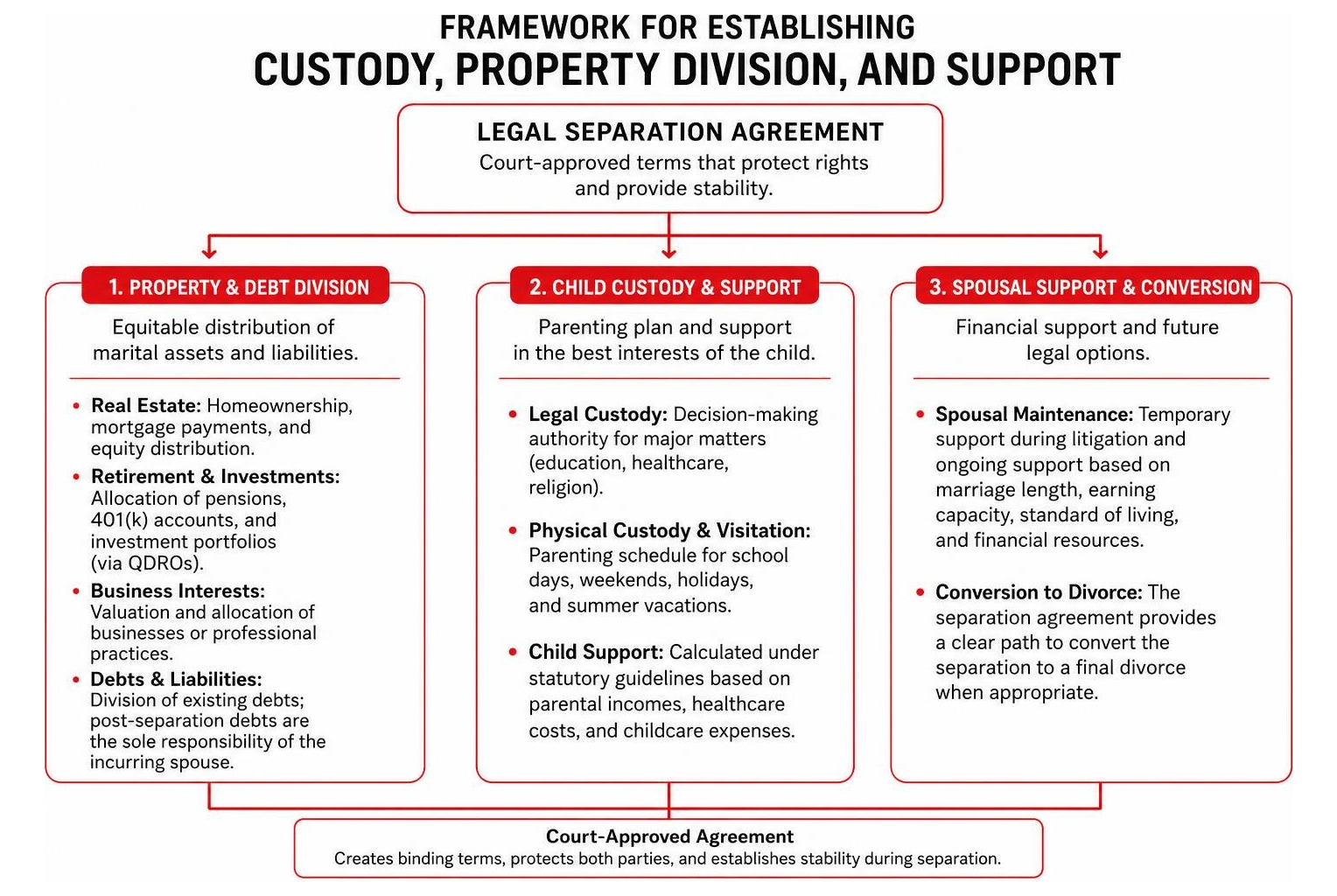
A comprehensive legal separation agreement addresses every issue that would otherwise appear in a final divorce decree. Relying on casual, verbal agreements during a separation exposes both parties to unnecessary risk. A court-approved agreement provides binding terms that protect your rights and provide stability.
Property and Debt Division
Just as in divorce proceedings, courts handling legal separations require a full accounting of all marital assets and liabilities. In Alabama, courts apply the rule of equitable distribution. “Equitable” means fair under the circumstances—not necessarily an exact 50/50 split.
The agreement must address:
- Real Estate: Determining who remains in the marital home, how mortgage payments are handled, and how equity will be distributed if the home is sold.
- Retirement Accounts and Investments: Defining how pensions, 401(k) accounts, and stock portfolios will be allocated using Qualified Domestic Relations Orders (QDROs).
- Business Interests: Valuing closely held businesses or professional practices to avoid disruptive disputes.
- Debts and Liabilities: Allocating existing credit card balances, vehicle loans, and personal loans, while establishing that debts incurred after the separation date are the sole responsibility of the debtor spouse.
Child Custody, Parenting Time, and Child Support
When children are involved, separation agreements must establish a clear parenting plan that serves the best interests of the child:
- Legal Custody: Determines decision-making authority for major matters like education, healthcare, and religious upbringing.
- Physical Custody and Visitation: Sets a predictable, stable parenting schedule, including school days, weekends, holidays, and summer vacations.
- Child Support: Calculated in accordance with statutory child support guidelines based on parental incomes, healthcare costs, and childcare expenses.
Spousal Maintenance and Long-Term Conversion to Divorce
A legal separation can establish temporary support (alimony pendente lite) during litigation, as well as ongoing spousal maintenance to ensure financial stability for a lower-earning partner. Support awards depend on factors like marriage length, earning capacity, standard of living, and each spouse’s financial resources.
If spousal support is a primary concern, consult our guide to resolving spousal support and alimony matters. If you and your spouse agree on major issues, exploring amicable separation and flat-fee options can save considerable time and expense.
Step-by-Step Guide: How to Search for and Choose a Legal Separation Attorney
Selecting legal representation during a family transition is an important decision. You need an advocate who understands the local courts, respects your financial boundaries, and communicates clearly.
Evaluating Experience When Searching for a Legal Separation Attorney Near Me
Not every general practitioner possesses the skills required for contested domestic relations matters. When evaluating attorneys:
- Look for Focused Practice Experience: Choose an attorney whose practice centers on family law and divorce litigation.
- Local Court Insight: Judges have distinct courtroom expectations. An attorney who regularly practices before your local family court bench understands how local judges tend to rule on support and temporary custody requests.
- Financial Acumen: If your marital estate includes retirement plans, real estate holdings, or family businesses, your lawyer must know how to structure complex settlements and coordinate with financial experts.
For more details on evaluating local counsel, read our ultimate guide to local divorce and family lawyers.
Understanding Fee Structures, Retainers, and Ethics Rules
Legal fees should be transparent from your initial meeting. Family law attorneys commonly use three primary billing models:
- Hourly Rates with a Retainer: The most common structure. You pay an upfront retainer fee, and the attorney bills against that account based on hourly work.
- Flat Fees: Used primarily for uncontested separations where all issues are agreed upon in advance.
- Fee Shifting: In certain circumstances, the court may order a higher-earning spouse to contribute to the other spouse’s legal fees.
Legal Ethics Note on Dual Representation: Spouses cannot share a single attorney in a legal separation or divorce. Because your legal interests are inherently distinct, dual representation creates an impermissible conflict of interest under state bar ethics rules. While an attorney-mediator can facilitate joint negotiations, each spouse must retain separate counsel for independent legal advice.
Questions to Ask a Legal Separation Attorney Near Me During Consultation
Prepare for your consultation by asking practical questions to evaluate whether the firm fits your needs:
- How much of your practice is dedicated to family law and separation agreements?
- What is your communication protocol, and how quickly does your office return client messages?
- What is your assessment of my case’s timeline and expected costs?
- Do you recommend mediation before pursuing courtroom litigation?
- Who within your firm will handle day-to-day work on my file?
Frequently Asked Questions About Legal Separation
Can a legal separation be converted into a divorce later?
Yes. If either spouse decides to end the marriage permanently, the legal separation agreement often serves as the direct blueprint for the final divorce decree. The terms already established for custody, child support, and property division can be incorporated into the divorce filing, streamlining the process.
Can spouses share a single attorney during legal separation?
No. State ethics rules strictly prohibit one attorney from representing both parties in domestic relations matters due to the direct conflict of interest. One lawyer can draft paperwork based on an amicable agreement, but they represent only one spouse; the other spouse should have independent counsel review the documents.
How long does the legal separation process take?
The timeline depends heavily on whether the matter is contested:
- Uncontested Separation: If both spouses agree on property, support, and custody, the agreement can be drafted, signed, and approved by the court in a matter of weeks to a few months.
- Contested Separation: If disputes over assets or parenting require discovery, court hearings, or mediation, the process can take six to twelve months or longer depending on local court scheduling.
Conclusion
A legal separation can protect your financial stability, secure your parental rights, and give your family needed structure during a major life transition. Navigating these issues requires thoughtful planning and an experienced advocate by your side.
At Shane A. Taylor PC, we provide straightforward, client-focused representation for families across Mobile, Alabama. Whether you are pursuing an amicable negotiated agreement or need strong courtroom advocacy, our team is ready to help you protect what matters most.
Ready to take control of your future? Contact our team of experienced family law attorneys today to schedule a confidential consultation.