


Start Equitable Distribution Mediation With a Clear Financial Plan
Equitable distribution mediation helps divorcing spouses negotiate a fair division of property and debt with a neutral mediator instead of asking a judge to decide. To prepare, make a full list of assets and debts, separate items that may be marital from those that may be separate, gather account statements and valuations, and identify the outcomes that matter most to you.
Fair does not always mean a 50-50 split. A workable agreement can account for each spouse’s income, future needs, contributions during the marriage, and practical concerns such as keeping a home, dividing retirement funds, or handling business interests. Mediation can also give families more privacy and flexibility than a courtroom fight.
I am Shane A. Taylor, an attorney with experience in Alabama and Mississippi state and federal courts, backed by a career in law enforcement and trial advocacy. That background informs a practical approach to equitable distribution mediation and the careful preparation needed to protect your financial interests.
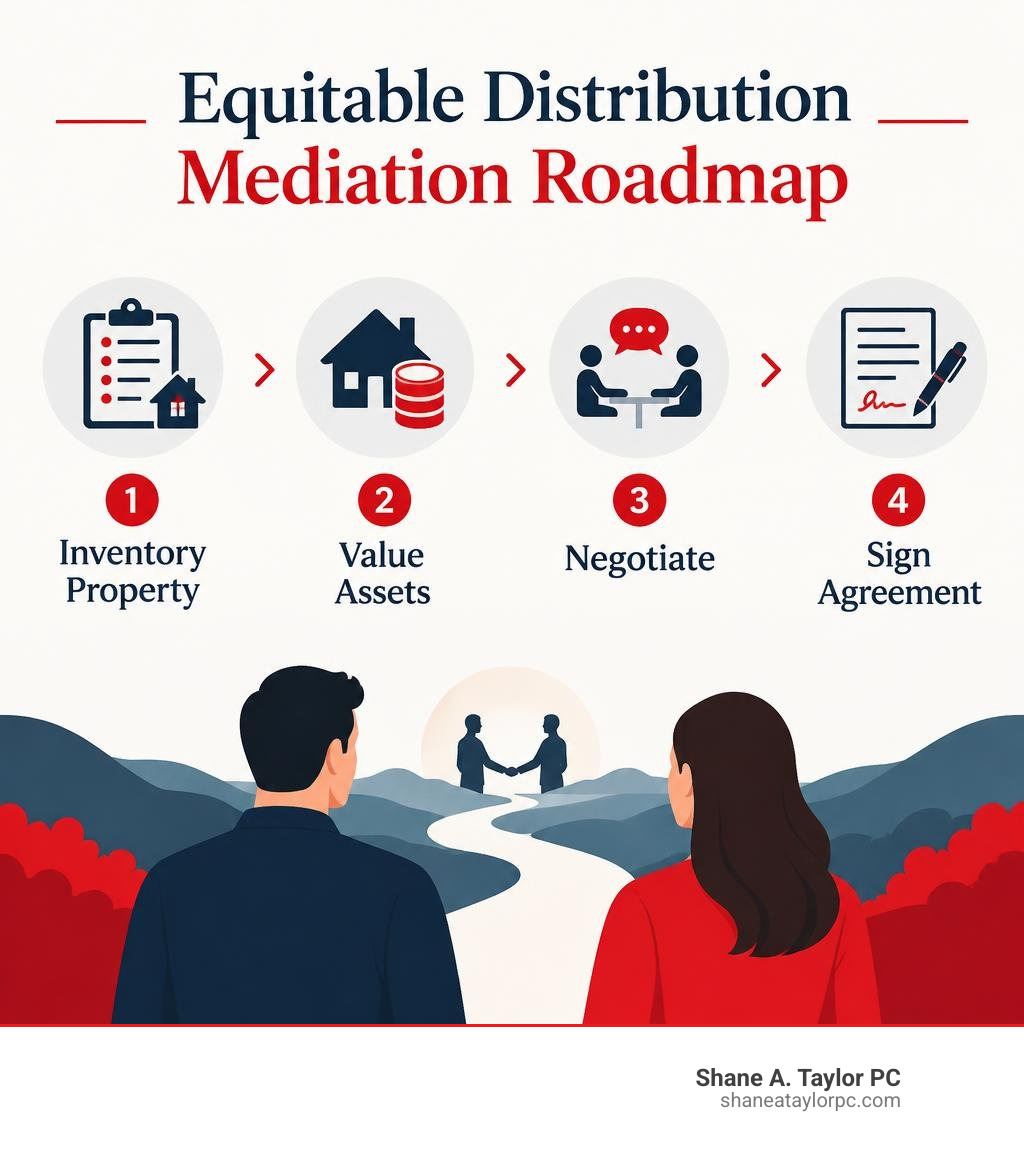
Understanding Equitable Distribution vs. Equal Division
When couples divide assets during a divorce, many assume everything is sliced right down the middle like an eight-slice pizza divided four and four. However, the legal doctrine of equitable distribution is rooted in fairness rather than strict mathematical equality.
In an equitable property system, the court—or spouses negotiating through mediation—aims for a distribution that reflects justice based on each spouse’s circumstances. A 50-50 split can sometimes produce an unfair result. For instance, if one spouse sacrificed career advancement to care for young children while the other built significant earning capacity, a mechanically equal division of liquid assets might leave the homemaker facing severe financial disruption.
Understanding how equitable principles differ from rigid community property rules is essential for setting realistic goals:
| Feature | Equitable Distribution | Community Property |
|---|---|---|
| Guiding Principle | Fair and just allocation based on equity | Equal 50/50 division of joint assets |
| Applicability | Majority of U.S. jurisdictions (including Alabama) | Nine community property states |
| Treatment of Debts | Assigned based on purpose and ability to pay | Typically split equally if incurred during marriage |
| Flexibility | High; accommodates tailored trade-offs | Low; strictly tied to mathematical halves |
| Judicial Discretion | Broad discretion to evaluate economic realities | Limited discretion regarding joint property division |
Mediation gives spouses the power to craft custom compromises that reflect these nuances, rather than leaving their future to a judge’s standardized ruling.
Marital Property vs. Separate Property
Before anything can be divided, property must be classified as either marital or separate.
- Marital Property: Generally encompasses assets and debts acquired by either spouse during the marriage, regardless of whose name appears on the title or deed. This includes wages earned, real estate purchased, retirement contributions, and personal property bought between the wedding date and the separation date.
- Separate Property: Typically includes assets owned individually prior to marriage, as well as gifts or inheritances received individually by one spouse during the marriage.
Complications arise when separate property becomes commingled with marital funds—such as depositing inherited cash into a joint checking account or using marital earnings to renovate a pre-owned property. If you are deciding to file for divorce, establishing clear boundaries between these asset classes with comprehensive documentation is a critical first step.
Key Factors Influencing Fair Division
Achieving an equitable outcome requires evaluating several practical and economic factors:
- Length of the Marriage: Longer marriages often involve deeply intertwined assets, requiring a more balanced long-term financial distribution.
- Economic and Non-Economic Contributions: Homemaking, child-rearing, and supporting a spouse through professional school hold real economic value.
- Future Earning Capacity: Differences in age, health, education, and employability play a significant role in ensuring both parties remain financially viable.
- Custodial Responsibilities: The parent providing primary physical custody may have a stronger practical need to retain the marital residence.
- Support Obligations: Property division often ties directly into spousal support considerations to balance ongoing living expenses.
How Equitable Distribution Mediation Resolves Complex Property Disputes
Navigating complex property disputes through litigation can quickly turn into an expensive, adversarial war of attrition. Mediation introduces a trained, neutral third-party facilitator whose sole objective is to guide both spouses toward mutually agreeable solutions.
Rather than forcing standard statutory outcomes, a mediator helps spouses design tailored agreements suited to their unique assets and long-term priorities.
Pre-Marital Homes and Real Estate Equity
Real estate is often a couple’s most valuable asset. When a home was purchased by one partner before marriage, determining the marital portion of that equity requires careful analysis. Over years of marriage, joint funds typically pay down the mortgage principal and fund structural improvements.
Mediation allows couples to explore creative solutions beyond a forced sale:
- Equity Buyouts: One spouse refinances the property to buy out the other’s share of marital equity.
- Deferred Sales: The custodial parent remains in the home until children complete high school, after which the property is sold and proceeds divided.
- Asset Trade-Offs: One partner retains full title to the real estate in exchange for relinquishing claims to equivalent retirement or investment funds.
Retirement Accounts and Pension Allocation
Retirement funds—such as 401(k)s, 403(b)s, IRAs, and defined-benefit pensions—frequently represent substantial wealth accumulated during marital years. Dividing these accounts requires technical precision.
Mediation helps couples structure division while accounting for deferred taxes, early withdrawal penalties, and future growth. When dividing employer-sponsored plans, the agreement must be implemented through a Qualified Domestic Relations Order (QDRO). A properly drafted QDRO allows retirement funds to be transferred into the non-employee spouse’s name without triggering early withdrawal taxes or penalties.
Business Ownership and Shared Marital Debts
Valuing and dividing a privately held business or professional practice can be complex. Court litigation often leads to disruptive forensic audits or orders that threaten the company’s daily operations.
Through mediation, couples can utilize independent valuations to structure sensible solutions, such as:
- Structured buyouts using future profit distributions.
- Offsetting business equity against other marital assets like investment portfolios or real estate.
- Establishing clear agreements if both parties choose to maintain co-ownership.
Marital liabilities—including credit card balances, personal loans, and auto financing—are addressed alongside assets. Mediation provides the space to trace how debts were accumulated and assign payment obligations fairly based on income and practical capabilities, rather than automatically splitting balances in half.
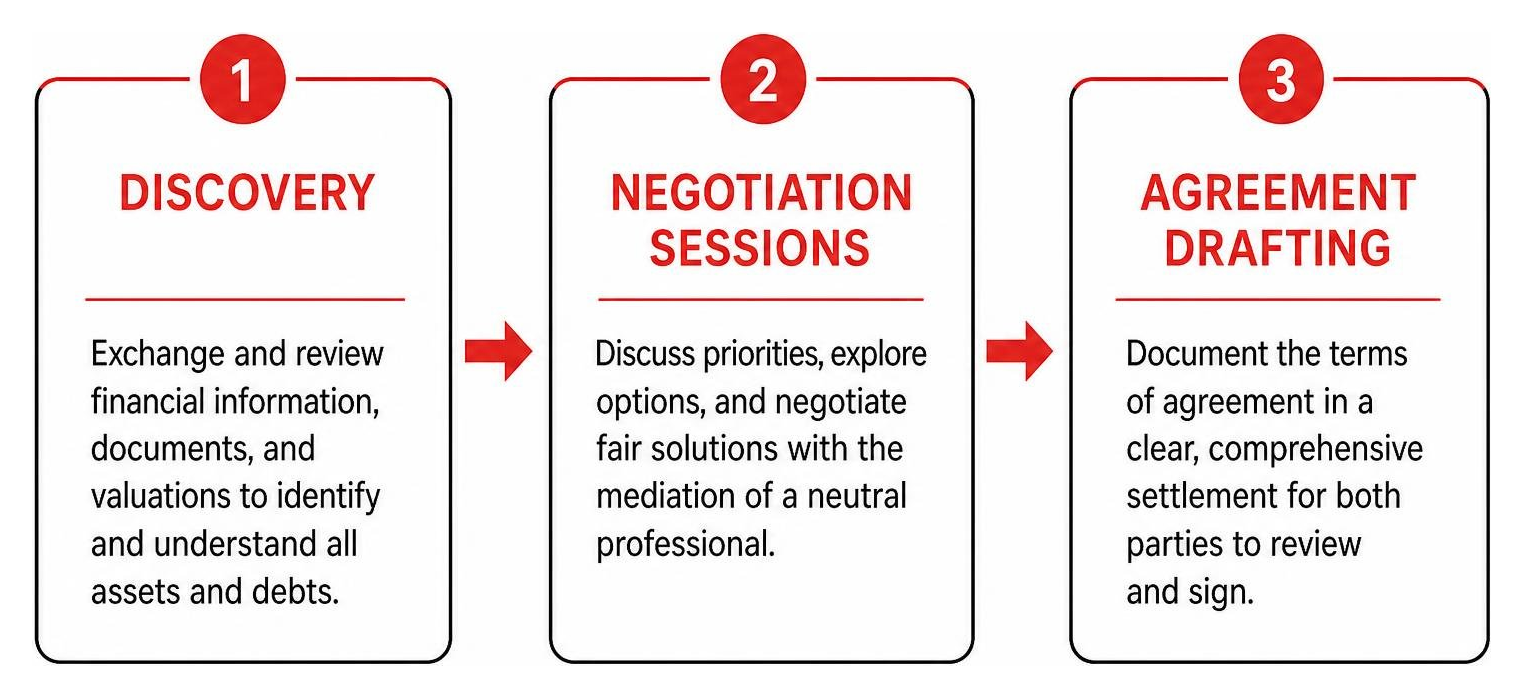
The Step-by-Step Mediation Process in Financial Disputes
Mediation follows a clear, structured framework designed to keep discussions productive and focused on resolution.
Preparing Financial Disclosures for Equitable Distribution Mediation
Honest and transparent disclosure is the foundation of successful mediation. Both spouses must provide a comprehensive inventory of all financial holdings and obligations, including:
- Bank, brokerage, and investment statements.
- Real estate deeds, current mortgage balances, and market appraisals.
- Retirement account statements and pension plan descriptions.
- Tax returns and business financial records.
- Loan documents, credit card statements, and outstanding liabilities.
Organizing these documents early ensures negotiations are based on verifiable numbers rather than guesswork.
Facilitated Negotiation and Creative Trade-Offs
During mediation sessions, the mediator works with both parties—together in joint discussions or separately in private caucuses—to explore settlement options. This format allows each spouse to voice their priorities without confrontation.
Instead of fighting over every individual account, couples can make strategic trades. For example, one spouse might prefer liquid cash reserves to secure new housing, while the other prioritizes long-term retirement stability. The mediator facilitates open dialogue to uncover options that work for both sides.
Drafting Binding Settlement Agreements
Once terms are settled, the mediator or legal counsel drafts a comprehensive marital settlement agreement detailing the division of every asset and debt.
To become legally enforceable, the document must be signed and executed under formal statutory requirements, including notarization. The agreement is then submitted to the court for formal review and incorporated into a final consent judgment, converting your mediated terms into an enforceable court order governed by district court family financial settlement rules.
Strategic Advantages of Mediation in Family Financial Cases
Choosing mediation over courtroom litigation offers clear advantages for your finances, your timeline, and your family’s well-being.
Why Equitable Distribution Mediation Outperforms Courtroom Litigation
The traditional litigation process often drains financial resources through depositions, motions, and trial preparation. Mediation significantly reduces these expenses by resolving disputes efficiently.
Beyond cost savings, mediation offers key benefits:
- Total Privacy: Court proceedings and filed financial exhibits become part of the public record. Mediation sessions remain entirely private and confidential.
- Control Over Decisions: In court, a judge who knows very little about your family makes permanent decisions about your assets. Mediation keeps the power in your hands.
- Preserving Relationships: Avoiding a courtroom battle reduces hostility, which is especially important for parents who need an effective co-parenting relationship moving forward.
Even in high-conflict scenarios, working with an experienced contested divorce lawyer to guide your mediation strategy ensures your rights remain protected throughout the process.
When Mediation Is Not Appropriate
While mediation works well for many couples, it is not the right fit for every situation. Litigation through the court system is necessary when:
- There is a history of domestic violence, threats, or severe intimidation.
- One spouse is actively hiding, transferring, or dissipating marital assets.
- Significant power imbalances prevent one party from advocating freely for their interests.
- A spouse refuses to provide complete and accurate financial disclosures.
In these circumstances, direct judicial intervention, formal discovery subpoenas, and skilled divorce attorney guidance are essential to protect your safety and financial rights.
Frequently Asked Questions About Equitable Distribution Mediation
Is property division mediation mandatory before trial?
In many jurisdictions, family court judges routinely issue scheduling orders requiring parties to attend a mediated settlement conference before setting a trial date. Courts use mandatory mediation to encourage settlement and reduce crowded trial dockets. However, judges can waive the requirement if good cause is shown, such as an active protection order or documented domestic abuse.
How long does mediation take compared to court litigation?
Litigating asset division in court can take anywhere from twelve to thirty-six months due to trial backlogs and procedural delays. In contrast, mediation is often completed in two to four sessions over a matter of weeks or months. Court-ordered financial mediation deadlines typically require conferences to wrap up within 150 days of the order, allowing couples to reach a final resolution much faster.
Are mediation agreements legally binding?
A verbal understanding reached in a mediation room is not legally binding on its own. For the agreement to be enforceable, it must be drafted into a formal written contract, signed by both parties, and properly notarized. Once submitted to and approved by the court, it is incorporated into the final divorce decree as a binding, legally enforceable consent order.
Conclusion: Protecting Your Financial Future Outside the Courtroom
Dividing property and debt does not have to become a prolonged, public battle. By approaching property division through structured mediation, you maintain control over your assets, reduce legal costs, and protect your privacy while working toward a fair outcome.
At Shane A. Taylor PC, we provide strategic, client-focused representation to help you navigate financial negotiations with clarity and confidence. Whether preparing comprehensive financial disclosures, negotiating complex asset divisions, or securing comprehensive family law counsel, our team is dedicated to safeguarding your interests every step of the way. Reach out to our Mobile office today to discuss your situation and take the first step toward a secure financial future.