


How a Defense Lawyer Protects Your Rights
A defense lawyer represents someone accused of a crime or named in a lawsuit. In a criminal case, they explain your rights, investigate the facts, challenge weak or improperly obtained evidence, negotiate with prosecutors, and defend you in court. If police want to question you, ask to speak with a lawyer first. Getting advice early can help you avoid choices that are hard to undo.
I’m Shane A. Taylor, a former Birmingham police officer who now practices in Alabama and Mississippi courts. When clients ask, “what does a defense lawyer do?” I draw on that experience to explain how counsel protects their rights and helps them make informed decisions.
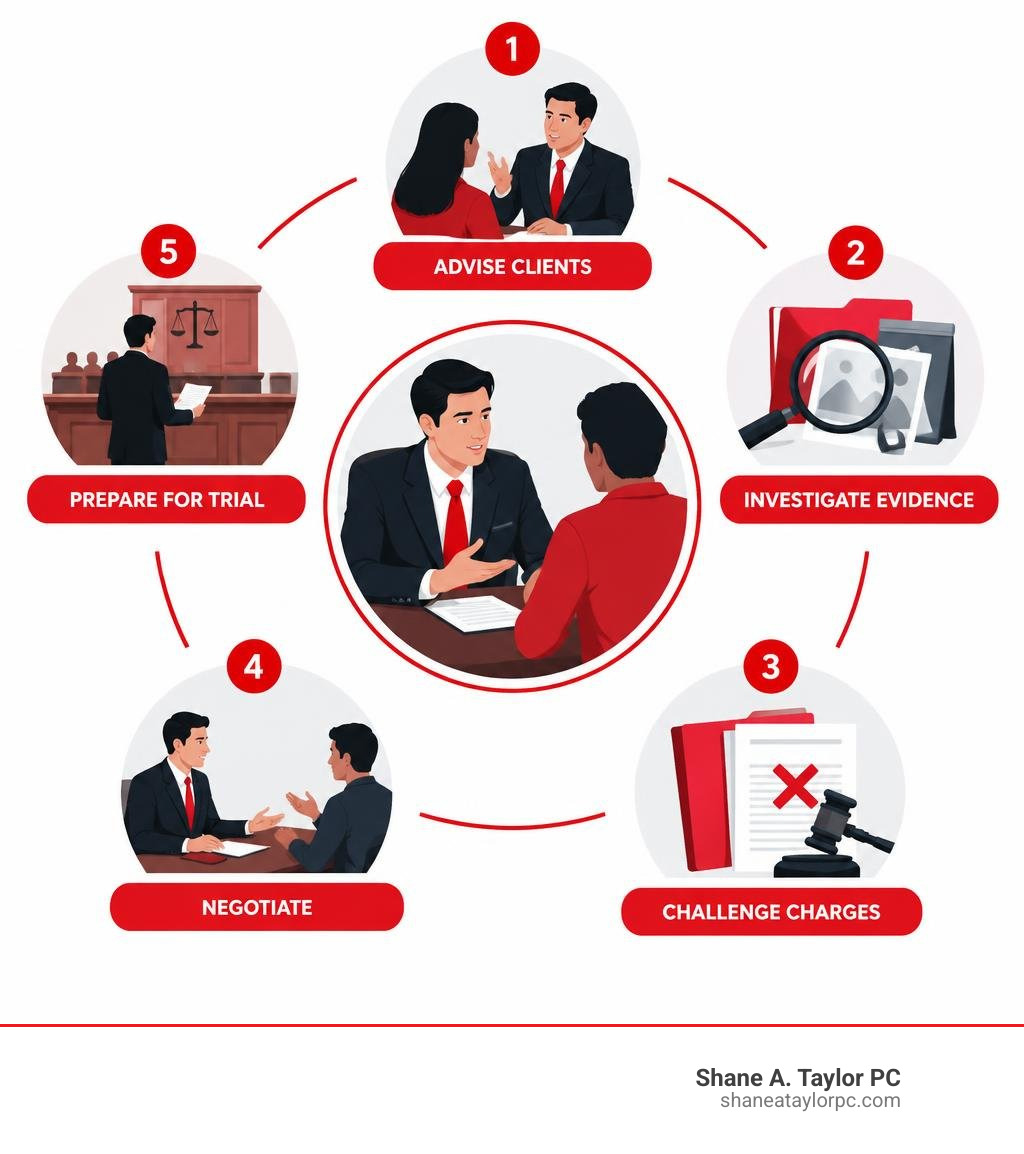
Understanding the Role: What Does a Defense Lawyer Do?
Facing legal allegations can feel isolating. At its core, the definition and role of defense attorneys revolves around one vital mandate: zealous advocacy. A defense attorney acts as your legal shield, your procedural guide, and your voice in a system that often feels overwhelming.
Under the core responsibilities of licensed lawyers, an attorney is bound to uphold the law while rigorously defending your constitutional rights. In criminal matters, you are guaranteed due process and the presumption of innocence. That means the government must prove every element of an alleged offense beyond a reasonable doubt.
Experienced criminal lawyers can make a difference by enforcing those constitutional boundaries. Through attorney-client privilege and strict duties of confidentiality, your lawyer provides a safe space where you can share the unvarnished facts of your situation. With those details, counsel can craft a tailored defense strategy aimed at achieving the best possible outcome.
Types of Cases Handled in Criminal and Civil Defense
Defense attorneys handle a broad spectrum of legal matters. While the public often associates defense work strictly with major felonies, representation spans across numerous practice areas:
- Violent Offenses: Accusations involving physical altercations require detailed factual reconstruction. Knowing the strategies for defending against assault and battery charges can expose inconsistencies in witness accounts or support a claim of self-defense.
- Substance Allegations: State and federal drug enforcement involves complex search-and-seizure laws. Understanding the roadmap for defending against drug charges is essential when challenging traffic stops, canine searches, and search warrants.
- Impaired Driving: Operating a vehicle under the influence carries steep license suspensions, mandatory fines, and potential jail time. Working with a dedicated Mobile DUI attorney allows you to challenge breathalyzer calibrations, field sobriety tests, and road checkpoints.
- Theft and Property Offenses: From petty larceny and shoplifting to grand theft and burglary, these matters hinge on proving intent, ownership rights, or mistaken identity.
- White-Collar and Financial Crimes: Allegations involving embezzlement, fraud, money laundering, and identity theft demand extensive financial audits and digital forensics.
- Domestic and Family-Related Disputes: Heightened emotions often result in hasty arrests or protective orders that require swift legal intervention.
- Civil Defense Litigation: Beyond criminal charges, individuals and businesses often face civil liability claims. Securing skilled representation for civil defense litigation ensures your assets, business operations, and financial interests are guarded against unwarranted lawsuits.
Defense Attorney vs. Prosecutor: Key Distinctions
The American justice system is adversarial, meaning truth and justice emerge from two opposing advocates presenting their best arguments before an impartial judge or jury. Understanding how defense lawyers and prosecutors differ clarifies the role each plays:
| Factor | Defense Attorney | Prosecutor |
|---|---|---|
| Client Represented | The individual accused of an offense or named in a claim | The State, government entity, or the public interest |
| Primary Objective | Protect the defendant’s rights; seek dismissal, acquittal, or mitigation | Secure a conviction while ensuring justice is served |
| Burden of Proof | Carries no burden; must only demonstrate reasonable doubt | Must prove every element of the crime beyond a reasonable doubt |
| Evidence Gathering | Seeks exculpatory evidence, alibis, and procedural errors | Gathers police reports, forensic results, and state witness statements |
| Role in Negotiations | Negotiates for charge dismissals, diversion, or reduced penalties | Offers plea bargains based on statutory guidelines and case strength |
While prosecutors represent the machinery of the state, your defense attorney stands exclusively in your corner, ensuring that power is checked at every stage.
How a Defense Lawyer Manages Your Case from Arrest to Trial

Navigating the criminal justice system involves strict deadlines and complex procedural rules. Understanding what happens if you are charged with a crime helps demystify the legal process. Defense attorneys adhere to established ethical standards for the defense function to maintain high-quality, diligent, and conflict-free representation.
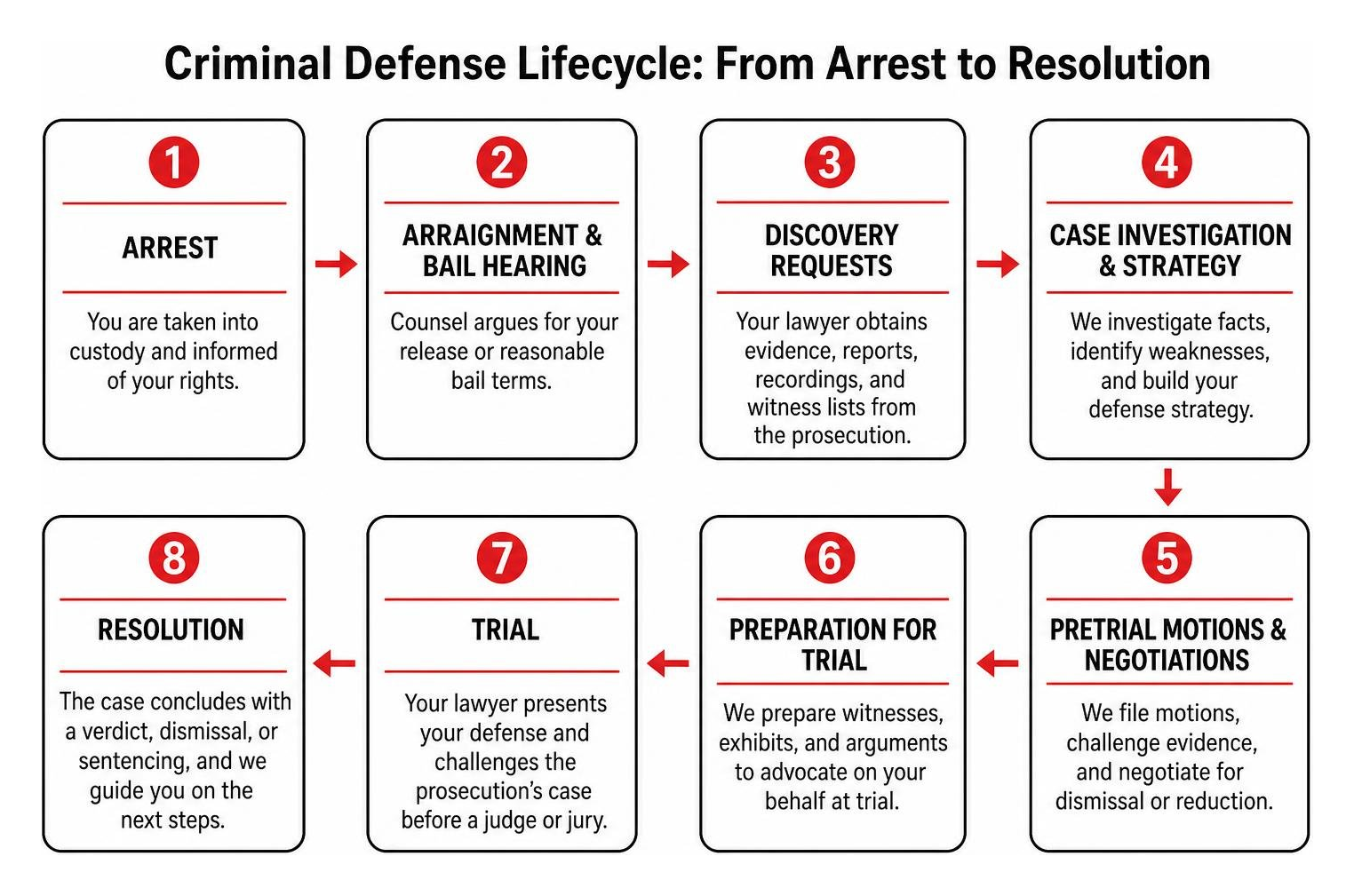
From the moment an arrest occurs, counsel takes immediate steps:
- Arraignment and Bail Hearings: Counsel argues for your release on your own recognizance or pushes for reasonable bail terms, preventing prolonged pretrial detention.
- Discovery Requests: Your lawyer formally demands that prosecutors turn over all evidence, including police narratives, body camera footage, audio recordings, lab tests, and witness lists.
- Client Strategy Sessions: You and your attorney review the government’s evidence to pinpoint factual gaps and develop a clear defense strategy.
Pre-Filing Intervention and Early Case Assessment
Many people assume a lawyer can only step in after formal charges have been filed in court. In reality, early pre-charge representation is one of the most effective tools in defense practice.
Between the time law enforcement makes an arrest (or begins an investigation) and the district attorney formally files an indictment or information, there is a critical window of time. During this stage, your defense lawyer can:
- Contact the assigned prosecutor directly to present exculpatory evidence.
- Provide witness affidavits that counter the police report narrative.
- Highlight constitutional search or identification defects.
- Demonstrate that the evidence does not support a felony, prompting the state to drop the matter or reduce the charges to a misdemeanor before formal filing.
What Does a Defense Lawyer Do During Case Investigation?
Defense lawyers do not simply rely on the evidence gathered by law enforcement. Police officers build cases designed to secure convictions; defense counsel investigates to uncover the complete story. Under professional standards, defense counsel has an independent duty to investigate every case, regardless of how strong the prosecution’s evidence appears.
An exhaustive defense investigation typically includes:
- Visiting the Scene: Inspecting lighting conditions, line-of-sight obstructions, traffic flow, and security camera placements.
- Independent Witness Interviews: Questioning witnesses outside the presence of law enforcement to obtain objective statements.
- Subpoenaing Records: Securing phone logs, GPS records, toll data, and point-of-sale receipts to establish alibis.
- Engaging Forensic Experts: Consulting independent ballistics experts, toxicologists, digital forensics specialists, or medical examiners to challenge state lab findings.
Filing Pretrial Motions and Challenging Evidence
One of the most powerful ways a defense attorney protects you is through pretrial motion practice. If the police violated your constitutional rights, your attorney can petition the judge to exclude that evidence from trial.
Key pretrial motions include:
- Motions to Suppress: Filed when police perform an unlawful stop, conduct a warrantless search, or execute a defective search warrant in violation of the Fourth Amendment.
- Motions to Exclude Statements: Aimed at tossing out confessions or statements extracted in violation of Miranda rights or through improper coercion.
- Motions to Dismiss: Filed when the charging documents fail to state a valid legal offense, when the statute of limitations has expired, or when the state lacks sufficient evidence to establish probable cause.
Suppressing critical evidence often eliminates the prosecution’s case, leading directly to a full dismissal of charges.
Strategic Negotiation, Trial Advocacy, and Sentencing Defense
Every case follows a distinct path based on the client’s goals and the strength of the evidence. An attorney helps you evaluate the options while keeping you informed about the short- and long-term consequences.
(Decision pathways during defense representation)
Negotiating Plea Bargains and Diversion Programs
While television portrays every criminal case heading to a dramatic jury verdict, the vast majority of cases nationwide resolve through negotiated settlements or diversion programs. A defense lawyer is legally and ethically bound to communicate every formal plea offer to the client promptly.
When negotiating with prosecutors, your lawyer works to:
- Secure Charge Reductions: Lowering a felony to a misdemeanor to protect your civil liberties and employment opportunities.
- Enroll in Pretrial Diversion: Guiding first-time or qualifying offenders into drug courts, mental health courts, or deferred adjudication programs that culminate in a complete dismissal upon successful completion.
- Mitigate Sentencing Terms: Securing agreements for probation, community service, or work release in place of active jail or prison time.
Understanding the direct and indirect impacts outlined in understanding consequences in your criminal case ensures you never accept an agreement without understanding how it affects your driver’s license, professional certifications, or immigration status.
Courtroom Representation and Trial Strategy
When an acceptable agreement cannot be reached, your defense attorney takes the fight to trial. Courtroom litigation is an art that demands preparation, quick thinking, and persuasive communication:
- Jury Selection (Voir Dire): Counsel questions prospective jurors to identify biases, ensuring an impartial panel is seated.
- Compelling Opening Statements: Outlining the defense theory of the case and framing the narrative before jurors hear the state’s witnesses.
- Rigorous Cross-Examination: Pointing out inconsistencies in witness testimony, exposing personal biases, highlighting memory lapses, and challenging the credibility of state experts.
- Direct Defense Presentation: Presenting defense witnesses, introducing exculpatory exhibits, and carefully preparing you to testify if you choose to exercise that right.
- Persuasive Closing Arguments: Tying together all evidentiary weaknesses to demonstrate why the prosecution failed to meet its burden of proving guilt beyond a reasonable doubt.
What Does a Defense Lawyer Do at Sentencing and Post-Conviction?
If a case results in a plea or a conviction at trial, a defense attorney’s responsibilities continue through the sentencing phase and beyond:
- Sentencing Advocacy: Presenting mitigating factors, such as personal history, community ties, letters of support, and rehabilitation efforts, to convince the judge to impose the minimum possible penalty.
- Probation and Compliance: Assisting clients through post-sentencing obligations, including navigating probation violation hearings if unexpected compliance issues arise.
- Post-Trial Motions and Appeals: Filing motions for a new trial, addressing judicial errors, and assisting appellate counsel with the trial record.
- Record Clearance: Helping eligible clients pursue expungements or record-sealing petitions down the line to remove past charges from public background checks.
How to Choose the Right Defense Attorney for Your Case
Choosing the attorney who will handle your case is a major decision. Knowing how to find local criminal defense lawyers near me with deep familiarity with regional courthouses, judges, and prosecutors can directly influence the progression of your case.
Preparing for Your Initial Legal Consultation
Your initial consultation serves as a mutual evaluation: you explain your situation, and the lawyer assesses the initial options. To make the most of this meeting, bring all relevant paperwork:
- Bail paperwork, bond receipts, and citations.
- Formal charging documents, indictments, or criminal complaints.
- A written timeline of events as you recall them.
- Names and contact details of potential witnesses.
During this discussion, be sure to ask targeted questions:
- How long have you practiced criminal defense in this specific jurisdiction?
- What defense strategies do you envision based on the initial facts of my case?
- Who in your firm will manage my day-to-day communications and court appearances?
- What is your fee structure, and what extra costs (such as investigators or experts) might arise?
- How often will I receive updates regarding case filings, discovery, and court dates?
Evaluating Experience, Caseload, and Fee Structures
When evaluating legal counsel, focus on three primary considerations:
- Caseload and Attention: Effective advocacy requires time. A lawyer juggling an excessive caseload may struggle to perform the deep factual investigation your case demands. Look for a firm that limits its intake to deliver responsive, thorough representation.
- Transparent Fee Structures: Understand whether the attorney bills via an hourly rate or a flat fee for pretrial and trial representation. Reputable attorneys provide clear, written fee agreements without hidden surprises.
- Courtroom Experience: While strong negotiation skills resolve many matters out of court, prosecutors know which attorneys are willing to go to trial. Working with an attorney who prepares every case for the courtroom gives you greater leverage during negotiations.
Frequently Asked Questions About Defense Attorneys
What is the difference between a public defender and a private defense lawyer?
Public defenders are court-appointed attorneys who represent individuals who meet statutory indigent income guidelines. They are dedicated, skilled advocates, but they often carry heavy caseloads with limited administrative support. A private defense attorney is retained directly by the client, allowing for smaller caseloads, tailored access, and flexible resources for private investigators and expert witnesses.
When is the best time to hire a defense attorney?
The ideal time to retain counsel is the moment you suspect you are under investigation or as soon as an arrest occurs. Hiring counsel before formal charges are filed enables pre-charge intervention that can prevent formal filings, secure early bond, and protect you from making self-incriminating statements to law enforcement.
Can a defense lawyer get charges dismissed before court?
Yes. By conducting an early investigation and presenting exculpatory evidence or procedural violations directly to the prosecutor before indictment, a defense lawyer can sometimes persuade the state to decline prosecution, drop the matter, or redirect it into an informal diversion program.
Conclusion: Protecting Your Future with Zealous Defense Representation
A criminal allegation does not have to define your life or dictate your future. From protecting you against improper police conduct to conducting independent investigations and presenting your case at trial, a defense attorney acts as your advocate every step of the way.
At Shane A. Taylor PC, we provide focused, responsive, and strategic defense representation for clients across Mobile, AL, and surrounding communities. If you or a loved one is facing criminal charges, protect your constitutional rights by contacting our team today for a confidential consultation with experienced criminal defense representation.