


What to Do When You Need a Disorderly Conduct Attorney Near Me
If you’re looking for a disorderly conduct attorney near me, here is what you need to know right now:
Quick answers:
- Get legal help immediately. Even a minor disorderly conduct charge can leave a permanent mark on your criminal record.
- Do not plead guilty without talking to a lawyer first. You may have more options than you think.
- Charges can often be reduced or dismissed. An experienced attorney can negotiate with prosecutors or challenge weak evidence.
- A conviction affects real life. Background checks, jobs, professional licenses, and custody cases can all be impacted.
- Free consultations are widely available. Most criminal defense attorneys offer them, so there is no reason to wait.
A disorderly conduct charge can feel like a minor embarrassment at first. A loud argument. A night out that went sideways. A neighborly dispute that got out of hand. But the legal consequences are anything but minor.
Disorderly conduct is one of the most commonly charged offenses across the country. It is a broad, catch-all statute — and because of its vague language, police have wide discretion in who they charge. That means innocent people get caught up in it all the time.
If you are also navigating a divorce or custody case, a criminal charge like this can make an already stressful situation significantly worse. Courts and opposing attorneys will use it against you.
The good news: these charges are often beatable with the right legal strategy.
I’m Shane A. Taylor, a Mobile, Alabama criminal defense attorney and the person you want in your corner when searching for a disorderly conduct attorney near me — I spent over a decade as a Birmingham police officer before becoming a lawyer, which means I understand exactly how these charges are built and how to challenge them. That background gives my clients a real strategic advantage, and I’ll put it to work for you.
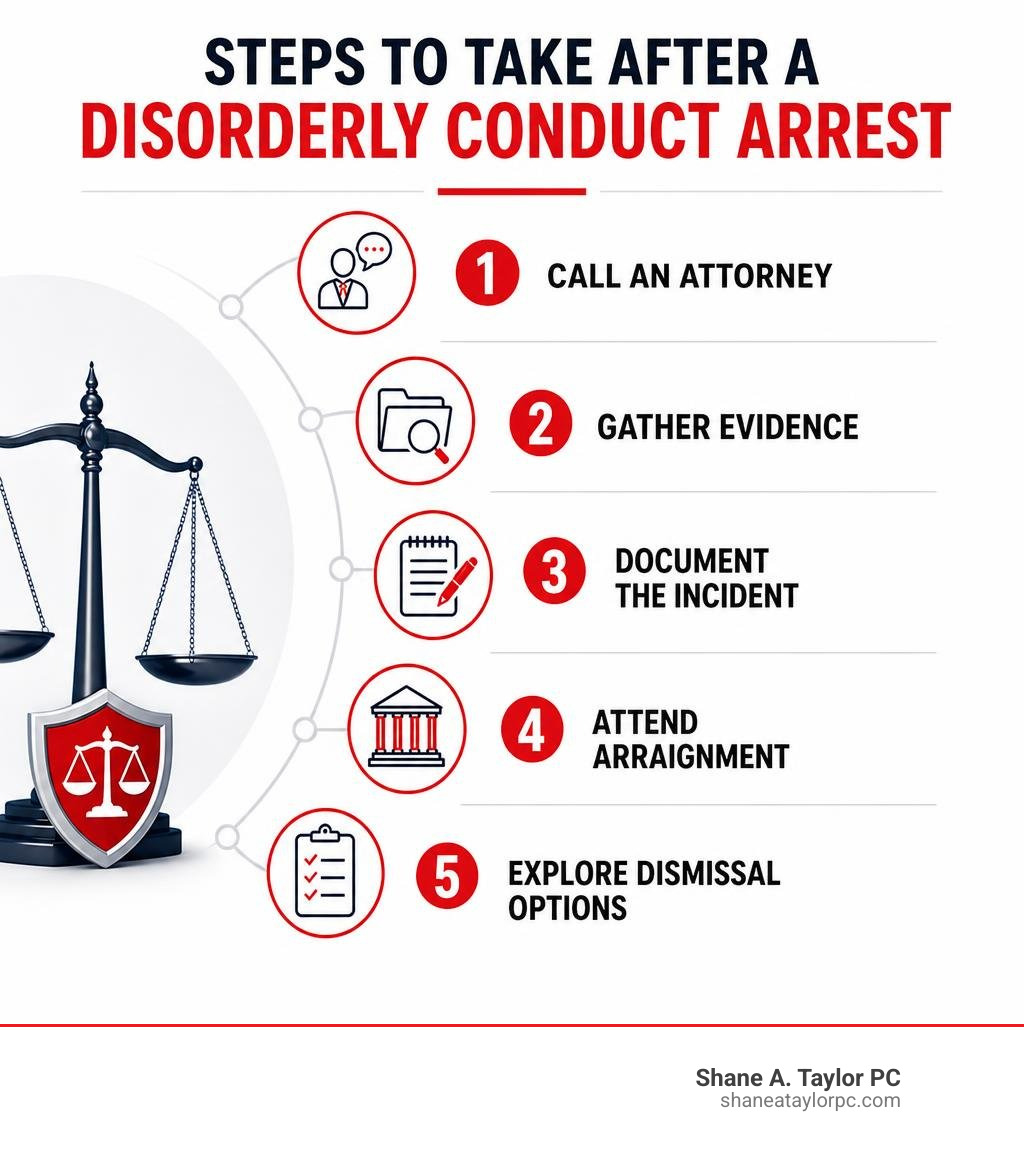
Understanding Disorderly Conduct: Definitions and Common Behaviors

When people hear the term “disorderly conduct,” they often picture a wild, movie-style bar brawl or someone shouting on a soapbox in the middle of a busy intersection. While those scenarios certainly qualify, the real-world application of this law is far broader.
Essentially, disorderly conduct is an offense against public peace and “good order.” Historically, these laws evolved from the old common law crimes of “breach of the peace” and “affray” (which typically involved two or more people fighting in a public space to the terror of the public).
Today, modern state statutes and municipal ordinances have codified these concepts into broad, sometimes vague rules designed to keep the peace. Because the language is so wide-reaching, law enforcement officers frequently use disorderly conduct as a “catch-all” charge. If an officer feels a situation is getting out of hand, or if they simply do not like someone’s attitude, a disorderly conduct charge is often the easiest tool in their belt to restore control.
Understanding the Legal Definition of Disorderly Conduct
In Alabama, the legal definition of disorderly conduct is governed by Alabama Code § 13A-11-7. Under this statute, a person commits the crime of disorderly conduct if, with the intent to cause public inconvenience, annoyance, or alarm, or by recklessly creating a risk of it, they engage in any of the following behaviors:
- Engaging in fighting, violent, tumultuous, or threatening behavior.
- Making unreasonable noise.
- Using abusive or obscene language, or making an obscene gesture, in a public place.
- Obstructing vehicular or pedestrian traffic.
- Disrupting a lawful assembly or meeting of people.
- Failing to obey a lawful order from law enforcement to disperse.
A key element here is the venue: the conduct must generally occur in a public place or affect the public peace. Furthermore, the use of “abusive language” is legally restricted to what courts call “fighting words”—words that by their very utterance inflict injury or tend to incite an immediate breach of the peace.
If you find yourself facing these allegations, it is highly beneficial to read our guide on What Happens If You Are Charged With a Crime to understand the immediate procedural steps that follow an arrest in Alabama.
Common Behaviors That Trigger a Disorderly Conduct Charge
Because the law is so subjective, a wide variety of everyday situations can escalate into a criminal charge. Some of the most common real-world triggers we see in Mobile include:
- Public Intoxication: While public drunkenness itself is a separate minor offense, it frequently crosses over into disorderly conduct when an individual begins shouting, arguing with bouncers, or refusing to leave an establishment.
- Physical Altercations: A minor scuffle outside a venue or a heated argument at a sporting event can quickly result in an arrest.
- Obstructing Traffic: Whether as part of a public protest or simply standing in the middle of a roadway during a dispute, blocking the free movement of vehicles or pedestrians is a classic trigger.
- Heated Verbal Disputes with Police: Citizens often exercise their right to complain about police conduct. However, when those complaints involve shouting, profanity, or physical posturing, officers frequently pivot to a disorderly conduct arrest.
It is worth noting that there are significant state-specific variations in how these laws are written and enforced. For example, some states focus heavily on noise levels, while others focus on the presence of minors. Regardless of the specific action, the core of the state’s case relies on proving your intent to disrupt the public peace—a standard that is often highly challengeable in court.
Classifications, Penalties, and the Domestic Violence Connection

Understanding how your charge is classified and the penalties it carries is crucial to preparing your defense. Misdemeanors are often dismissed by the public as “minor” offenses, but a criminal conviction of any level can disrupt your life in ways you might not expect.
Is Disorderly Conduct a Misdemeanor or a Felony?
In Alabama, disorderly conduct under § 13A-11-7 is classified as a Class C misdemeanor. This is the lowest level of misdemeanor in the state, but it still carries real criminal penalties, including:
- Up to 3 months (90 days) in the county jail.
- Fines of up to $500.
- A permanent criminal record.
To put this in perspective, let’s look at how other states classify and penalize this offense. While some states treat it as a minor infraction, others enforce much harsher penalties:
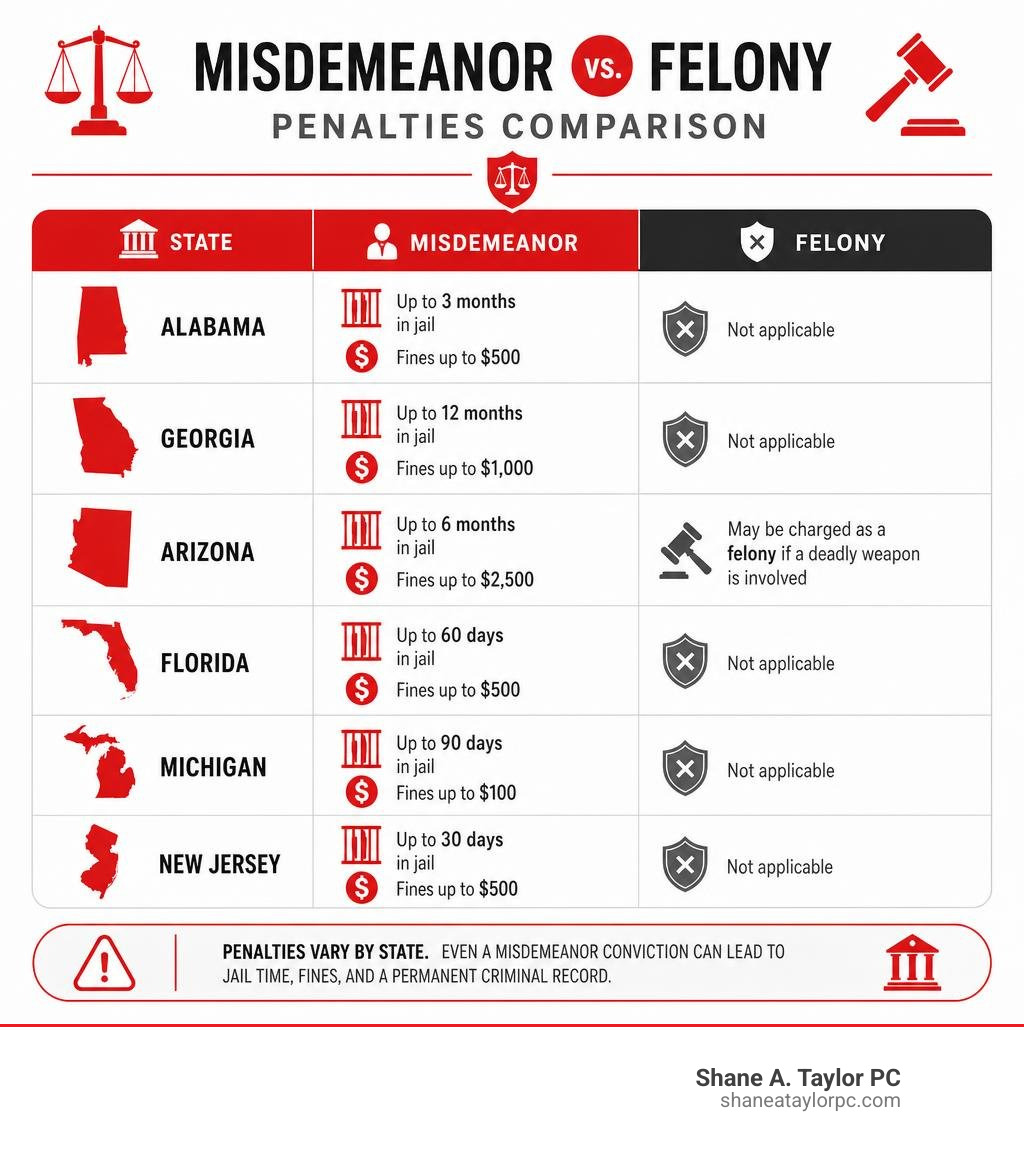
- Georgia: Classified strictly as a misdemeanor, punishable by up to 12 months in jail and fines up to $1,000.
- Arizona: Typically a Class 1 misdemeanor (the most serious misdemeanor type), carrying up to 6 months in jail and fines up to $2,500. However, if the offense involves the reckless handling or display of a deadly weapon, it can be charged as a felony (a “wobbler” offense).
- Florida: Classified as a second-degree misdemeanor, carrying up to 60 days in jail and fines up to $500.
- Michigan: Punishable by up to 90 days in jail and/or a $100 fine.
- New Jersey: Handled as a petty disorderly persons offense, resulting in up to 30 days in jail and fines up to $500.
- Massachusetts: A first offense carries a fine of up to $150 or up to 6 months in jail. Subsequent offenses can carry up to 2 years in jail.
- Delaware: Can range from an unclassified misdemeanor (up to 30 days in jail) to a Class A misdemeanor (up to 1 year in jail and a $2,300 fine).
- Ohio: Typically a minor misdemeanor with fines up to $150, but can escalate to a fourth-degree misdemeanor (up to 30 days in jail) if the offender ignores warnings or is near a school.
As you can see, while Alabama’s penalties are on the lower end of the national spectrum, 90 days in jail is still a massive disruption to your family, your job, and your freedom.
How a Conviction Affects Your Criminal Record and Future
The immediate court fines and jail time are only the tip of the iceberg. The long-term, collateral consequences of a criminal conviction are often what cause the most damage.
When you apply for a job, rent an apartment, or apply for a loan, a standard background check will reveal your criminal record. Employers in fields such as healthcare, education, finance, and security are particularly sensitive to any history of violent or disruptive behavior. A disorderly conduct conviction can suggest an inability to manage anger or respect authority, which can instantly disqualify you from competitive positions.
Furthermore, if you hold a professional license (such as a nursing, real estate, or teaching license), a misdemeanor conviction must often be reported to your licensing board, triggering disciplinary proceedings. To learn more about how these outcomes can ripple through your life, read our article on Understanding Consequences in Your Criminal Case.
The Intersection of Disorderly Conduct and Domestic Violence
One of the most complex areas of criminal defense is when a disorderly conduct charge intersects with domestic disputes. In Mobile and throughout Alabama, law enforcement agencies operate under strict domestic violence protocols.
When officers respond to a domestic 911 call, they are often mandated to make an arrest if there is any evidence of physical violence or a credible threat of harm. If the physical evidence of battery is weak, or if both parties were simply yelling and slamming doors, officers will frequently use disorderly conduct as their “go-to” charge to defuse the situation and separate the parties.
If a disorderly conduct charge is flagged as a domestic violence offense, the stakes skyrocket:
- Immediate Protective Orders: At your arraignment, the court may issue a protection order, forcing you to move out of your home and preventing you from contacting your spouse or children.
- Impact on Family Law Cases: If you are currently going through a divorce or child custody dispute, a domestic-related disorderly conduct charge will be heavily leveraged by the opposing party to argue that you are an unfit parent or pose a risk to the family.
- Loss of Firearm Rights: Federal law prohibits individuals convicted of domestic violence misdemeanors from owning or possessing firearms.
Navigating these dual battlefields requires an attorney who understands both criminal defense and family law. For a deeper look at how we protect families in these high-stakes situations, see Family and Criminal Lawyers in Mobile: Protecting Your Rights.
How to Fight the Charges: Defenses and Dismissals
Just because you have been arrested does not mean you will be convicted. Disorderly conduct charges are highly subjective, meaning there are numerous legal avenues to challenge the prosecution’s case and fight for a dismissal.
Best Legal Defenses Against Disorderly Conduct
An experienced defense attorney will carefully review the police report, witness statements, and any available video footage to build a tailored defense. Some of the most effective strategies include:
- First Amendment Protections: The U.S. Constitution protects your right to free speech, even if that speech is offensive, angry, or critical of law enforcement. Unless your words crossed the line into “fighting words” or “true threats,” your speech cannot legally be the sole basis of a disorderly conduct charge.
- Self-Defense: If you were arrested following a public fight, but you were merely defending yourself or someone else from an aggressor, self-defense is a complete bar to conviction.
- Lack of Intent: The prosecution must prove that you acted with the specific intent to cause public inconvenience, annoyance, or alarm, or that you recklessly disregarded that risk. If your conduct was accidental or occurred in a private setting where the public was not affected, the charge should not stand.
- De Minimis Infraction: This defense argues that even if a technical violation of the law occurred, the conduct was so minor and trivial that prosecuting it is a waste of judicial resources.
Can Disorderly Conduct Charges Be Dropped or Dismissed?
Yes. In fact, many disorderly conduct cases are resolved favorably without ever going to trial.
In some cases, your attorney can negotiate a nolle prosequi (a formal entry by the prosecutor declaring they will not prosecute the case further), effectively dropping the charges. This is often achieved by presenting mitigating evidence early, such as showing that you have completed an anger management course or alcohol education class.
For first-time offenders, Alabama courts often offer diversion programs or delayed sentencing options. Under these programs, you agree to complete a period of probation, community service, or counseling. Once you successfully meet all the conditions, the prosecution dismisses the charges, allowing you to keep your record clean.
To understand how the burden of proof works in these negotiations, read our detailed analysis on Mobile Criminal Lawyers: Crime Must Be Paid Beyond Reasonable Doubt.
Why You Need a Disorderly Conduct Attorney Near Me
It is tempting to look at a misdemeanor charge and think, “I’ll just go to court, explain my side of the story to the judge, pay the fine, and get this over with.” This is one of the most common—and costly—mistakes defendants make.
How a Disorderly Conduct Attorney Near Me Protects Your Rights
Pleading guilty to “get it over with” means you are accepting a permanent criminal conviction that will follow you for the rest of your life. A local defense attorney does far more than just stand next to you in court; they actively dismantle the state’s case:
- Motion Practice: Your attorney can file motions to suppress evidence if the police violated your constitutional rights during the arrest or search.
- Custom Jury Instructions: If your case goes to trial, your lawyer can draft specific jury instructions that force the prosecution to prove the exact, narrow definitions of “abusive language” or “unreasonable noise,” rather than relying on vague generalities.
- Plea Bargaining: Prosecutors are busy. An experienced local attorney knows how to present your case in a way that makes a dismissal or reduction to a non-criminal civil infraction the most appealing option for the state.
To learn more about how professional legal counsel alters the trajectory of your case, see Criminal Lawyers Can Make a Difference.
Finding the Right Disorderly Conduct Attorney Near Me
When searching for a disorderly conduct attorney near me, you need someone with deep roots in the local legal community. The laws, court procedures, and even the temperament of prosecutors and judges vary significantly from county to county.
An attorney who regularly practices in Mobile’s municipal and district courts will understand the local nuances, diversion programs, and negotiation styles that out-of-town lawyers simply won’t know. Look for a firm with a proven trial record, strong client reviews, and a dedicated focus on both criminal defense and family law. For practical tips on your search, check out our guide on Smart Ways to Find Criminal Defense Attorneys Near Me.
Frequently Asked Questions About Disorderly Conduct
Can I be charged with disorderly conduct for a verbal argument?
Yes, but with major constitutional limitations. Police officers frequently make arrests during heated verbal arguments, especially if they occur in public or involve shouting at an officer. However, under the First Amendment, speech alone is protected unless it constitutes “fighting words”—words that directly incite violence—or “true threats.” If your argument did not cross these legal thresholds, a skilled attorney can often get the charges dismissed.
Is public intoxication the same as disorderly conduct?
No, they are distinct legal charges, though they frequently go hand-in-hand. Public intoxication involves being in a public place under the influence of alcohol or drugs to the degree that you pose a danger to yourself or others. Disorderly conduct focuses on disruptive, loud, or violent behavior that breaches the public peace. You can be sober and charged with disorderly conduct, and you can be quietly intoxicated in public without being disorderly.
Can a disorderly conduct charge be expunged?
Yes, in Alabama, it is possible to have a disorderly conduct charge expunged (cleared) from your record under certain conditions. If your charge was dismissed, resolved through a diversion program, or if you were found not guilty, you are generally eligible to apply for expungement. If you were convicted of this misdemeanor, you may still be eligible after a specific waiting period, provided you have met all court requirements and have not had subsequent arrests. To explore this process, read our comprehensive guide on Expungements.
Conclusion
A disorderly conduct charge might start as a minor misunderstanding, a heated moment, or a night out that escalated too quickly. But without the right defense, it can quickly turn into a permanent mark on your criminal record, threatening your employment, your professional licenses, and even your family’s future.
At Shane A. Taylor PC, we combine aggressive, modern criminal defense strategies with a deep, personal commitment to our clients. Having spent years on both sides of the law—first as a police officer and now as a dedicated defense attorney—we understand exactly how the state builds its cases, and more importantly, how to tear them down.
If you are facing disorderly conduct charges in Mobile, Alabama, do not leave your future to chance. Protect your future with Shane A. Taylor PC criminal defense services and let us fight to keep your record clean. Contact us today to schedule your consultation.