


What the Alabama Record Expungement Process Can Do for Your Future
The alabama record expungement process is one of the most powerful legal tools available to people who want to move past an old arrest or charge — but most people don’t know where to start, what they qualify for, or what it actually costs.
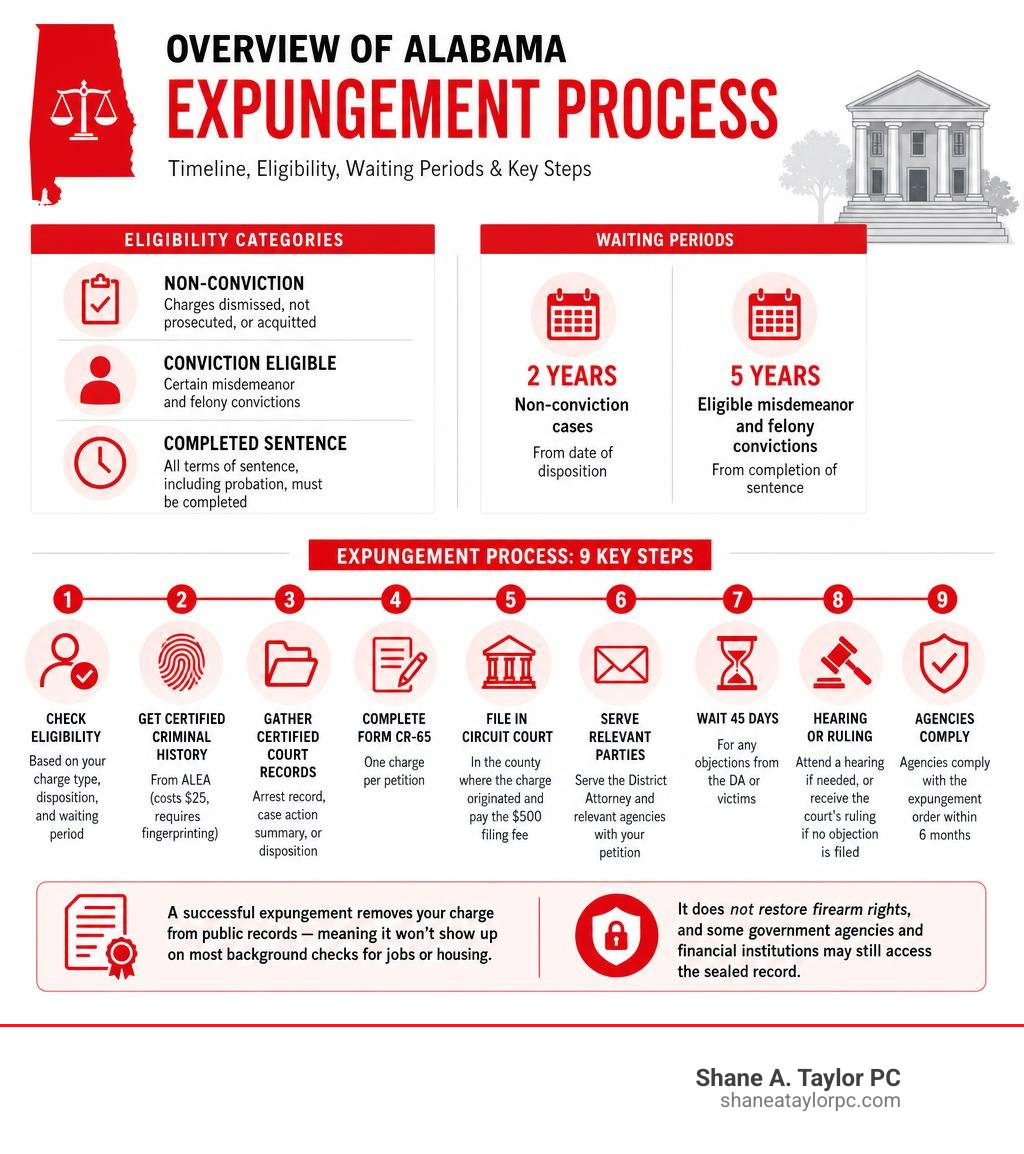
Here is a quick overview of the core steps:
- Check your eligibility — based on your charge type, disposition, and waiting period
- Get your certified criminal history from ALEA (costs $25, requires fingerprinting)
- Gather certified court records — arrest record, case action summary, or disposition
- Complete Form CR-65 — one charge per petition
- File in the Circuit Court of the county where the charge originated and pay the $500 filing fee
- Serve the District Attorney and relevant agencies with a copy of your petition
- Wait 45 days for any objections from the DA or victims
- Attend a hearing if needed, or receive the court’s ruling if no objection is filed
- Agencies comply with the expungement order within 6 months
A successful expungement removes your charge from public records — meaning it won’t show up on most background checks for jobs or housing. It does not restore firearm rights, and some government agencies and financial institutions may still access the sealed record.
I’m Shane A. Taylor, a criminal defense attorney based in Mobile, Alabama, with a background as a former Birmingham police officer — experience that gives me a street-level and courtroom understanding of the alabama record expungement process that few attorneys can offer. If your past record is affecting your family’s future, I can help you determine your eligibility and guide you through every step.
Eligibility and Waiting Periods for the Alabama Record Expungement Process

Navigating the legal system to clear your name can feel like reading a map written in a foreign language. Fortunately, Alabama’s laws have evolved significantly to offer more clear-cut pathways. The foundation of modern expungement in our state rests on the REDEEMER Act, which went into effect in January 2021, and subsequent amendments that have reshaped how we handle old records. For an in-depth look at these legislative shifts, you can read our breakdown of the New Expungement Law in Alabama.
To help you quickly identify where your situation falls, we have compiled the general waiting periods and eligibility criteria under the current 2026 guidelines in the table below:
| Charge Type / Disposition | Mandatory Waiting Period | Prerequisite / Special Conditions |
|---|---|---|
| Non-Conviction (Dismissed with Prejudice, Acquitted, No-Billed) | 90 Days | None |
| Non-Conviction via Diversion / Drug Court | 1 Year | Full completion of all program requirements |
| Misdemeanor Dismissed Without Prejudice | 1 Year (or 2 years depending on circumstances) | Must have no subsequent convictions (excluding minor traffic) |
| Felony Dismissed Without Prejudice | 5 Years | Must have no subsequent convictions |
| Misdemeanor Conviction | 3 Years | Limit of 2 lifetime expungements; must be a non-violent, eligible offense |
| Felony Conviction | 180 Days after pardon | Must first obtain a full Certificate of Pardon with restored civil rights |
What is Expungement vs. Sealing?
Many people use the terms “expungement” and “sealing” interchangeably, but they have distinct legal meanings in Alabama. Under Alabama Code Title 15, Chapter 27 (2025) – Expungement., a granted expungement does not mean your physical and digital records are tossed into a courthouse incinerator.
Instead, “expungement” in Alabama means the records are sealed and archived away from public view. The Alabama Law Enforcement Agency (ALEA) removes the charges from your publicly accessible criminal history record, which is what standard employers, landlords, and private background check databases see. However, the files are still maintained in a secure, non-public archive by ALEA and can be accessed by law enforcement agencies, courts, and specific government entities under highly restricted circumstances (such as active criminal investigations).
Non-Convictions: Dismissed With vs. Without Prejudice
If you were charged with a crime but never convicted, your eligibility depends heavily on how the case was resolved:
- Dismissed with Prejudice, No-Billed, or Acquitted: If your case was dismissed with prejudice (meaning the state cannot refile the charges), no-billed by a grand jury, or you were found not guilty at trial, you only have to wait 90 days from the date of the disposition to file your petition.
- Dismissed Without Prejudice: If the prosecution dismissed your case without prejudice, they reserved the right to refile the charges within a certain timeframe. Because of this, the law requires you to wait longer to ensure the case is truly over. For a misdemeanor dismissed without prejudice, you must wait 1 year (or up to 2 years depending on the specific charge) without any subsequent convictions. For a felony dismissed without prejudice, you must wait 5 years without any other convictions before you can apply.
These strict timelines are laid out in detail under Alabama Code § 15-27-1 (2025) – Petition to Expunge Records – Misdemeanor Offense, Violation, Traffic Violation, or Municipal Ordinance Violation. :: 2025 Code of Alabama :: U.S. Codes and Statutes :: U.S. Law :: Justia.
Misdemeanor Convictions Under the REDEEMER Act
Before the passage of the REDEEMER Act in 2021, Alabama only allowed the expungement of non-convictions. If you pled guilty or were found guilty of a misdemeanor, it stayed on your record forever.
The REDEEMER Act changed that by allowing individuals to expunge certain misdemeanor convictions. To qualify, you must have completed all terms of your sentence (including probation, community service, and paying all fines and restitution) and waited at least 3 years from the date of conviction without any new legal trouble. That Alabama places a strict lifetime limit on this: you may only expunge a maximum of two misdemeanor convictions in your lifetime. You can find more details on these rules through Expungements in Alabama.
Felony Convictions and the Pardon Pathway
Can a felony conviction ever be expunged in Alabama? Yes, but the road is much steeper. Under Alabama Code § 15-27-2 (2025) – Petition to Expunge Records – Felony Offense. :: 2025 Code of Alabama :: U.S. Codes and Statutes :: U.S. Law :: Justia, you cannot directly petition the court to expunge a felony conviction.
Instead, you must first apply for and receive a full Certificate of Pardon with the restoration of civil and political rights from the Alabama Board of Pardons and Paroles. Once that pardon is officially granted, you must wait an additional 180 days before you are legally eligible to file a petition for expungement in the Circuit Court.
Ineligible Offenses and the 2023 DUI Exclusion
Not every mistake can be wiped clean. Alabama law permanently excludes certain serious offenses from expungement eligibility, regardless of whether they are misdemeanors or felonies. These permanently ineligible offenses include:
- Violent Felonies: Any offense classified as a violent crime under Alabama law (such as capital murder, kidnapping, or first-degree assault).
- Sex Offenses: Any crime requiring registration on the state’s sex offender registry.
- Crimes of Moral Turpitude: Offenses that involve dishonesty or depravity that the state deems too serious to hide.
- DUI Convictions: Effective July 1, 2023, Driving Under the Influence (DUI) was reclassified as a serious traffic offense, making it permanently ineligible for expungement under any circumstances.
Navigating the Filing, Costs, and Court Procedures

Once you establish that you are eligible, the actual filing process requires careful attention to detail. A single missing document or administrative error can result in your petition being rejected, forcing you to start over. The state provides a basic outline of these requirements in the Criminal Record Expungement Kit, but let’s break down the exact steps you need to take.
Step-by-Step Guide to the Alabama Record Expungement Process
To successfully clear your record, you must follow this step-by-step sequence:
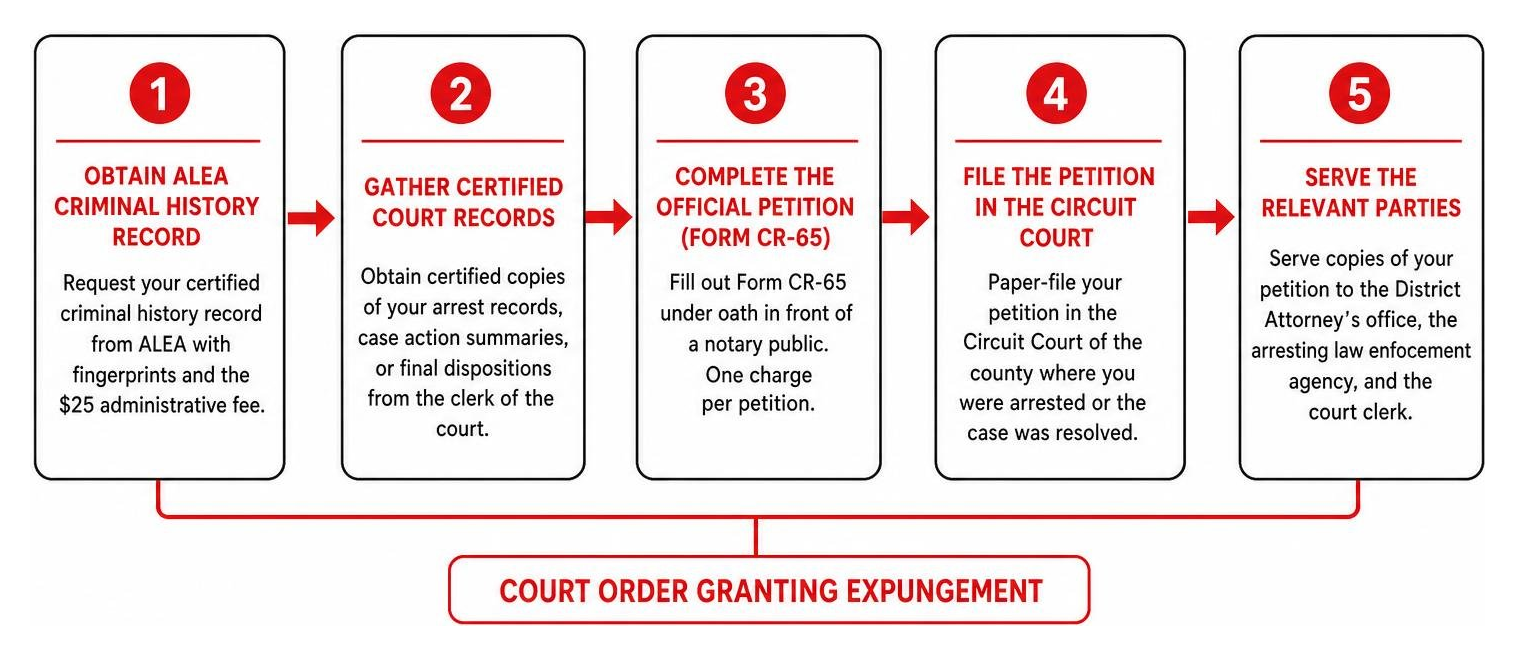
- Step 1: Obtain Your Certified ALEA Criminal History Record. You must request your official criminal record directly from the Alabama Law Enforcement Agency. This step requires you to submit a classifiable set of fingerprints (which you can get taken at your local sheriff’s department or police station) along with a $25 administrative fee. This certified document is a mandatory prerequisite; you cannot file your petition without it.
- Step 2: Gather Certified Court Records. You must contact the clerk of the court where your case was handled to obtain certified copies of your arrest records, case action summaries, or final dispositions. Standard photocopies are not accepted.
- Step 3: Complete the Official Petition (Form CR-65). You must fill out the PETITION FOR EXPUNGEMENT OF RECORDS (Form CR-65) under oath in front of a notary public. Remember the “one charge per petition” rule: if you have multiple charges from different arrests, you must file a separate petition for each one.
- Step 4: File the Petition in the Circuit Court. All expungement petitions must be paper-filed in the Circuit Court of the county where you were arrested or where the case was resolved. For more context on court jurisdictions, see our guide on What Happens If You Are Charged With a Crime.
- Step 5: Serve the Relevant Parties. You are legally required to serve copies of your completed petition to the District Attorney’s office, the arresting law enforcement agency, and the court clerk. If you fail to serve an agency, the court has no authority to order them to seal your records. You can access the official forms directly on the Criminal Record Expungement | Alabama Law Enforcement Agency portal.
Costs, Fees, and Financial Hardship Options
Clearing your record is an investment in your future, but it does come with a price tag.
- Filing Fee: The standard administrative filing fee is $500 per petition, paid directly to the Circuit Court clerk at the time of filing.
- Fee Consolidation: If you are expunging multiple charges that all stem from a single arrest, you only have to pay one $500 filing fee. However, if your charges stem from multiple separate arrests, you must pay $500 for each arrest.
- Financial Hardship: The $500 filing fee is an administrative fee that cannot be waived entirely. However, if you are truly low-income, you can file an Affidavit of Substantial Hardship. If the judge finds you indigent, they may approve a payment plan, allowing you to pay the fee in installments. The expungement will not be finalized until the fee is paid in full.
- Other Costs: Expect to pay the $25 ALEA record fee, nominal fees for certified court copies (usually around $10), and attorney fees, which typically range from $1,000 to $2,500 depending on the complexity of your case.
The Role of the District Attorney and Court Hearings
Once your petition is filed and served, the District Attorney and any named victims have a 45-day window to file a written objection to your expungement.
Under the legislative updates introduced in SB88 (which went into effect on October 1, 2025, and are fully active in our current 2026 legal landscape), the procedural rules have shifted:
- If No Objection is Filed: The court must rule on the merits of your petition based on the paperwork submitted, without requiring a formal hearing.
- If an Objection is Filed: The court must schedule a formal hearing. Under SB88 ENROLLED, this hearing must be set at least 30 days after the objection is filed (an increase from the old 14-day rule) to allow both sides to prepare.
- Judicial Discretion: The judge will evaluate 10 specific factors, including the nature of your offense, your age at the time, your probation history, and evidence of your rehabilitation (such as steady employment or community involvement). There is no constitutional right to an expungement; it is entirely at the court’s discretion.
- Appeals: If the judge denies your petition, SB88 changed the rules so that the decision is subject to certiorari review rather than a standard appeal, meaning the ruling can only be overturned if you can prove a clear abuse of judicial discretion.
Life After Expungement: Rights, Limitations, and Special Provisions
A successful expungement order brings immense relief, but it is important to understand exactly what your clean slate means—and what it doesn’t. For a broader look at how criminal matters affect your long-term goals, read our guide on Understanding Consequences in Your Criminal Case.
Special Provisions for Human Trafficking Victims
Alabama law includes compassionate provisions for victims of human trafficking. If you were coerced into committing a crime as a direct result of being trafficked, you can petition to expunge misdemeanors, violations, and even certain violent felony convictions (such as domestic violence 3rd or promoting prostitution). You must prove by a preponderance of the evidence that your actions were forced by your trafficker. If successful, the court can bypass the standard waiting periods to grant you relief.
What Happens to Records After the Alabama Record Expungement Process
Once the judge signs your expungement order, the court sends it to ALEA and all arresting agencies. They have up to 6 months to comply.
- Public Records: The records are completely removed from public-facing databases. On private employment or housing applications, you can legally state that the arrest or charge never occurred.
- The Exceptions: You still have a legal duty to disclose the expunged record if you are applying for a job with a government regulatory agency, a law enforcement agency, a utility company, a financial/banking institution, or the Department of Human Resources (especially for positions involving children or vulnerable adults).
- Third-Party Databases: Private background check companies buy public records in bulk. While they are legally barred from distributing expunged records once notified, it can take time for their systems to update. Providing them with a copy of your official court order is the fastest way to get them to update their files. You can refer to the official Criminal Record Expungement guidelines for details on post-expungement compliance.
Frequently Asked Questions about Alabama Expungements
Can I expunge multiple charges from a single arrest?
Yes. If you were arrested once but charged with multiple offenses (a multi-count case), you must file a separate petition for each individual charge. However, Alabama law allows for “single arrest fee consolidation,” meaning you only have to pay one $500 administrative filing fee for all charges arising from that single incident.
Will an expunged record show up on a federal background check?
Generally, no, because ALEA seals the state records and requests that the FBI database update its records accordingly. However, federal law enforcement agencies, military branches, and federal security clearance investigators will still be able to access the archived, non-public files.
How long does the entire expungement process take in Alabama?
On average, the alabama record expungement process takes between 3 to 6 months. The exact timeline depends heavily on how quickly ALEA processes your background check, the backlog of the Circuit Court clerk, and whether the District Attorney files a written objection during the 45-day window.
Conclusion
Living with a past mistake on your record can feel like running a race with weights tied to your ankles. The alabama record expungement process is designed to help deserving individuals reclaim their futures, secure better employment, and find stable housing for their families.
At Shane A. Taylor PC, we understand that your family’s peace of mind is what matters most. Based in Mobile, Alabama, our responsive, client-focused team is dedicated to helping you navigate the complexities of criminal defense and record clearing. If you are ready to explore your options and secure a true fresh start, contact us today to discuss how we can assist you with Expungements.