


Understanding Civil Service Law and Public Employee Rights
Civil service law governs the relationship between government bodies and their workforce across state, municipal, and federal agencies. Designed to shield civil servants from arbitrary firing, political patronage, and unfair workplace treatment, the system helps ensure government positions are filled and maintained based on merit rather than political connections.
For public employees in Mobile, Alabama, and across the Gulf Coast, civil service issues can also overlap with matters that require separate legal help. A workplace investigation may involve alleged criminal conduct, a protective order, a domestic dispute, or a family law issue that affects employment, licensing, custody, or reputation. Shane A. Taylor PC focuses on criminal defense and family law, so this guide explains what civil service lawyers do while also helping public employees understand when related criminal or family law counsel may be important.
This framework dates back to historical milestones like the Pendleton Civil Service Reform Act of 1883, which transformed public sector hiring from a political spoils system into a competitive, merit-based civil service. Under modern constitutional law, many permanent public employees hold a recognized property interest in their employment. This means government employers often cannot deprive a tenured worker of their job without establishing just cause and affording statutory due process.
What Civil Service Lawyers Near Me Actually Do
When you search for civil service lawyers near me, you are usually looking for legal advocates who understand administrative law, public sector regulations, and employee appeal procedures. Civil service attorneys may represent employees through stages such as:
- Pre-Disciplinary Representation: Reviewing notices of proposed adverse action and preparing written or oral responses during preliminary due process meetings.
- Administrative Litigation: Presenting evidence, examining witnesses, and arguing appeals before administrative law judges, local hearing officers, or specialized commissions.
- Bypass and Promotional Appeals: Challenging instances where public safety or administrative personnel are skipped on civil service candidate lists despite higher test scores.
- Retaliation and Rights Protection: Filing claims when public employers penalize employees for blowing the whistle, asserting union rights, or exercising protected speech.
If your employment issue also involves criminal accusations, domestic allegations, divorce, custody, or another personal legal matter, it may be important to coordinate your civil service strategy with counsel experienced in those areas. You can review Shane A. Taylor PC’s full spectrum of legal representation by visiting our Practice Areas page.
Civil Service Protections vs. Private Sector Employment
Private sector workers are usually at-will employees, meaning their employment can be terminated at any time for almost any lawful reason, or no reason at all. Civil servants, by contrast, may enjoy procedural due process rights protected by state statutes, local rules, and federal or state constitutions.
| Employment Feature | Private Sector Employees | Civil Service Public Employees |
|---|---|---|
| Employment Basis | At-will, typically | Permanent tenure or property interest, when applicable |
| Termination Requirement | Any non-discriminatory reason | Established just cause may be required |
| Pre-Termination Rights | None required by law in many situations | Notice and an opportunity to respond may be required |
| Constitutional First Amendment | Very limited against a private employer | Protected in some public concern speech situations |
| Primary Dispute Forum | Civil courts or arbitration | Administrative commissions, boards, or agency tribunals |
Because public employers act as direct arms of the government, they are bound by constitutional limits that do not apply in the same way to private companies. Public sector employees may retain protected rights to speak on matters of public concern and receive equal protection under the law, giving them legal remedies unavailable to many private corporate workers.
Key Cases Handled by Civil Service Lawyers Near Me
Public sector employment disputes take many forms, ranging from initial hiring list errors to wrongful discharge proceedings. If you are a police officer, firefighter, corrections employee, teacher, municipal worker, or other public employee, a civil service issue can affect your paycheck, pension, license, and professional reputation.
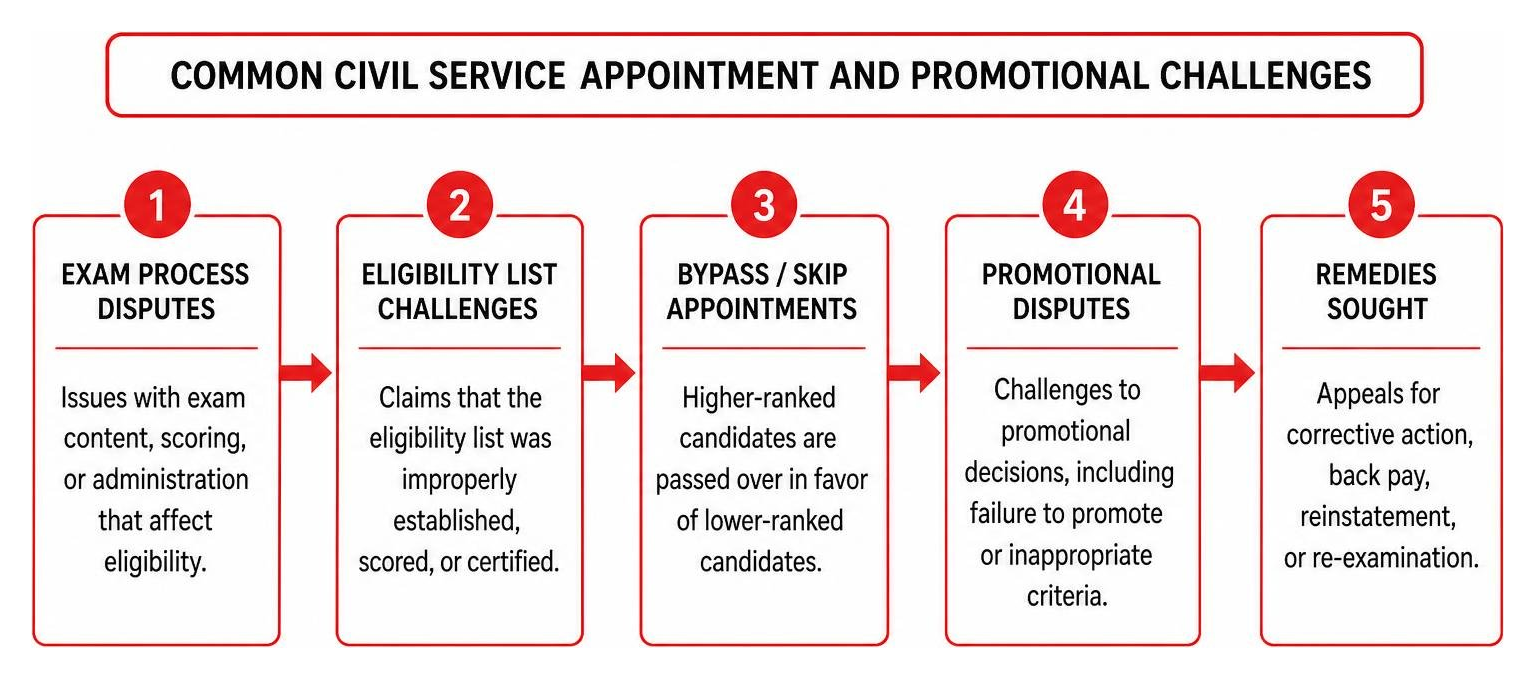
Bypass Appeals, Examinations, and Hiring Disputes
Public safety workers like police officers, firefighters, and corrections personnel, along with general municipal employees, often earn career advancement by taking civil service promotional examinations. When an agency passes over a higher-ranked candidate on an eligibility list, the skipped employee may be able to file a bypass appeal, depending on the governing civil service rules.
Common appointment and promotional challenges include:
- Unjustified disqualification based on disputed medical or psychological evaluations
- Procedural errors in scoring or administering civil service examinations
- Selecting lower-ranked candidates for improper, political, or personal reasons
- Unfair removal of a qualified candidate’s name from an eligible hiring roster
Challenging an administrative hiring decision requires gathering records quickly and filing formal administrative objections before strict statutory cutoffs expire.
Disciplinary Actions, Skelly Hearings, and Termination Proceedings
Before a permanent civil servant can be suspended, demoted, or fired, the government employer may be required to provide advance written notice of charges, access to the evidence supporting those charges, and a meaningful opportunity to present a defense.
In some jurisdictions, preliminary proceedings, often referred to as Skelly hearings or administrative due process conferences, allow civil servants to contest proposed discipline before it takes effect. If an adverse action moves forward, attorneys may litigate formal appeals before municipal civil service boards or administrative commissions. In states like New York, Civil Service Law Section 75 guarantees a formal evidentiary hearing before an impartial officer prior to major discipline or discharge.
When the same facts could also lead to criminal charges, such as allegations of assault, theft, fraud, domestic violence, or misuse of public property, public employees should be careful about making statements in an employment interview without understanding the criminal consequences. In those situations, a civil service lawyer and a criminal defense attorney may need to coordinate strategy.
Whistleblower, Discrimination, and Constitutional Rights Claims
Public employees who expose corruption, safety hazards, or illegal agency actions may be protected under government whistleblower statutes. If an agency retaliates through unfavorable reassignments, unwarranted performance deficiencies, or termination, civil service attorneys can bring administrative claims or civil lawsuits.
Additionally, public employees are protected by civil rights laws like Title VII, the Americans with Disabilities Act (ADA), and the Age Discrimination in Employment Act (ADEA). When government leadership retaliates against a public employee for exercising First Amendment rights on matters of public concern, an attorney may bring federal civil rights actions under 42 U.S.C. Section 1983.
State vs. Federal Civil Service System Differences
While all civil service systems exist to enforce merit-based employment, the legal rules and administrative bodies differ between state, municipal, and federal levels. For an Alabama public employee, the first step is identifying whether the case is governed by federal employment rules, Alabama law, a county personnel board, a city merit system, a collective bargaining agreement, or a specific agency policy.

Federal Civil Service Appeals and the MSPB
Federal civilian employees operate under a distinct framework governed by federal statutes and administrative agencies. When federal agencies propose adverse actions, such as suspensions exceeding 14 days, demotions, or removals, the employee may appeal to the U.S. Merit Systems Protection Board (MSPB), if eligible.
Federal employment cases involve specialized processes:
- MSPB Appeals: Independent administrative judges hear witness testimony, evaluate agency evidence, and issue formal initial decisions.
- Federal Circuit Review: Decisions from the MSPB can be appealed to the U.S. Court of Appeals for the Federal Circuit in many cases.
- Security Clearance Defense: Federal workers whose roles require clearances must navigate specialized administrative proceedings before bodies like the Defense Office of Hearings and Appeals (DOHA) if their credentials are threatened.
- Equal Employment Opportunity (EEO): Federal sector EEO complaints follow specific procedural regulations distinct from private sector EEOC filings.
State and Municipal Administrative Commissions
State and local public servants rely on state statutes, local acts, personnel boards, and municipal civil service commissions to handle employment disputes. Alabama public employees should confirm the exact authority that controls their job classification and appeal deadline. In the Mobile area, some public employment matters may involve local personnel rules or agency-specific procedures rather than a single statewide civil service forum.
Other states use different systems. For example:
- Massachusetts: Under General Laws Chapter 31, the Civil Service Commission hears appeals regarding appointments, promotions, suspensions, and discharges.
- New Jersey: The New Jersey Civil Service Commission oversees state and municipal merit systems, while minor disciplinary decisions can be reviewed by state courts through prerogative writs.
- New York: Public sector labor relations are governed by the Taylor Law and the Public Employment Relations Board (PERB), alongside Civil Service Law Section 75 for discipline.
- California: The Meyers-Milias-Brown Act (MMBA) regulates local public agency labor practices, while administrative appeals move through local civil service commissions.
Regardless of your state, local municipal charters, personnel board rules, and agency policies can set tight timelines for challenging disciplinary actions or list bypasses.
Evaluating and Hiring the Right Legal Representation
Navigating civil service disputes requires an attorney who understands administrative proceedings and administrative law tribunals. If your case also involves an arrest, investigation, protective order, divorce, child custody dispute, or allegations that could affect your freedom or family, you may need more than one type of legal guidance.
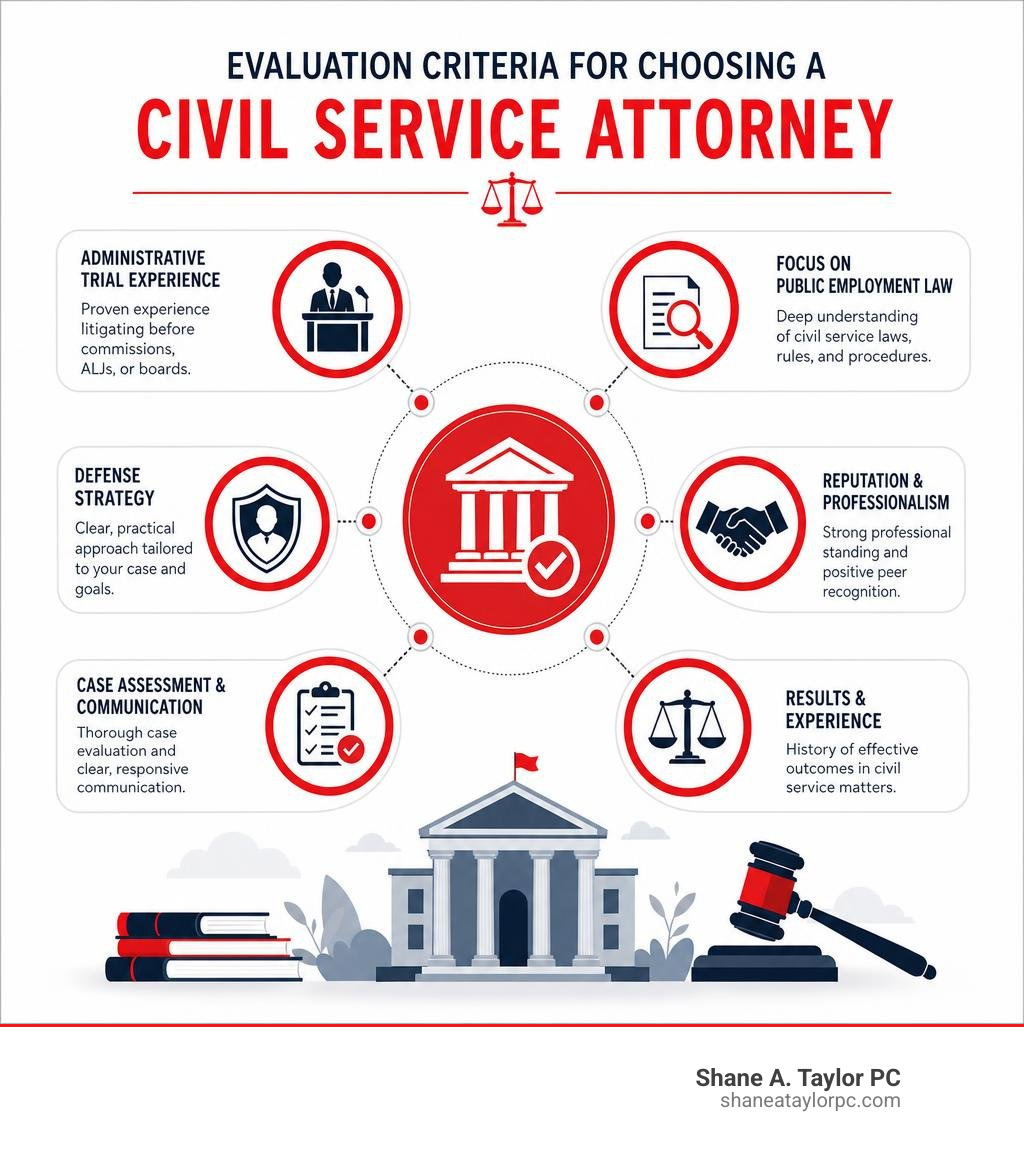
Key Criteria for Evaluating Civil Service Lawyers Near Me
When reviewing prospective civil service attorneys, evaluate their specific experience in public employment law:
- Administrative Trial Experience: Has the lawyer tried cases before civil service commissions, administrative law judges, personnel boards, or municipal boards?
- Knowledge of Due Process Standards: Does the firm regularly handle pre-disciplinary hearings, internal affairs investigations, and tenure protections?
- Fee Structures and Transparency: Understand whether the attorney works on an hourly retainer, fixed flat fee for administrative hearings, or contingency basis for civil rights litigation.
- Union Coordination: Experienced attorneys know how to work alongside union representatives and navigate collective bargaining agreements (CBAs), where applicable.
- Parallel Case Awareness: If the facts may involve criminal exposure or family court consequences, ask whether the attorney can coordinate with separate criminal defense or family law counsel.
Essential Steps to Take Before Your Initial Consultation
Preparation ensures you maximize value during your legal consultation:
- Gather All Official Documentation: Collect your formal notice of proposed action, agency investigation reports, written responses, performance reviews, and personnel files.
- Track Administrative Deadlines: Write down the exact date you received your adverse action notice. Administrative appeal windows are short and may range from only a few days to a few weeks.
- Draft a Timeline of Events: Prepare a clear, chronological summary of relevant incidents, conversations, and written correspondence.
- Avoid Making Uncounseled Statements: Do not submit formal written statements or attend administrative interviews without first consulting appropriate counsel, especially if criminal allegations are possible.
- Separate Employment, Criminal, and Family Issues: A civil service appeal may decide job status, but a criminal court or family court may decide separate issues. Make sure each legal risk is addressed by the right attorney.
Frequently Asked Questions About Civil Service Appeals
What is the role of the Civil Service Commission?
The Civil Service Commission is an administrative body that oversees merit-based public employment systems. It may act as an impartial reviewer when public employees appeal adverse agency decisions regarding hiring, promotional bypasses, suspensions, demotions, or terminations. Depending on the jurisdiction, the commission or personnel board may conduct evidentiary hearings and can affirm, modify, or reverse agency actions.
What remedies can a civil service employee receive after a successful appeal?
Depending on the jurisdiction and nature of the case, successful appellants may receive:
- Full reinstatement to their previous position
- Back pay and restoration of lost benefits
- Expungement of disciplinary notices from personnel records
- Placement on active eligible lists or promotional appointments
- Reimbursement of legal fees in eligible statutory claims
If the employment dispute is connected to a criminal accusation or family law issue, those separate cases may have different remedies, risks, and deadlines.
When should I consult an attorney for a bypass appeal?
You should speak with a qualified civil service lawyer immediately after receiving formal notice that a candidate ranked lower than you was selected from an eligible hiring or promotional list. Because bypass appeal deadlines are strict, engaging counsel early helps ensure your appeal statement is properly prepared and filed within the statutory window.
If your situation also involves criminal allegations, a domestic dispute, or a family court matter, consult appropriate counsel before making statements that could be used outside the civil service process.
Protect Your Public Career and Related Legal Rights
Serving the public is a commitment that deserves fair treatment and full legal protection. If your career, promotion, or reputation is threatened by unfair administrative action, a qualified civil service attorney can help you evaluate deadlines, hearing rights, and available remedies.
At Shane A. Taylor PC, our Mobile, Alabama team focuses on helping clients through criminal defense and family law matters. If you are a public employee and your workplace issue overlaps with an arrest, investigation, domestic allegation, divorce, custody dispute, or other related legal concern, our team can help you understand those risks and protect your rights in the appropriate forum. To learn more, visit our Civil Defense practice area page or Contact our team today.