


How to Start Fighting a DUI Charge in Mobile
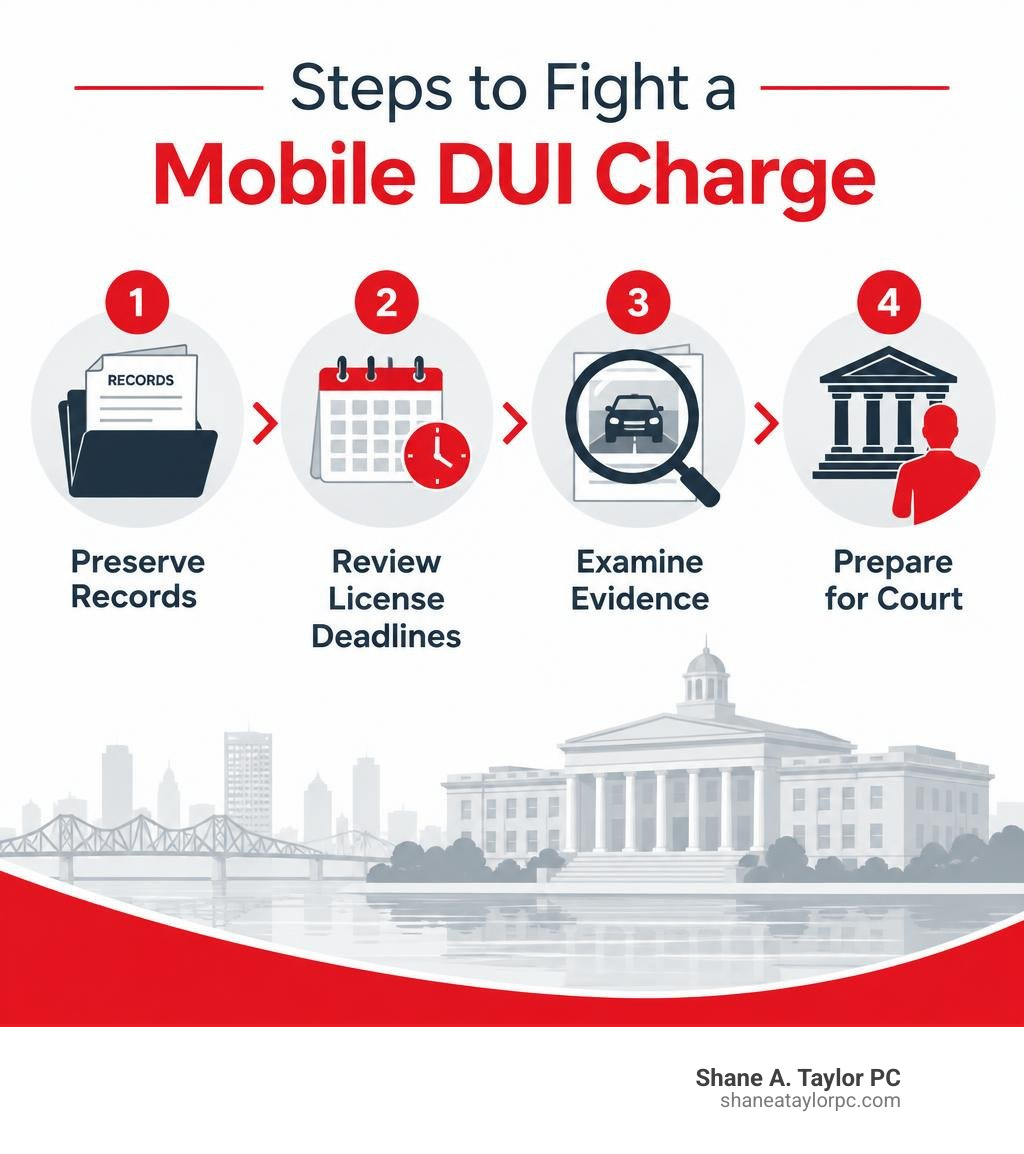
After a DUI arrest, contact an Alabama DUI attorney promptly. Keep your arrest papers and any driving permit, note what happened during the stop, and ask about the deadline to challenge a license suspension. The court case and the license process are separate, so waiting for your first court date could put your driving privileges at risk.
I’m Shane A. Taylor. Before practicing criminal defense in Alabama, I served as a Birmingham police officer for more than 10 years; that experience helps me examine how officers gathered evidence and explain your options in Mobile Municipal Court. The National Highway Traffic Safety Administration publishes standardized field sobriety testing guidance that can help you understand what officers are supposed to do during a roadside stop.
Critical Consequences of a Drunk Driving Conviction in Alabama
A drunk driving charge in Alabama is not simply a traffic ticket that disappears after paying a fine. Under state law, a conviction triggers mandatory statutory penalties that follow you for years. Whether this is an unexpected first encounter with law enforcement or a subsequent charge, understanding consequences in your criminal case is the first step toward building an effective defense.
The legal fallout from an Alabama DUI conviction generally includes:
- Driver’s License Suspension: A standard first-offense conviction typically involves a 90-day suspension of driving privileges, which can be stayed or reduced if you install an approved interlock device. Refusing a chemical test carries an automatic administrative suspension.
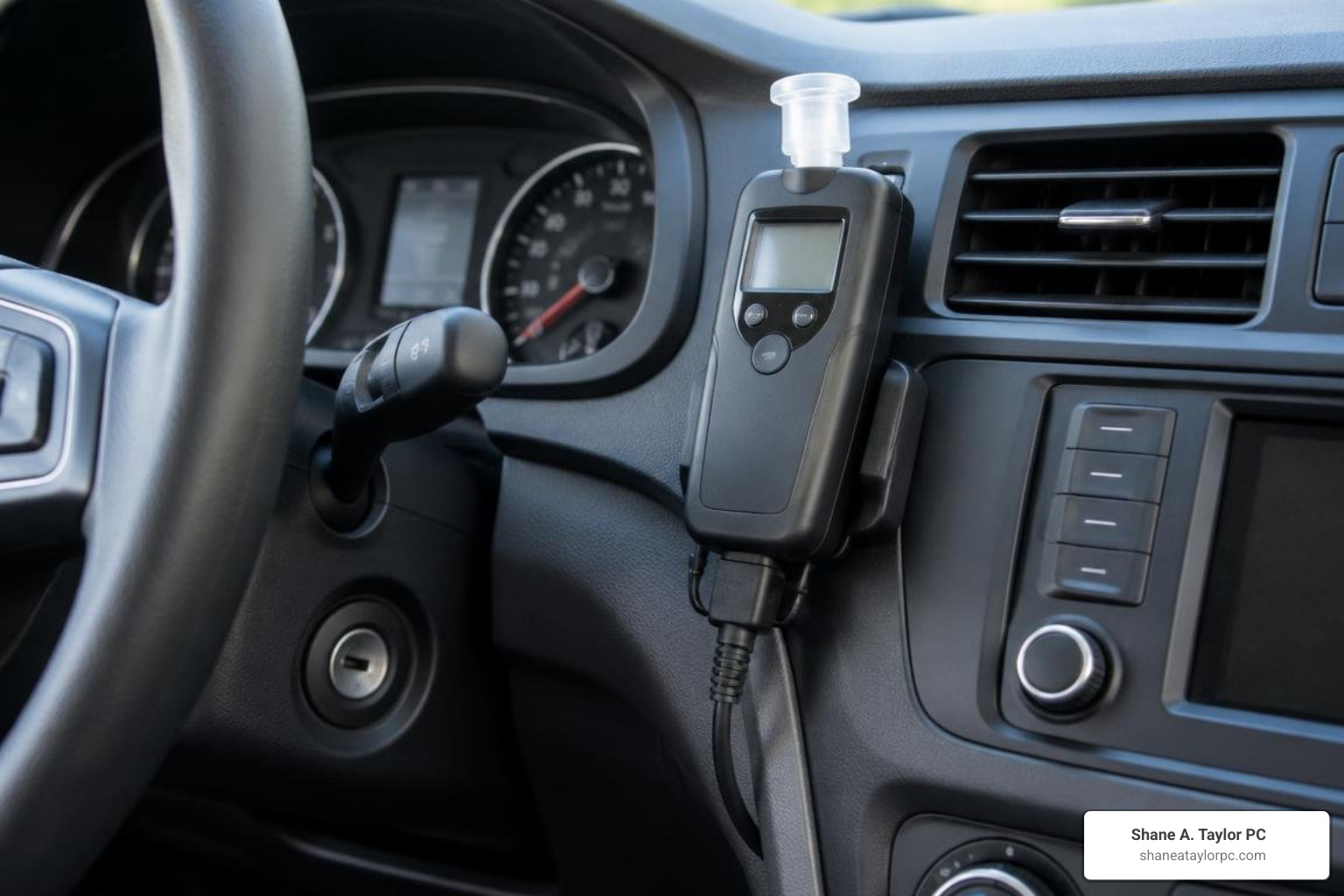
- Mandatory Ignition Interlock Device (IID): Alabama’s interlock laws require most drivers convicted of DUI—even first-time offenders—to install an ignition interlock device on their vehicle. If your blood alcohol concentration (BAC) registered at 0.15% or higher, or if you refused testing or had a minor passenger in the car, extended interlock requirements become mandatory. You are responsible for all installation and monthly maintenance fees.
- Fines, Fees, and Mandatory Programs: Fines for a first offense range from $600 up to $2,100, plus substantial court costs. In addition, you must complete a court-approved chemical abuse evaluation and driver safety program.
- SR-22 Insurance Rates: To reinstate your license, your insurance provider must file an SR-22 certificate of financial responsibility. This classification significantly increases your auto insurance premiums for at least three continuous years.
- Permanent Criminal Record: DUI convictions in Alabama cannot be expunged if you are found guilty. A conviction stays on your record permanently, surfacing during background checks conducted by prospective employers, landlords, and educational institutions.
- Career and Security Clearances: In our coastal region, many workers rely on specialized credentials—such as merchant mariner documents, port access badges, defense contractor credentials, or active military security clearances. A criminal conviction can cause the immediate loss of clearances and termination of employment.
Proven Defense Strategies Used by an Alabama DUI Attorney
Pleading guilty at your initial appearance should never be your default plan. An arrest merely reflects an officer’s opinion; it is not definitive proof of legal guilt. When evaluating what does a defense lawyer do to protect your rights, our priority is dissecting every phase of the traffic stop, testing protocols, and arrest procedures to identify procedural defects and constitutional violations.
| Defense Approach | Challenging Field Sobriety Tests (FSTs) | Challenging Chemical / Breath Tests |
|---|---|---|
| Primary Legal Focus | Officer administration errors, environmental factors, lack of reasonable suspicion. | Machine calibration lapses, operator licensing, improper observation periods. |
| Key Vulnerability | Subjective scoring by officer; medical conditions or footwear mimicking impairment. | Mechanical drift, electrical interference, mouth alcohol, unverified software logs. |
| Standard of Review | Strict adherence to NHTSA training protocols and objective grading rubrics. | Alabama Department of Forensic Sciences administrative rules and chain of custody. |
| Potential Outcome | Elimination of probable cause for arrest, leading to suppression of all evidence. | Invalidation and exclusion of BAC numerical readings from trial proceedings. |
To challenge the state’s case, we systematically examine four core areas:
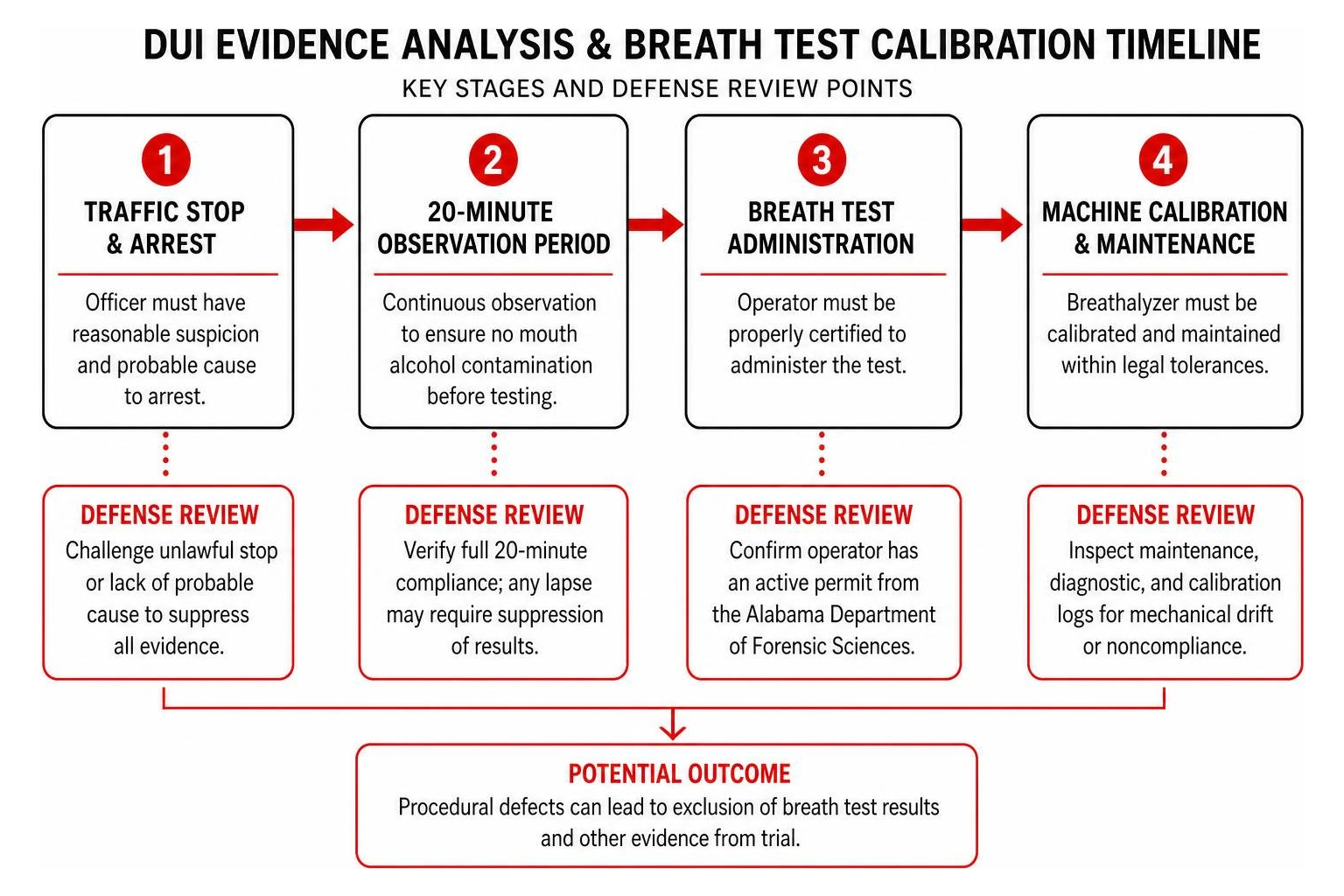
- Unlawful Traffic Stops: An officer must have reasonable, articulable suspicion of an actual traffic infraction or criminal activity to pull you over. If the officer initiated the stop on a mere hunch, all evidence obtained afterward may be suppressed.
- Lack of Probable Cause for Arrest: An officer cannot arrest you based solely on an odor of alcohol or minor lane wandering. They must establish probable cause through objective, verifiable evidence before placing you in handcuffs.
- Chain of Custody and Biological Samples: If police collected blood or urine samples, the state must prove an unbroken chain of custody, sterile storage, and proper laboratory handling.
- Miranda and Statutory Warning Violations: If law enforcement questioned you during custodial interrogation without providing Miranda warnings, or failed to give required implied consent advisories, those statements can be excluded from court.
Challenging Chemical and Breathalyzer Evidence with an Alabama DUI Attorney
Breath testing machines used across Alabama—such as the Draeger Alcotest series—are complex analytical instruments that require rigorous maintenance, regular calibration, and careful operation. They do not directly measure alcohol in your blood; rather, they analyze deep-lung breath and apply a mathematical ratio to estimate blood alcohol concentration.
When evaluating chemical evidence, we inspect:
- The 20-Minute Deprivation/Observation Period: Alabama Department of Forensic Sciences regulations mandate that an officer observe you continuously for at least 20 minutes before testing. This ensures you do not burp, regurgitate, smoke, or place anything in your mouth that could introduce raw mouth alcohol into the sample chamber and skew the result.
- Machine Calibration and Maintenance Logs: Breathalyzers experience mechanical drift. We request maintenance logs, diagnostic checks, and calibration records to verify whether the device was operating within legal tolerances.
- Operator Certification: The officer administering the test must hold an active permit from the Alabama Department of Forensic Sciences. If their certification lapsed, the test results may be ruled inadmissible.
- Medical Conditions and Interfering Substances: Conditions like gastroesophageal reflux disease (GERD), acid reflux, diabetes (ketones), or specific dental work can cause mouth alcohol contamination, producing an artificially high BAC reading.
Contesting Standardized Field Sobriety Testing Protocols
Field sobriety tests are designed to gather evidence to justify an arrest. The National Highway Traffic Safety Administration (NHTSA) developed a standardized three-test battery:
- Horizontal Gaze Nystagmus (HGN): The officer checks for an involuntary jerking of the eyes as you track an object side-to-side.
- Walk-and-Turn (WAT): A divided-attention test requiring you to walk heel-to-toe along a straight line, turn, and return.
- One-Leg Stand (OLS): A balance test where you stand on one foot and count out loud for 30 seconds.
Under NHTSA rules, if an officer modifies the directions, demonstrates the test incorrectly, or grades normal human balance variations as clues of intoxication, the test loses its diagnostic reliability.
Environmental conditions in Mobile—such as broken asphalt, uneven road shoulders, heavy traffic winds, rain, flashing strobe lights, or inappropriate footwear—frequently compromise testing accuracy. Additionally, physical injuries, inner ear issues, weight, or age can affect balance. By reviewing police body camera and dashcam recordings, we can cross-reference the officer’s written report against what actually occurred on the roadside.
Navigating the Mobile Municipal Court DUI Process
DUI arrests made within the city limits of Mobile by the Mobile Police Department are prosecuted in the Mobile Municipal Court, located at Government Plaza (205 Government Street). Understanding the procedural stages helps reduce stress and prevents missed deadlines.
When deciding what happens if you are charged with a crime in Mobile Municipal Court, your case moves through several distinct steps:
- Initial Appearance and Arraignment: This is your formal introduction to the charges. Your attorney enters a plea of not guilty, confirms that your constitutional rights are protected, and requests discovery from the city prosecutor. In many instances, an attorney can waive your formal arraignment appearance.
- Discovery Requests and Evidence Review: We obtain and examine the police reports, video footage, calibration certificates, dispatch logs, and witness statements held by the city prosecutor.
- Pretrial Conferences and Negotiations: We meet with the city prosecutor to discuss legal defects in the arrest, present mitigating factors, and explore options such as charge reductions, dismissals, or entry into pretrial diversion programs.
- Motion Practice and Suppression Hearings: If the officer conducted an illegal stop or mishandled chemical testing, we file formal motions to suppress the evidence, asking the municipal judge to exclude that material from trial.
- Municipal Bench Trial: In Alabama municipal courts, cases are heard directly by a municipal judge rather than a jury. If negotiations do not yield an acceptable outcome, we present your defense at trial.
- Appeal for a Trial De Novo: If you are dissatisfied with a municipal court ruling, Alabama law grants an automatic right to appeal to the Mobile County Circuit Court for a trial de novo, where you can have your case heard anew before a 12-person jury.
Essential Factors When Selecting Legal Representation for DUI Defense
Selecting defense counsel is one of the most critical decisions you will make after an arrest. DUI defense blends constitutional criminal procedure, traffic enforcement standards, and technical toxicology. When researching how to choose the right lawyer for your criminal case, prioritize practitioners who actively try cases in Mobile courts and understand field sobriety testing mechanics.
Key qualifications to evaluate include:
- Law Enforcement or Prosecutorial Insight: An attorney with prior law enforcement experience understands police field procedures, report drafting methods, and patrol tactics from the inside out.
- Familiarity with Local Court Personnel: Working regularly in Mobile Municipal Court ensures your attorney understands the specific procedures, prosecutor policies, and local administrative rules.
- Technical and Scientific Knowledge: Your lawyer should understand how breath testing equipment functions, how blood draws are analyzed, and how to identify mechanical or chemical errors.
- Accessible Communication: Choose a firm that provides direct updates and explains complex legal options in straightforward, practical terms.
Why Experience and Trial Readiness Matter for an Alabama DUI Attorney
Prosecutors can tell when a defense lawyer is simply looking to enter a quick guilty plea versus one who is prepared to challenge the evidence at trial. True trial readiness provides vital leverage during negotiations.
Through focused criminal defense preparation, our team evaluates every available avenue:
- Interviewing arresting officers to highlight factual inconsistencies.
- Filing targeted motions to suppress improper evidence before trial begins.
- Retaining toxicology and roadside testing experts when technical disputes arise.
- Presenting well-documented mitigation evidence to negotiate alternatives to jail time.
Frequently Asked Questions About Fighting DUI Charges in Mobile
How quickly must I act to prevent driver’s license suspension after an arrest?
Under Alabama administrative license suspension statutes, you have a limited window—typically 45 days from the date of your notice of suspension—to request an administrative hearing with the Alabama Law Enforcement Agency (ALEA).
If you do not request this hearing in writing within the required timeframe, your license will be suspended automatically, regardless of what later happens in your court case. Requesting this hearing allows your attorney to contest the suspension and seek a temporary driving permit or interlock driving privileges while your municipal case is pending.
Can a first-time DUI charge in Mobile Municipal Court be dismissed?
Yes, first-time DUI charges in Mobile Municipal Court can be dismissed under appropriate legal circumstances. Dismissals typically occur through two primary paths:
- Pretrial Diversion Programs: If you have a clean prior record and meet eligibility guidelines (such as no high-BAC accidents or injuries), you may qualify for a court-approved diversion program. Completing community service, alcohol education, and monitoring requirements can lead to a formal dismissal of the charge.
- Evidentiary Deficiencies: If we successfully argue that the officer lacked reasonable suspicion for the stop or probable cause for the arrest, the judge may suppress critical evidence, leaving the prosecution with insufficient proof to proceed.
How does a DUI arrest impact professional licenses and security clearances in Alabama?
A DUI arrest or conviction can trigger mandatory reporting obligations to state licensing boards, military commanding officers, or corporate security managers.
Medical professionals, attorneys, commercial drivers (CDL holders), educators, and mariners often face disciplinary reviews following a conviction. For defense contractor personnel and military service members stationed near Mobile Bay, alcohol-related convictions can raise security concerns regarding personal conduct and judgment. Intervening early allows us to work toward resolutions that protect your professional standing and clearance status.
Conclusion
A drunk driving arrest in Mobile does not have to derail your career, family life, or future. From evaluating roadside procedures to challenging breath testing devices and appearing in Mobile Municipal Court, taking proactive steps is essential to protecting your record and driving privileges.
At Shane A. Taylor PC, we combine extensive courtroom experience with former law enforcement insight to deliver responsive, strategic defense for every client. If you or a loved one is facing drunk driving charges, contact our team today for a confidential consultation with a dedicated Mobile DUI Attorney.