


Find a Civil Attorney Near Me and Take the Right First Step
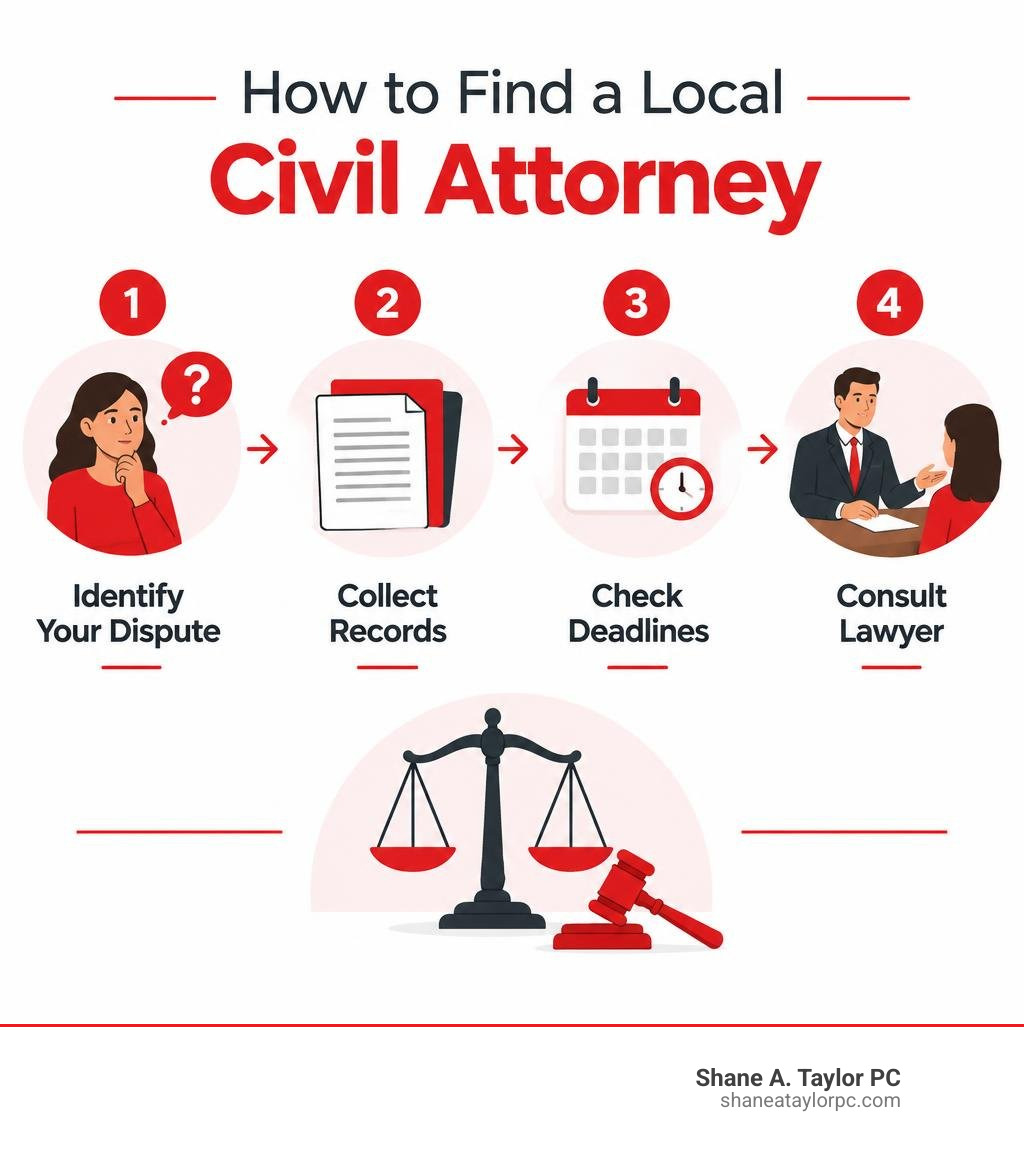
To find a qualified civil attorney near me, start by identifying your dispute, gathering key records, and speaking with a local lawyer who handles that type of case. For divorce, custody, property, contract, or other non-criminal conflicts, ask about filing deadlines, likely costs, settlement options, and who will handle your case before you hire anyone.
Civil law helps people and businesses resolve disputes without criminal charges. The goal may be money damages, a court order, enforcement of an agreement, or another fair remedy. Many cases settle through negotiation, mediation, or arbitration, but a lawyer can help you prepare if court becomes necessary.
If your family, finances, home, or future feel at risk, acting early matters. Save texts, emails, contracts, court papers, and other documents. A short consultation can help you understand your options before a deadline passes or a conflict gets harder to resolve.
I am Shane A. Taylor, an Alabama and Mississippi attorney with experience practicing in state and federal courts. My background as a former police officer and trial-advocacy editor helps me bring clear, practical guidance to people searching for a civil attorney near me.
Understanding Civil Litigation vs Criminal Law
Legal disputes generally fall into two broad buckets: civil litigation and criminal prosecution. While television dramas love to blend them together for maximum suspense, the courtroom realities, standards of proof, and ultimate stakes are entirely distinct.
In a criminal proceeding, the government prosecutes an individual accused of violating public laws. The goal is punitive—often involving incarceration, probation, or state fines—and the prosecution must prove guilt under the highest legal standard: “beyond a reasonable doubt.”
In contrast, civil litigation deals with private disputes between individuals, businesses, or government entities. The initiating party (the plaintiff) claims that another party (the defendant) failed to carry out a legal duty, caused financial harm, or breached an agreement.
Instead of proving a case beyond a reasonable doubt, civil claims rely on a lower standard known as the preponderance of the evidence. This simply means the plaintiff must show that their version of events is more likely true than not—think of it as tipping the scales of justice to 51%. In some specific matters, such as fraud or estate challenges, courts may apply an intermediate standard known as “clear and convincing evidence.”
| Feature | Civil Litigation | Criminal Law |
|---|---|---|
| Parties Involved | Private citizens, companies, or organizations | Government prosecutor vs. individual defendant |
| Standard of Proof | Preponderance of the evidence (more likely than not) | Beyond a reasonable doubt (highest standard) |
| Primary Objective | Financial restitution, specific performance, injunctions | Punishment, public deterrence, rehabilitation |
| Potential Outcomes | Monetary awards, property division, court orders | Incarceration, criminal records, probation, fines |
| Right to Free Counsel | Generally none (must hire private or seek legal aid) | Guaranteed by Sixth Amendment for indigent defendants |
When to Search for a Civil Attorney Near Me vs Handling Claims in Small Claims Court
Not every disagreement requires full-scale representation by private counsel. In Alabama, the court system provides small claims courts specifically designed for minor financial disputes. Small claims dockets feature streamlined evidentiary rules and lower procedural barriers, allowing parties to represent themselves without extensive legal overhead.
However, jurisdictional thresholds dictate where your case belongs. When a financial dispute exceeds statutory small claims limits, or when the conflict involves complex evidence, property title issues, or family custody matters, navigating the formal district or circuit court system alone becomes risky. Making procedural errors or missing filing deadlines can permanently derail a valid claim. For those navigating broader legal complexities, understanding consequences in your criminal case and civil proceedings highlights why knowledgeable representation makes an enormous difference.
Civil Court Remedies vs Criminal Penalties
The remedies available in civil court focus primarily on restoring an injured party to the position they would have occupied had the wrong not occurred:
- Compensatory Damages: Money intended to cover actual financial losses, such as out-of-pocket expenses, property repairs, unpaid invoices, or lost income.
- Specific Performance: A court order compelling a party to perform a specific action, such as executing a property deed or finishing contracted work.
- Injunctive Relief: An order restraining a party from doing something harmful, like violating a non-compete clause or constructing a structure over a property line.
- Punitive Damages: Reserved for cases involving wanton misconduct or deliberate malice, aimed at punishing egregious behavior rather than merely reimbursing losses.
In criminal courts, penalties focus on liberty deprivation and state-sanctioned rehabilitation. If you want to explore how criminal exposure operates, review what happens if you are charged with a crime to see the stark contrast between civil remedies and criminal penalties.
Core Practice Areas Handled by Civil Litigation Lawyers

Civil litigation encompasses virtually every non-criminal dispute that can arise between people and organizations. When searching for counsel, identifying the specific subfield of civil law ensures you work with an advocate who understands the relevant local court rules and statutory standards. You can examine a wide selection of legal disciplines across our practice areas to understand how civil disputes are categorized.
Business, Commercial, and Real Estate Disputes
Commercial life does not always run smoothly. Even well-crafted operating agreements can break down when partners disagree on profit distribution, strategic direction, or fiduciary obligations.
Civil attorneys frequently step in to handle:
- Breach of Contract: When one party fails to deliver goods, pay invoices, or meet contractual milestones.
- Partnership and Shareholder Disputes: Conflicts regarding business dissolution, minority shareholder rights, or misappropriation of company assets.
- Real Estate & Title Conflicts: Resolving quiet title actions to clear deed defects, boundary disagreements with neighboring parcels, commercial lease breaches, and partition actions to divide co-owned real property.
- HOA & Landlord-Tenant Matters: Addressing lease violations, wrongful eviction claims, property damage, and homeowners association rule enforcement.
- Probate & Estate Litigation: Contesting invalid wills, resolving allegations of undue influence, and managing fiduciary disputes during trust administration.
Torts, Personal Injury, and Civil Rights Claims
Torts involve civil wrongs where one person’s negligent, reckless, or intentional conduct causes harm to another:
- Negligence and Premises Liability: Claims arising from slip-and-falls, dangerous property conditions, or motor vehicle collisions.
- Wrongful Death: Actions brought by surviving family members or estate representatives seeking compensation for the loss of a loved one caused by wrongful conduct.
- Civil Rights Violations: Cases involving unlawful discrimination, voting rights violations, and instances of unconstitutional treatment or police misconduct.
The Step-by-Step Stages of a Civil Lawsuit
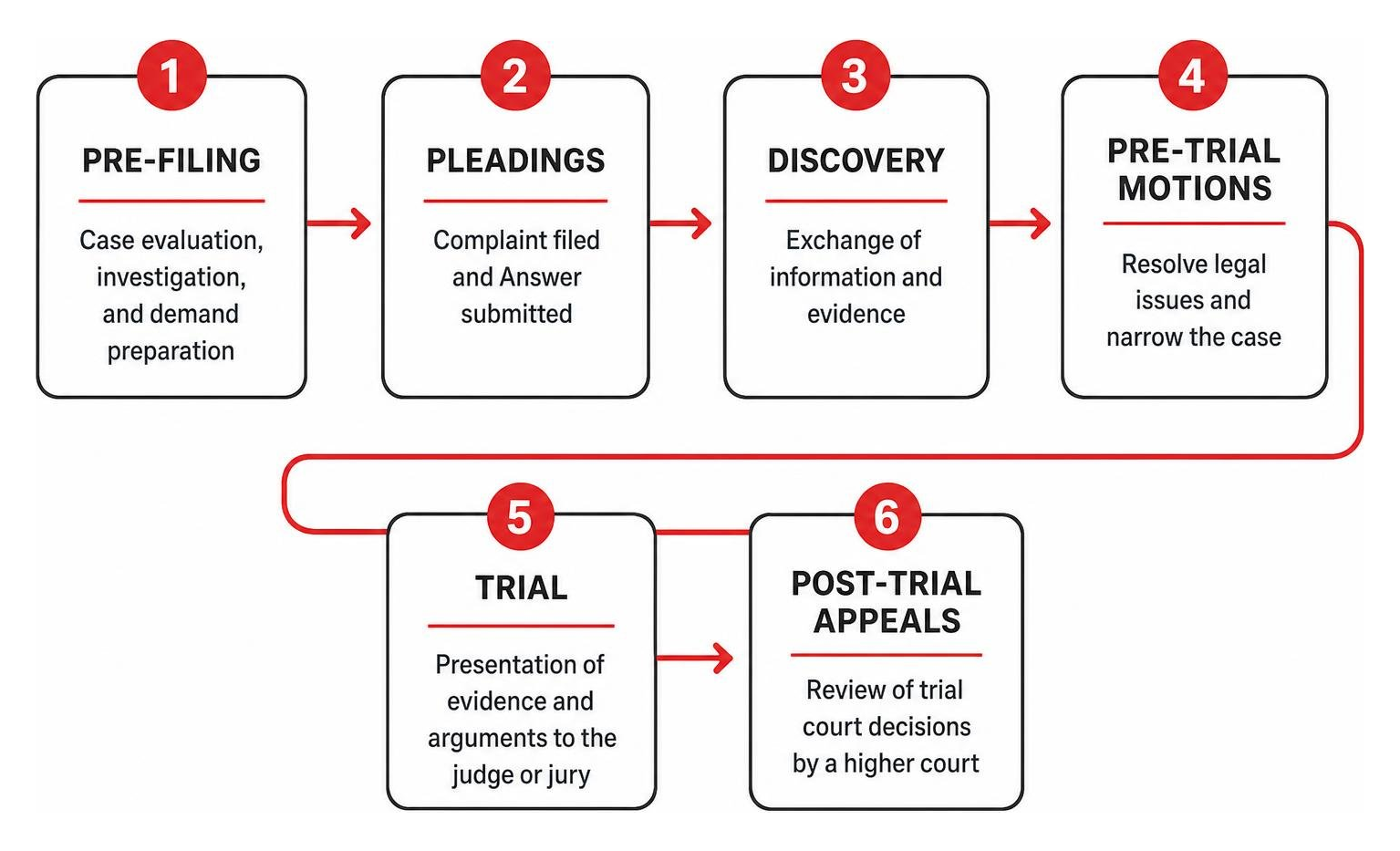
A civil lawsuit rarely jumps straight into a dramatic courtroom battle. Litigation follows a formal, structured progression designed to give both parties opportunities to evaluate evidence, narrow disputed issues, and explore settlement.
Discovery and Pretrial Motions
Once a plaintiff files a formal Complaint and the defendant submits an Answer, the case enters its most labor-intensive phase: Discovery. During discovery, both sides exchange information to prevent trial ambushes and assess the real strength of each argument.
Key discovery tools include:
- Interrogatories: Formal, written questions that the opposing party must answer in writing under oath.
- Requests for Production: Demands for physical documents, emails, financial records, contracts, and digital communications.
- Depositions: In-person or video-recorded question-and-answer sessions where witnesses and parties testify under oath before a court reporter.
- Requests for Admission: Written requests asking the other party to admit or deny specific facts to narrow the issues for trial.
Throughout this period, attorneys file Pretrial Motions. A party may file a Motion to Dismiss early on, arguing that the complaint fails to state a legally recognized claim. Later, either party may file a Motion for Summary Judgment, asking the judge to rule on the case without a full trial because the undisputed facts demonstrate that one side must win as a matter of law.
Settlement Negotiation, Trial, and Appeals
The vast majority of civil cases conclude before reaching a jury. Pretrial settlements can be reached through informal counsel negotiations or structured Alternative Dispute Resolution (ADR) methods:
- Mediation: A confidential session led by a neutral third-party mediator who helps the parties find common ground and draft an enforceable settlement agreement.
- Arbitration: A private, less formal hearing before an arbitrator whose decision is typically binding and enforceable in court.
If settlement efforts fail, the dispute proceeds to trial—either a bench trial (where the judge decides both facts and law) or a jury trial. Both sides present opening statements, examine witnesses, submit exhibits, and deliver closing arguments. Following the final verdict and judgment, a dissatisfied party may seek appellate review if legal errors occurred during the proceedings.
How to Choose the Right Civil Attorney Near Me
Selecting legal representation is one of the most critical decisions you will make during a dispute. The right advocate pairs deep procedural knowledge with clear, responsive communication.

When evaluating candidates, review practical indicators of skill and local standing:
- Courtroom Experience: Ask how many cases the attorney has taken through depositions, summary judgment hearings, and full jury trials.
- Local Court Insight: A lawyer who regularly practices before your local judges and opposes local counsel understands the court’s scheduling practices and procedural preferences. You can verify standing and find licensed practitioners through the Mobile Bar Association lawyer directory.
- Communication Standards: Choose a firm that prioritizes prompt responses and keeps you updated at every step.
Options for Securing Legal Representation
Legal representation takes several forms depending on financial circumstances and the nature of the claim:
- Private Law Firms: Offer customized, dedicated representation for complex disputes, business litigation, defense matters, and family law proceedings. Private counsel operates under various billing models tailored to the matter.
- Legal Aid Organizations: Funded in part by the Legal Services Corporation, legal aid organizations offer free or low-cost civil legal assistance to qualifying low-income individuals facing essential civil issues like unlawful eviction, domestic violence, or benefits denials.
- Pro Bono Programs: Many private attorneys volunteer their time through local bar associations and pro bono panels to assist community members who lack the financial resources to hire counsel.
Key Questions to Ask When Consulting a Civil Attorney Near Me
Before signing an engagement agreement, use your initial consultation to ask targeted questions:
- How many cases similar to mine have you handled over your career?
- Who in your office will be doing the day-to-day work on my file?
- What are the realistic strengths, weaknesses, and financial risks of my claim?
- What billing structure do you use (hourly, contingency, flat fee, or hybrid)?
- What is our strategic roadmap for the next 60 to 90 days?
Frequently Asked Questions About Hiring a Civil Lawyer
What is the statute of limitations for filing a civil dispute?
A statute of limitations is a strict statutory deadline for filing a lawsuit. If you fail to file your complaint before the statutory clock expires, the court will almost certainly dismiss your case permanently, regardless of its merits.
Deadlines vary widely depending on the legal theory and jurisdiction. For instance, breach of written contract claims, property damage actions, and personal injury claims all carry distinct timeframes set by state law. Because certain circumstances can pause (“toll”) or shorten these windows, speaking with an attorney as soon as a dispute arises is essential to protect your legal rights.
Can most civil litigation cases settle out of court?
Yes. Most civil lawsuits resolve through negotiated settlements before a trial ever begins. Settlement allows both parties to manage financial risk, keep sensitive disputes confidential, and avoid the substantial expenses and uncertainties associated with a protracted courtroom battle. Engaging in early mediation often helps parties reach practical resolutions without months of adversarial litigation.
How much does it cost to retain a civil litigation lawyer?
Attorney compensation depends on the type of matter being handled:
- Hourly Billing: Common in business disputes, defense cases, and complex litigation. The client pays an agreed hourly rate for attorney and paralegal time, usually supported by an upfront retainer deposit.
- Contingency Fees: Common in plaintiff-side injury matters, where the lawyer collects an agreed percentage of the financial recovery. If there is no recovery, the client owes no attorney fee (though court costs may apply).
- Flat Fees: Occasionally offered for predictable, document-heavy tasks such as drafting contracts, uncontested matters, or discrete filings.
Conclusion
Facing a legal dispute can feel overwhelming, whether you are defending your business, resolving a high-stakes contract disagreement, or navigating a family crisis. Taking decisive action, organizing your records, and securing experienced local counsel gives you the strategic advantage needed to protect your assets and future.
At Shane A. Taylor PC, our client-focused team delivers responsive, aggressive, and professional advocacy in state and federal courts throughout Mobile and Southwest Alabama. If you are facing a lawsuit or need guidance on protecting your rights, reach out to discuss our civil defense services today.