


How to Find Criminal Defense Near You
Start with the court handling the case, not just the closest office. Look for a licensed defense lawyer who handles similar charges in that court. Ask who will work on the case, how soon they can help, and what the fees cover. If you cannot afford a lawyer, ask the court whether you qualify for appointed counsel.
If you or a loved one has been arrested, ask to speak with a lawyer before answering questions about the case. Keep all court papers, note every deadline, and follow any release conditions. Tell your lawyer about related divorce or custody proceedings, too.
I am Shane A. Taylor, a former Birmingham police officer who now practices in Alabama and Mississippi state and federal courts. If your search for criminal defense near me brought you here, I will help you sort out what to do first and what to ask before hiring counsel.
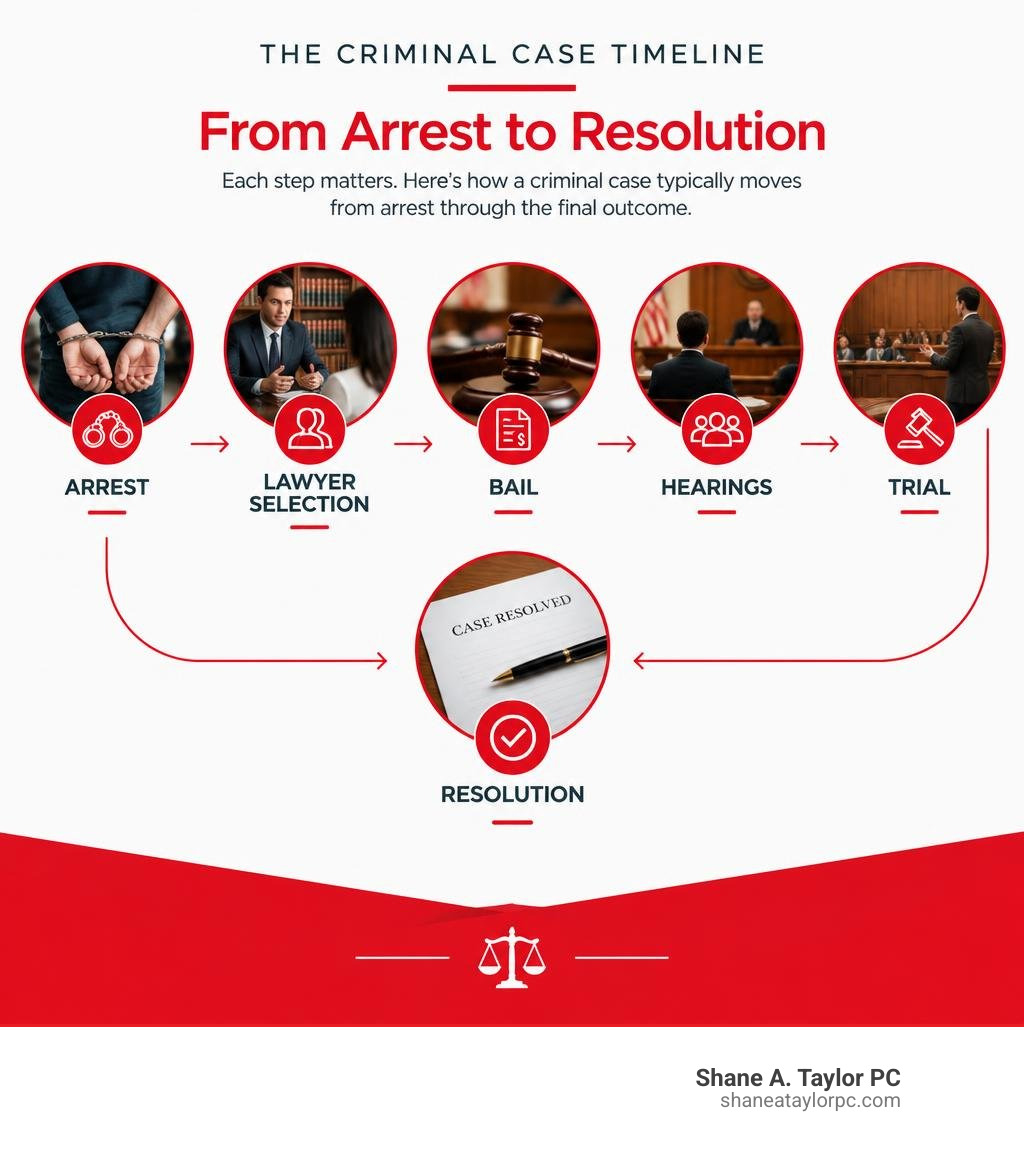
Common criminal defense near me vocab:
Immediate Actions After an Arrest or Active Warrant

An arrest is disorienting, high-stress, and intentionally . Law enforcement officers rely on confusion to prompt self-incriminating statements. Knowing how to react in the initial minutes and hours can determine whether your charges stand or get thrown out.
The most critical step is understanding what happens if you are charged with a crime so you do not surrender vital constitutional protections.
Asserting Constitutional Rights and Handling Warrant Surrenders
Your rights begin the moment an officer detains you:
- The Right to Remain Silent (Fifth Amendment): You must verbally state, “I am invoking my right to remain silent, and I want to speak with an attorney.” Police do not have to stop asking questions until you invoke this right clearly. Do not attempt to explain your innocence, justify your actions, or chat casually. Anything you say will be recorded and used against you.
- Protection Against Unreasonable Searches (Fourth Amendment): Do not consent to any search of your person, vehicle, phone, or home. State clearly: “I do not consent to any searches.” If officers search anyway over your objection, your attorney can later challenge the search in court.
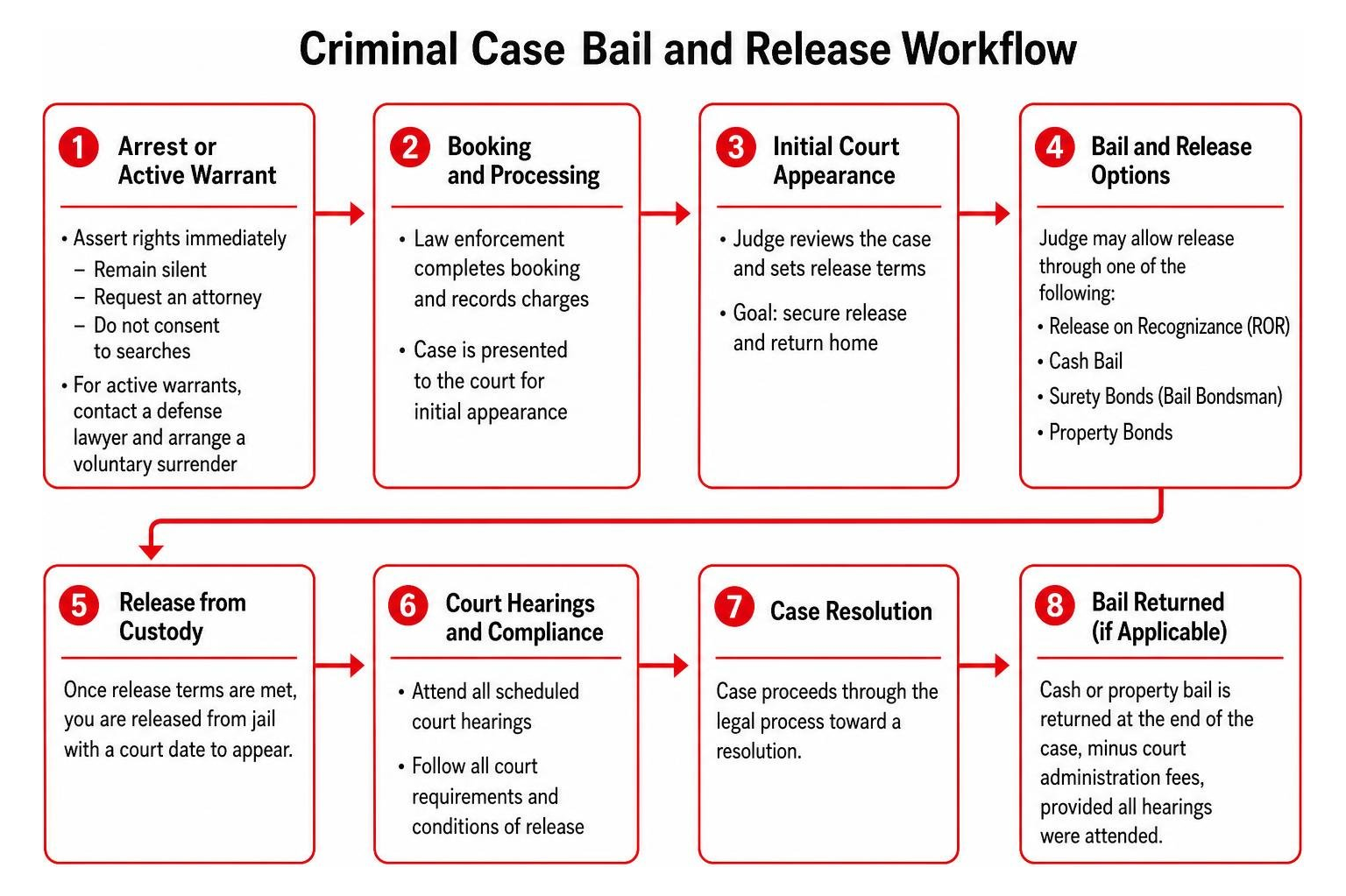
- Handling Active Warrants: If you discover a warrant for your arrest, do not wait for law enforcement to pull you over or knock on your door. Contact a defense lawyer immediately. We can confirm the warrant, check the preset bond amount, and coordinate a voluntary surrender. Walking in with an attorney shows the court you are not a flight risk, speeding up your release and keeping bail amounts lower.
Securing Fast Jail Release and Navigating Bail Options
After booking, the primary goal is getting home. Securing release requires navigating the court’s bail system through one of several mechanisms:
- Release on Recognizance (ROR): For certain nonviolent or first-time offenses, a judge may release you on your promise to appear at all scheduled hearings without requiring cash upfront.
- Cash Bail: You or your family pay the full bail amount directly to the court clerk. This money is returned at the end of the case (minus court administration fees), provided you attend every hearing.
- Surety Bonds (Bail Bondsman): When the full bail is unaffordable, a licensed bondsman posts the bond for a nonrefundable fee (typically 10% to 15% of the total amount).
- Property Bonds: In higher-stakes cases, equity in real estate can secure release if permitted by local court rules.
Watch out for inmate release scams: Disreputable operators scan public arrest logs and call anxious family members demanding immediate payment via gift cards, wire transfers, or cryptocurrency. Legitimate courts and licensed bondsmen never demand payment through these methods.
Understanding Charges, Penalties, and Case Timelines
Every criminal charge carries unique procedural rules, mandatory minimum sentences, and lasting collateral consequences. When evaluating your situation, understanding consequences in your criminal case helps you prepare for every stage.
| Offense Classification | Common Examples | Typical Incarceration Range | Financial Penalties | Estimated Resolution Timeline |
|---|---|---|---|---|
| Class A Misdemeanor | Assault, domestic violence, first/second DUI | Up to 1 year in county jail | Fines up to $6,000 | 4 to 12 months |
| Class B / C Misdemeanor | Minor property offenses, disorderly conduct | 30 days to 6 months jail | Fines up to $3,000 | 2 to 6 months |
| Class C / D Felony | Possession of controlled substances, auto theft | 1 year and 1 day up to 10 years | Fines up to $15,000 | 6 to 18 months |
| Class A / B Felony | Aggravated assault, robbery, major trafficking | 2 to 20 years (Class B); 10 to 99 years or Life (Class A) | Fines up to $60,000 | 12 to 24+ months |
Misdemeanor vs Felony Classifications and Trial Timelines
Misdemeanors are heard in district or municipal courts and move swiftly. Many resolve within four to twelve months via dismissals, diversion agreements, or bench trials.
Felonies involve more severe consequences. They begin with preliminary hearings before moving to a grand jury for indictment. Once indicted, the case enters formal discovery, pre-trial motion practice, and evidentiary hearings before reaching a trial docket. A felony case frequently spans twelve to twenty-four months.
DWI Arrests and Critical Administrative Deadlines
DUI and DWI charges carry dual tracks: the criminal prosecution and an administrative driver’s license suspension.
When arrested for drunk driving, you have only 15 days to request an administrative hearing to challenge the automatic suspension of your driver’s license. Missing this deadline results in automatic suspension, regardless of what happens in your criminal trial.
A seasoned Mobile DUI attorney scrutinizes every technical detail of the stop:
- Was the initial traffic stop based on reasonable suspicion?
- Were Standardized Field Sobriety Tests administered properly?
- Was the breathalyzer device properly maintained and calibrated according to state standards?
- Did medical conditions, dietary factors, or acid reflux artificially inflate BAC readings?
How to Evaluate and Choose Criminal Defense Near Me

Hiring the right defense counsel is one of the most critical decisions you will ever make. You can read broader national legal resources such as The Best Criminal Defense Lawyers | Expertise.com to understand general standards, but local courtroom experience remains indispensable.
Key Criteria for Vetting Criminal Defense Near Me
When vetting prospective attorneys, use these key standards:
- Local Courtroom Experience: Every courthouse has unique docket management styles, prosecutors, and judicial expectations. A lawyer who appears regularly in your jurisdiction knows how local prosecutors negotiate and how local judges rule on specific motions.
- Background in Law Enforcement or Prosecution: Attorneys with former police or prosecutorial backgrounds understand investigative playbooks, search protocols, and evidence collection vulnerabilities from the inside out.
- Direct Communication: Ensure your case is handled by an experienced attorney rather than handed off entirely to paralegals or junior associates.
For a detailed roadmap on selecting legal representation, explore our guide on how to choose the right lawyer for your criminal case.
Defense Lawyer Costs, Retainers, and Fee Structures
Legal fees reflect the seriousness of the charge, the volume of evidence, and the work required to prepare a trial defense:
- Hourly Rates vs. Flat Fees: Standard hourly rates for defense attorneys range from $200 and up. For many criminal matters, lawyers charge flat fees so you know your total investment upfront.
- Misdemeanor Costs: A straightforward misdemeanor defense typically starts around $1,500 to $3,500.
- Felony Representation: Complex felonies involving grand jury reviews, forensic analyses, expert witnesses, and multi-day jury trials require retainer fees ranging from several thousand to tens of thousands of dollars.
- Payment Options: Reputable firms offer structured, milestone-based payment plans to help clients secure capable representation without delay.
Key Strategies for Dismissing or Reducing Criminal Charges
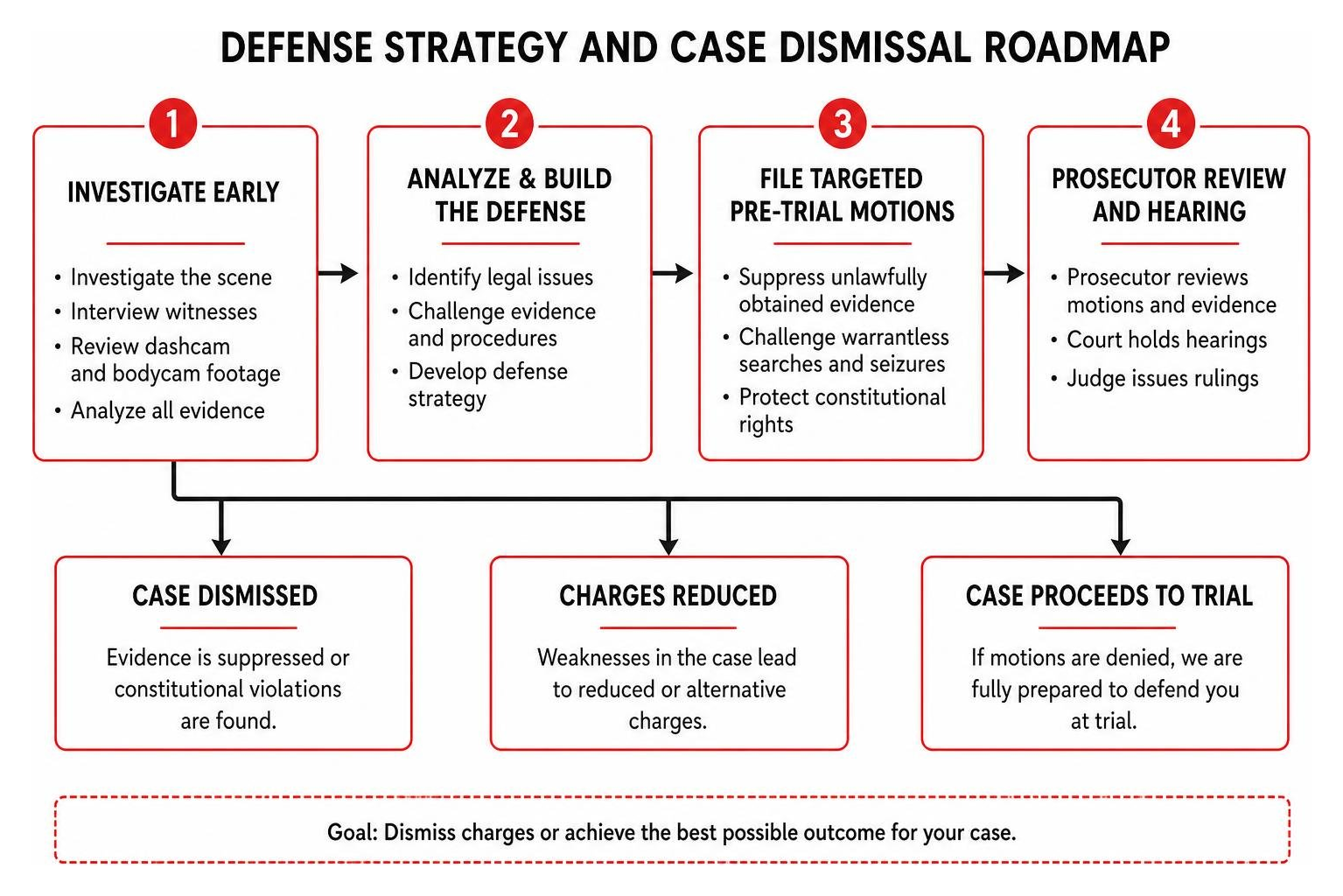
Experienced defense attorneys do not wait for trial to begin fighting charges. We build a defense early by investigating the scene, interviewing witnesses, reviewing dashcam and bodycam footage, and filing targeted pre-trial motions. Learn more about what a defense lawyer does to protect your rights throughout each phase of your case.
Challenging Warrantless Vehicle and Property Searches
The Fourth Amendment shields citizens from unreasonable searches and seizures. If law enforcement conducted a search without a valid warrant, prosecutors must prove an established legal exception applies:
- Exigent Circumstances: An emergency where officers believe evidence is being destroyed or lives are at risk.
- Plain View Doctrine: Contraband visible to an officer from a lawful vantage point.
- Consent: Permission granted freely and voluntarily by someone with actual authority over the premises.
- K9 Sniffs: Drug dog sniffs that unreasonably prolong the duration of a standard traffic stop without independent reasonable suspicion violate constitutional protections.
If officers executed a search without a warrant or valid exception, we file a Motion to Suppress Evidence. If granted, illegally seized evidence is excluded, often forcing the prosecution to dismiss the charges.
Why You Need Criminal Defense Near Me Even When Innocent
Many people believe that if they are innocent, they do not need an attorney. This assumption is dangerous. Innocent individuals face wrongful prosecution due to mistaken identity, faulty eyewitness accounts, circumstantial anomalies, or biased investigations.
An attorney investigates the facts, presents exculpatory evidence to prosecutors before indictment, and works to secure a grand jury “no-bill.” If your case is dismissed, we can then help you file for expungement through an expungement attorney to clear your arrest record.
Frequently Asked Questions About Criminal Defense
Can police search my home or vehicle without a warrant?
Generally, no. The Fourth Amendment mandates that police obtain a search warrant signed by a neutral judge upon showing probable cause. However, police can search without a warrant if:
- You give explicit, voluntary consent.
- Exigent circumstances exist (such as preventing imminent harm or destruction of evidence).
- Contraband is in plain view during a lawful encounter.
- The search is conducted incident to a lawful physical arrest.
How long does a standard criminal case take to go to trial?
Case duration depends on the court’s schedule and the severity of the charge:
- Misdemeanor cases: Typically reach resolution or trial within 4 to 12 months.
- Felony cases: Usually take between 6 and 24 months due to preliminary hearings, grand jury proceedings, extensive evidence discovery, and expert witness preparations.
Can criminal charges be dismissed before going to court?
Yes. Charges can be dismissed before trial if:
- Pre-trial motions establish that key evidence was seized unconstitutionally.
- The defense demonstrates a lack of probable cause.
- Witnesses recant or are shown to be unreliable.
- The defendant successfully completes a pre-trial diversion program.
- A grand jury issues a “no-bill” after reviewing defense evidence.
Conclusion
A criminal charge threatens your reputation, career, financial security, and personal liberty. Facing the justice system alone or delaying legal representation increases the risk of severe penalties.
At Shane A. Taylor PC, we bring deep insight into police tactics and criminal procedure to protect our clients’ constitutional rights. If you or a family member is facing criminal charges, take control of your defense immediately. Contact us today for a confidential consultation and let our legal team begin building your defense.